
Grenache wine: why does it taste so ripe?
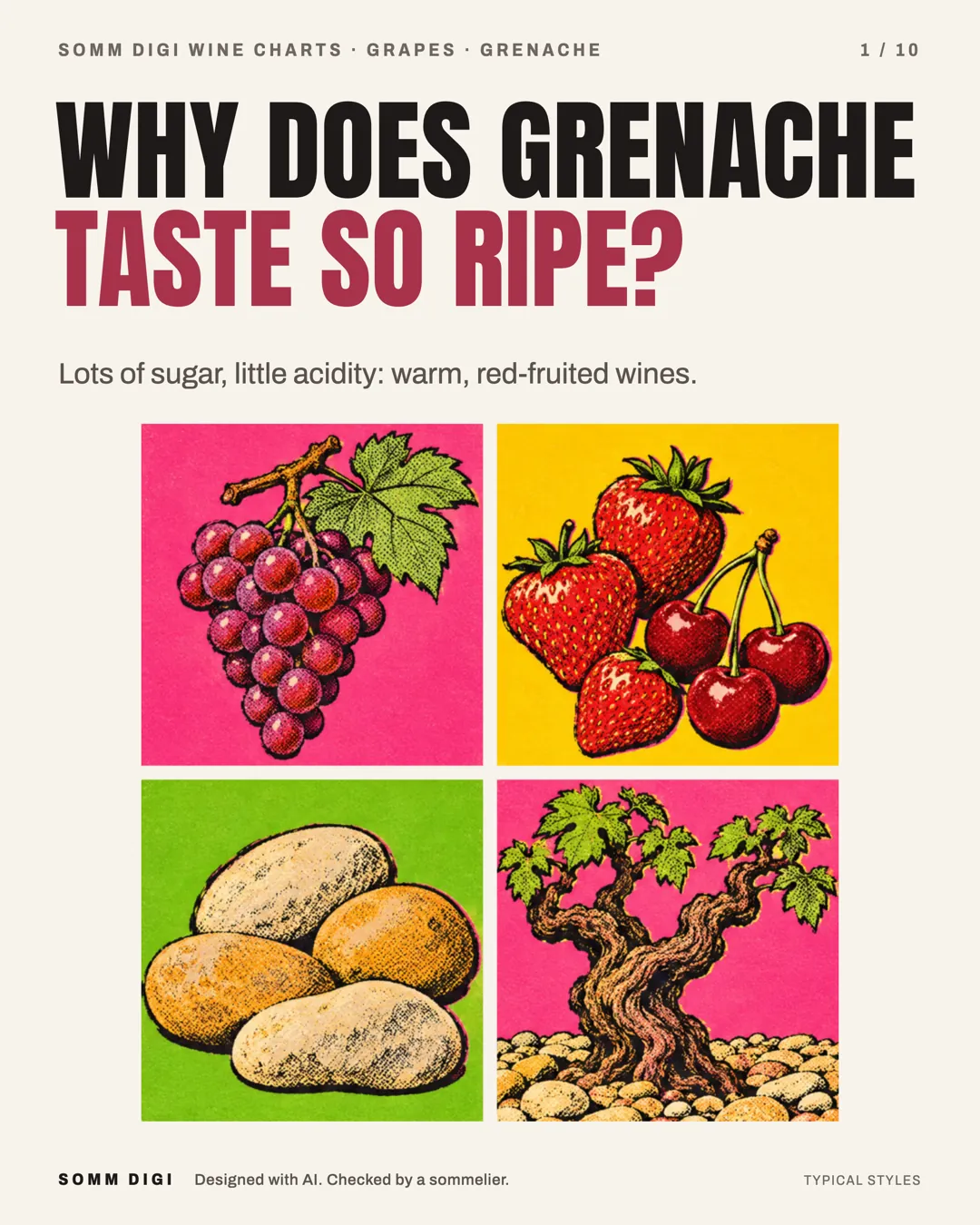
Grenache tastes like the sun it needs: strawberry, red plum and a pinch of white pepper. In Spain it is called Garnacha, and in Priorat its very old vines make its most powerful wines.
Quick answer
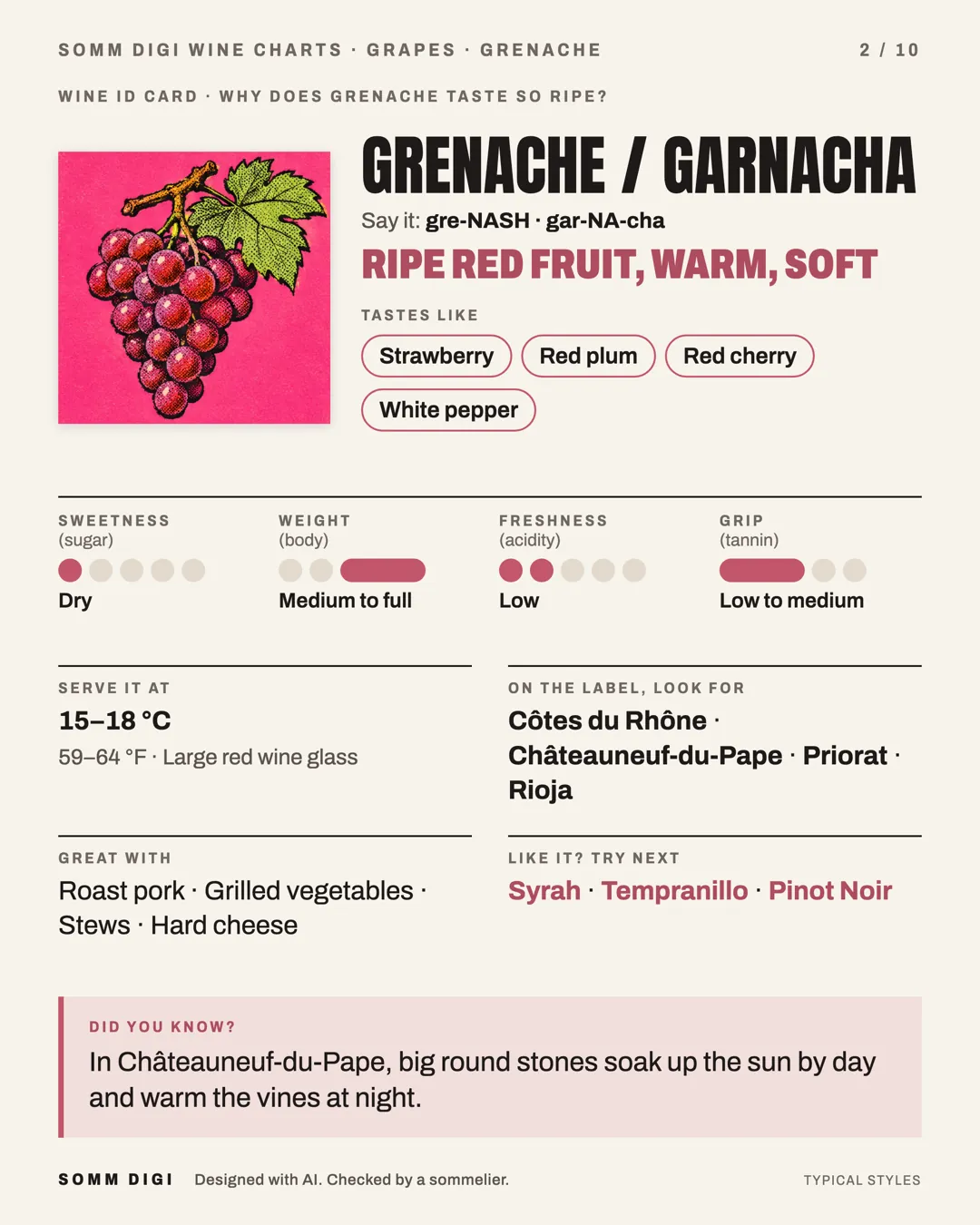
Grenache (say it gre-NASH; in Spain, Garnacha, gar-NA-cha) is a red grape that needs heat to ripen. Its wines are dry, medium to full in body, low in acidity and soft in tannin, with strawberry, red plum, red cherry and white pepper. Serve it at 15–18 °C (59–64 °F). Want ripe and warm? Look for Côtes du Rhône, Châteauneuf-du-Pape, Priorat or Rioja.

Alper Billik · Advanced Sommelier
Updated November 2026 · Edited with AI
This article may contain affiliate links.
On this page
- What is Grenache wine?
- Grenache or Garnacha: one grape, two names
- What does Grenache taste like?
- Is Grenache sweet? Why it tastes so ripe
- Where does Grenache grow?
- Southern Rhône: where Grenache is at home
- How to read a Grenache label
- Which Grenache is for you?
- Grenache vs Syrah and Tempranillo
- How to serve Grenache: temperature and glass
- Grenache food pairing
- Grenache questions, answered
What is Grenache wine?
Grenache (say it gre-NASH) is a red grape that loves heat. It ripens only in warm places, and its wines show it: ripe red fruit, warm and soft. Think strawberry, red plum and red cherry, often with a pinch of white pepper.
Is Grenache red or white? Red. Its red fruit also makes fresh rosé, drunk chilled and young. And the grape has a second name: in Spain, Grenache is Garnacha (say it gar-NA-cha). The profile card puts the essentials on one page.
Grenache or Garnacha: one grape, two names
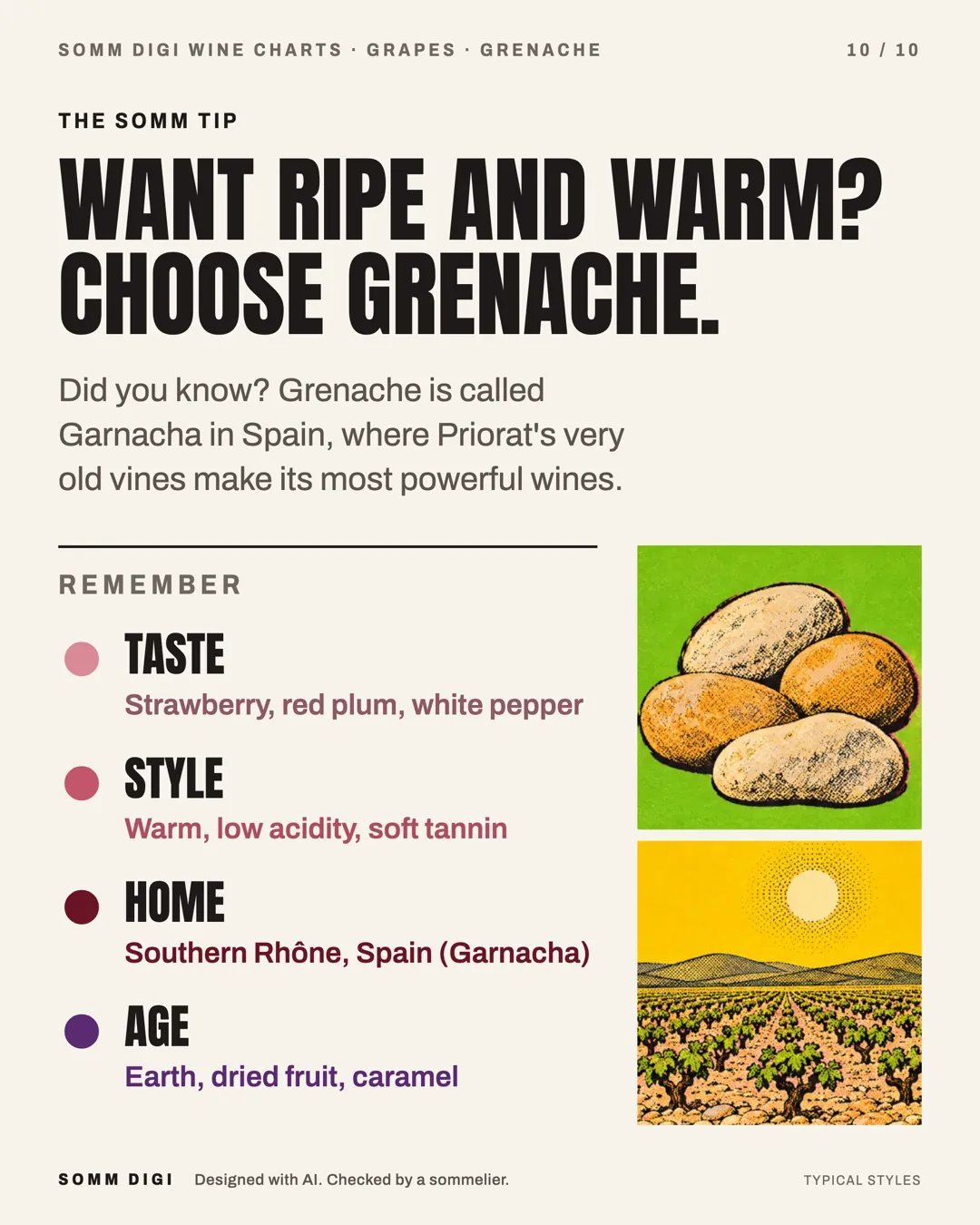
Grenache and Garnacha are the same grape. Garnacha is the name in Spain, so that is the word on bottles from Rioja, Navarra and Priorat. In the Rhône Valley in France, it is Grenache.
Spain shows the grape's whole range. In Priorat, very old vines and tiny yields make its most powerful wines. In Rioja, Garnacha adds body and fresh red fruit. In Navarra, it makes dry rosé, to drink chilled and young. The tip card keeps it short.
What does Grenache taste like?
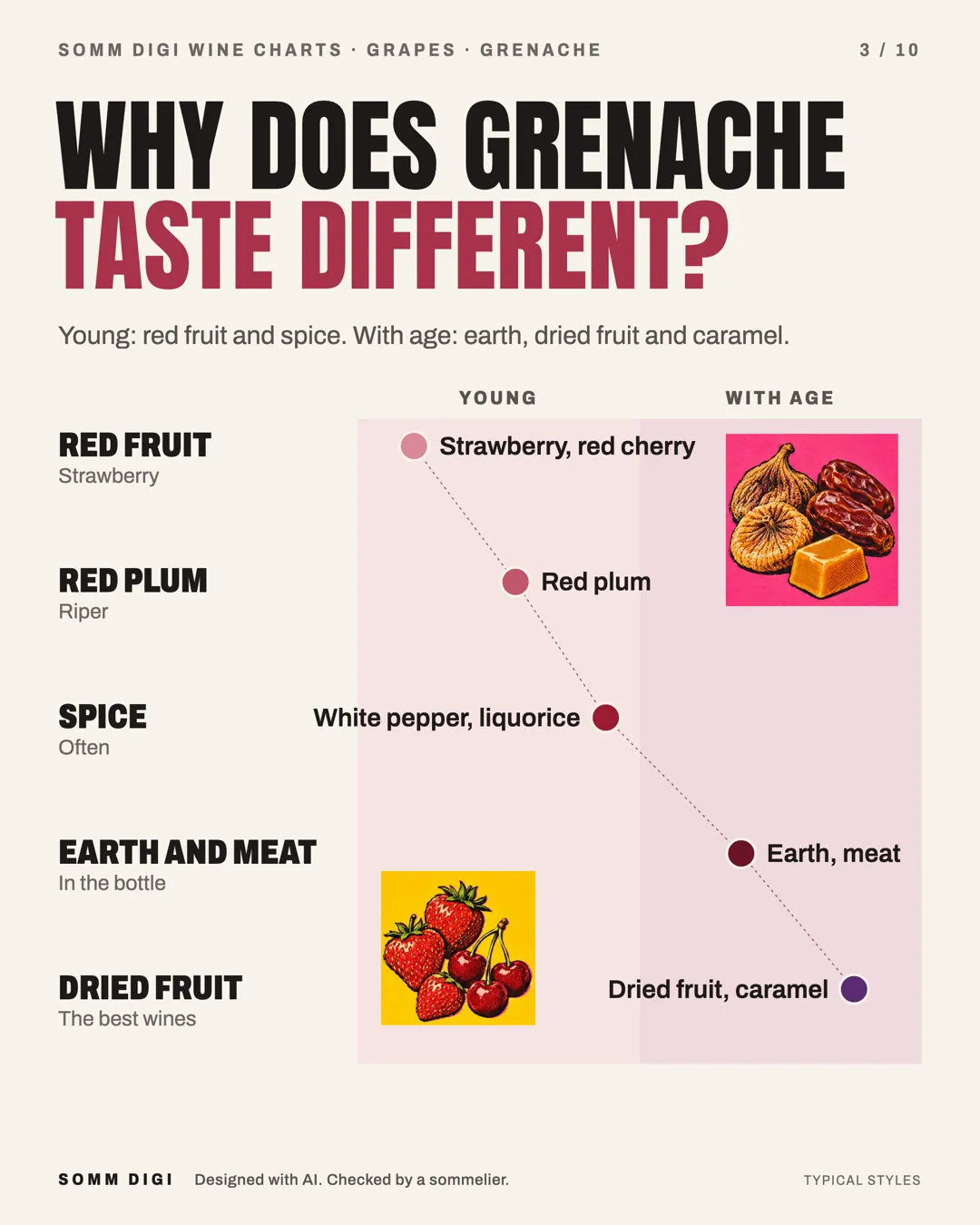
Young Grenache tastes of red fruit: strawberry and red cherry, with red plum when the grapes are riper. Spice is often there too, white pepper or liquorice. Fruit first, spice second: that is young Grenache.
In the mouth, Grenache feels round and soft. Its acidity is low and its tannin low to medium, so there is little grip, just warm fruit. Body runs from medium to full.
With time in the bottle, the wine changes. Earth and meat notes appear, and the top wines move on to dried fruit and caramel. Follow the taste chart from young to old.
Is Grenache sweet? Why it tastes so ripe
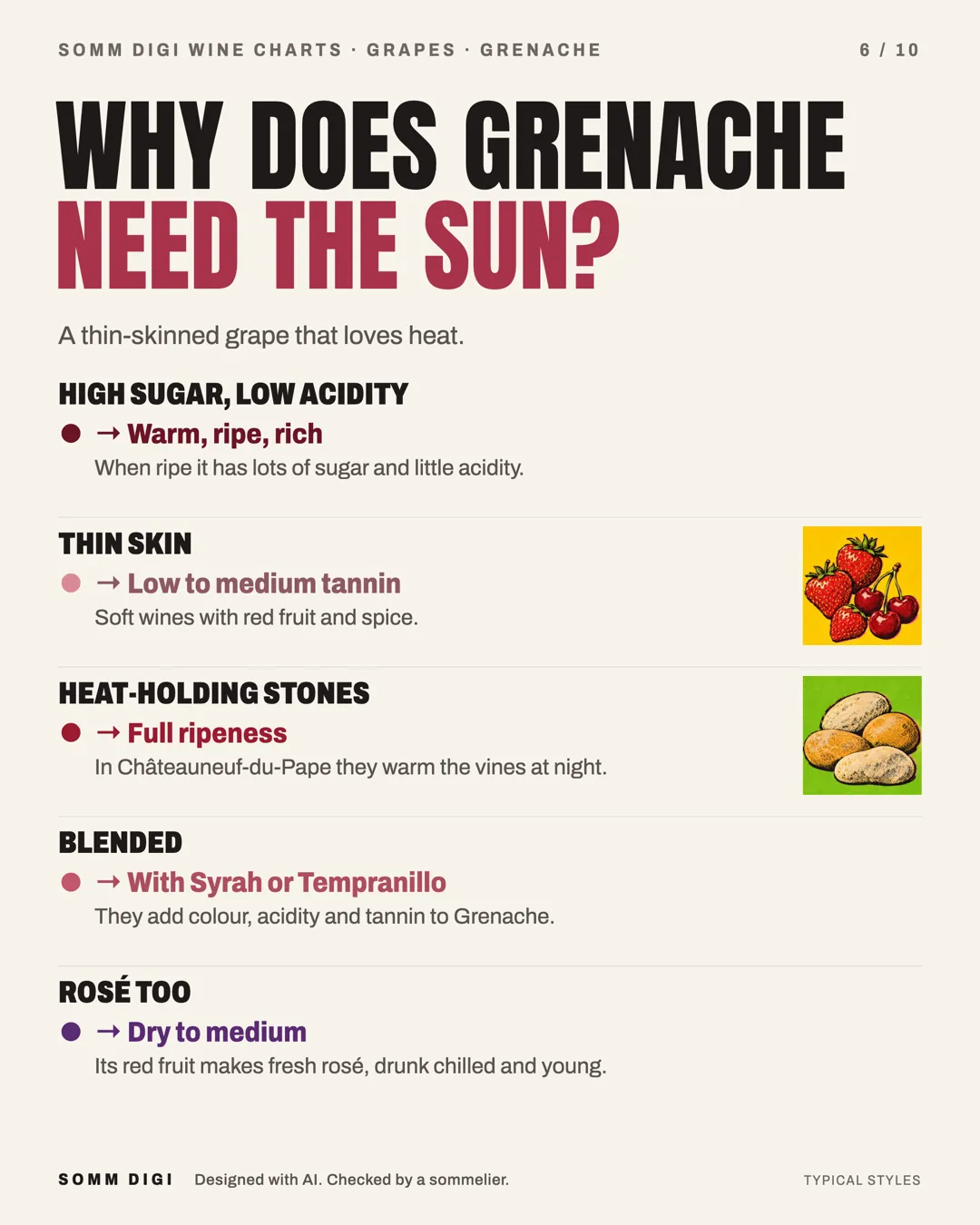
No. Red Grenache is dry. The ripe taste comes from the grape itself: when ripe, Grenache has lots of sugar and little acidity, so its wines taste warm, ripe and rich. Many are high in alcohol too, like Châteauneuf-du-Pape.
It is a thin-skinned grape that loves heat. Thin skins mean low to medium tannin, so Grenache is soft, with red fruit and spice. The sun does the rest. In Châteauneuf-du-Pape, big round stones soak up the sun by day and warm the vines at night, for full ripeness.
Grenache is often blended with Syrah or Tempranillo, which add colour, acidity and tannin. And its red fruit makes fresh rosé, dry to medium, drunk chilled and young. The sun chart shows all five reasons Grenache tastes the way it does.
Where does Grenache grow?
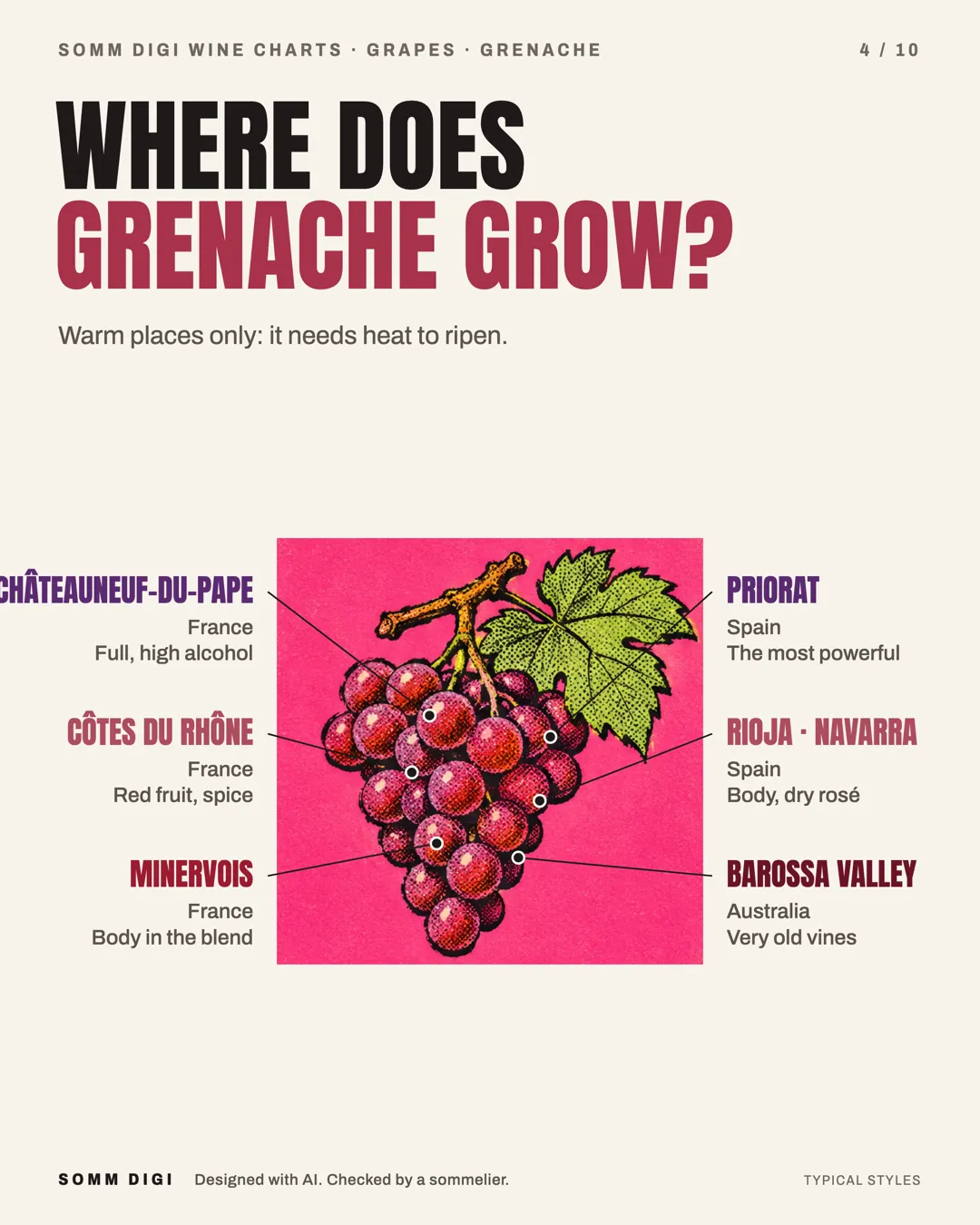
Warm places only: Grenache needs heat to ripen. In France, Châteauneuf-du-Pape makes full wines, high in alcohol. Côtes du Rhône brings red fruit and spice. In Minervois, Grenache gives body to the blend.
In Spain, Priorat makes the most powerful Grenache, while Rioja and Navarra use it for body and for dry rosé. In Australia, the Barossa Valley grows it on very old vines. The regions chart shows all six.
Southern Rhône: where Grenache is at home
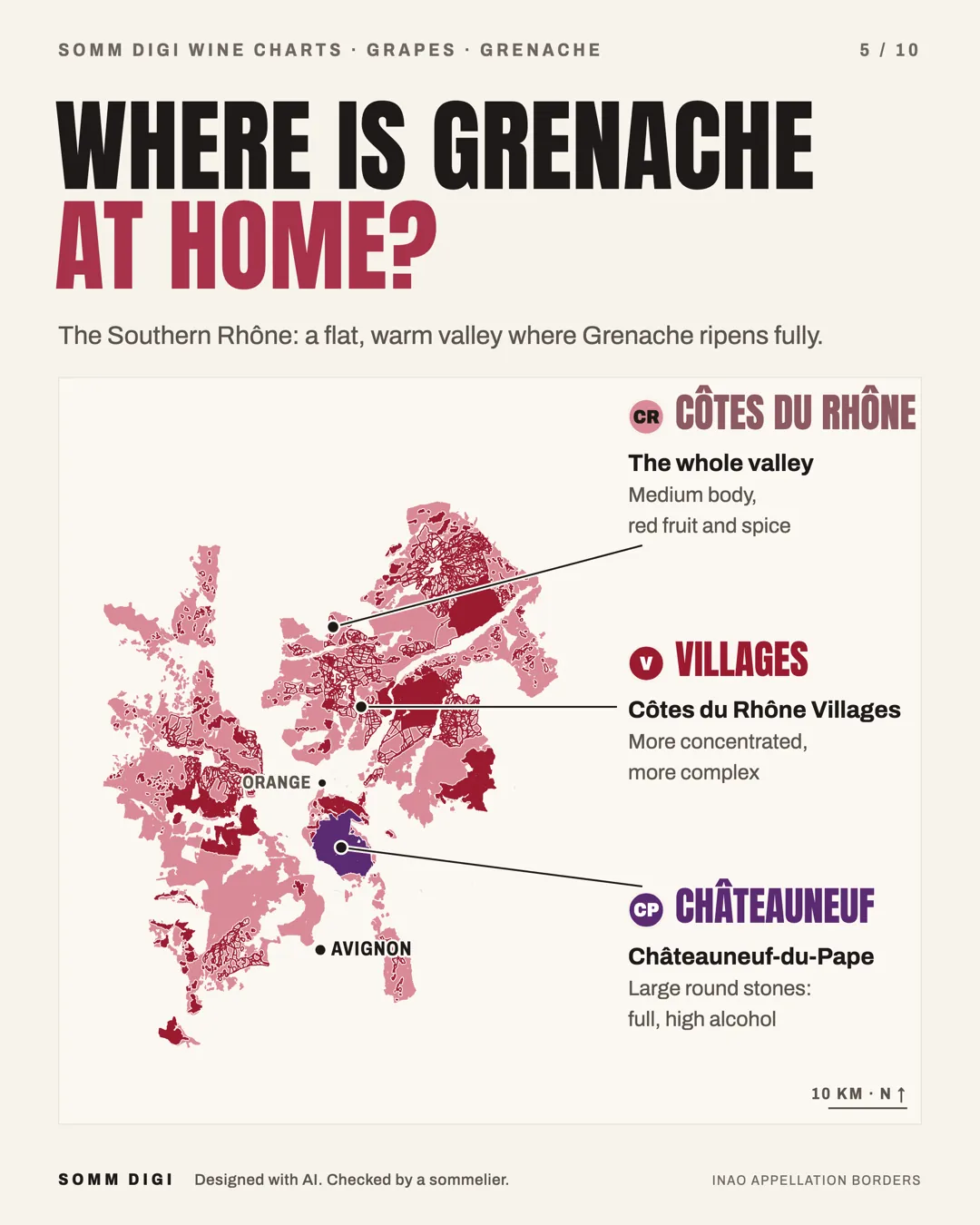
Grenache's home is the Southern Rhône, a flat, warm valley where the grape ripens fully. Its wines come in three names, and all three are Grenache-led blends.
Côtes du Rhône covers the whole valley: medium body, red fruit and spice. Côtes du Rhône Villages is more concentrated and more complex. Châteauneuf-du-Pape, with its large round stones, makes full wines high in alcohol. The map shows where each one sits.
How to read a Grenache label
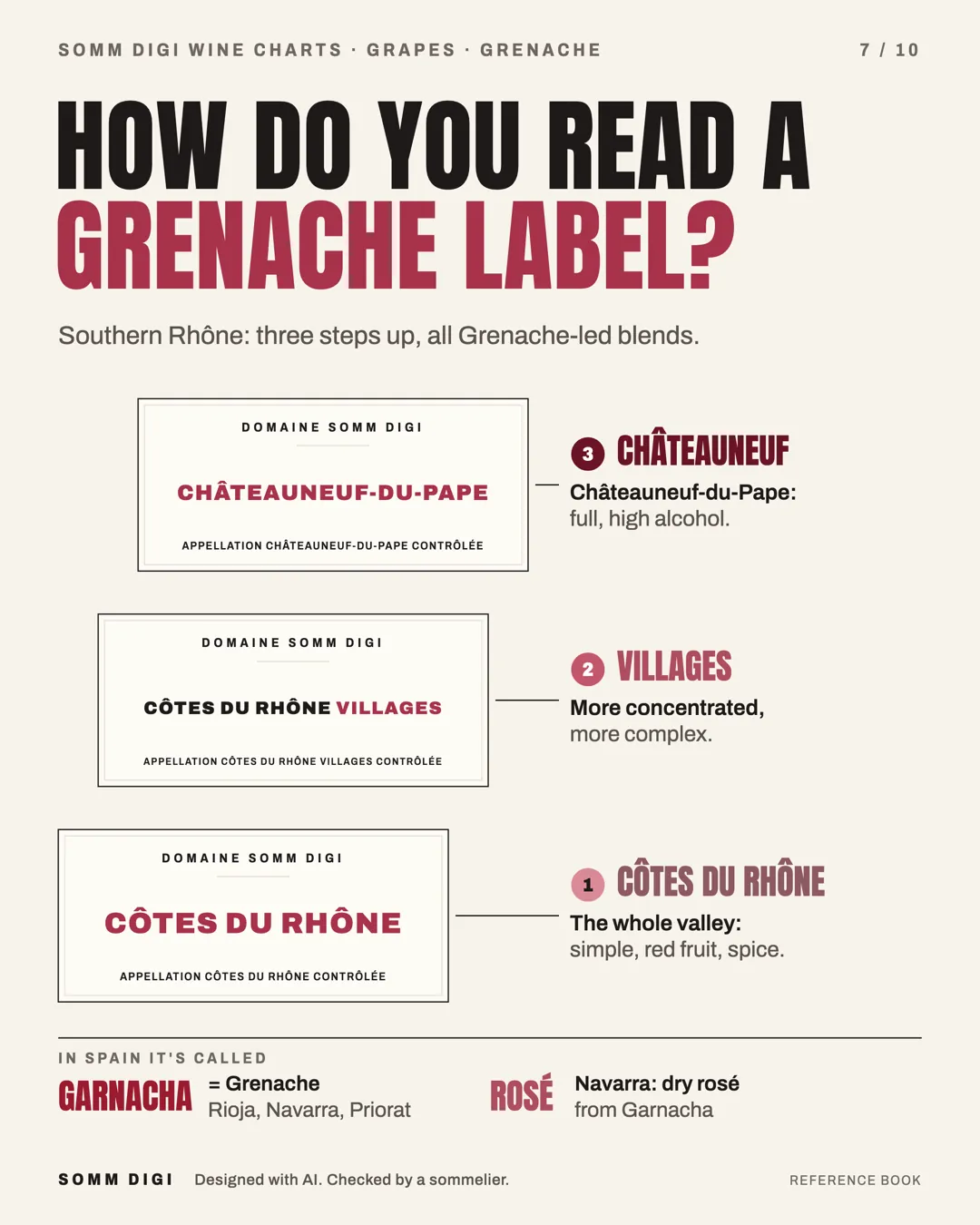
On a Southern Rhône bottle, read the name as three steps up. Côtes du Rhône is simple, with red fruit and spice. Villages is more concentrated and more complex. Châteauneuf-du-Pape is full and high in alcohol.
On a Spanish bottle, look for Garnacha: it is Grenache, from Rioja, Navarra or Priorat. A Navarra rosé is dry rosé made from Garnacha. The label chart puts all five words in one place.
Which Grenache is for you?
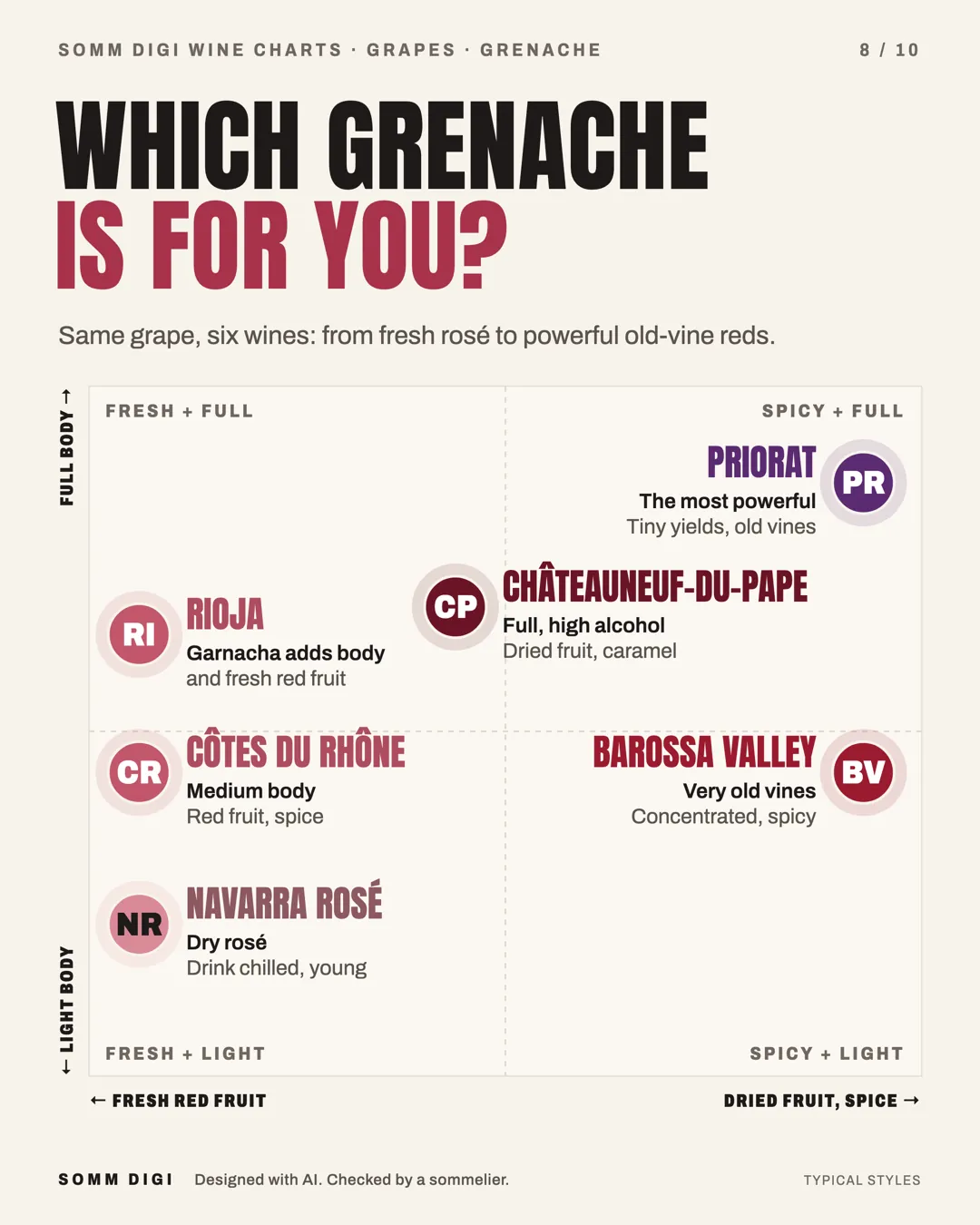
Same grape, six wines, from fresh rosé to powerful old-vine reds. For something light, a dry Navarra rosé, chilled and young. For an easy red, Côtes du Rhône: medium body, red fruit, spice. In Rioja, Garnacha adds body and fresh red fruit.
For more power, the Barossa Valley's very old vines give concentrated, spicy wines. Châteauneuf-du-Pape is full and high in alcohol, with dried fruit and caramel. And Priorat is the most powerful of all: tiny yields, old vines. The styles chart lines all six up.
Grenache vs Syrah and Tempranillo
Syrah and Tempranillo are Grenache's usual blending partners, and each one brings what Grenache is short of: colour, acidity and tannin.
The difference shows in the glass. Grenache is red fruit and white pepper, soft and warm. Syrah is black fruit and black pepper, with medium to high acidity and tannin. Tempranillo mixes red and black fruit, often with vanilla from oak.
Want Grenache's red fruit in a lighter wine? Try Pinot Noir: light, fresh and silky, with strawberry, raspberry and red cherry. Want it darker and spicier? Go to Syrah.
How to serve Grenache: temperature and glass
Serve red Grenache at 15–18 °C (59–64 °F), in a large red wine glass. Pour Grenache rosé chilled, and drink it young.
Which glass?
For a large glass that suits it, see the red wine glass picks on universalwineglasses.com, SOMM DIGI's glass site.
Grenache food pairing
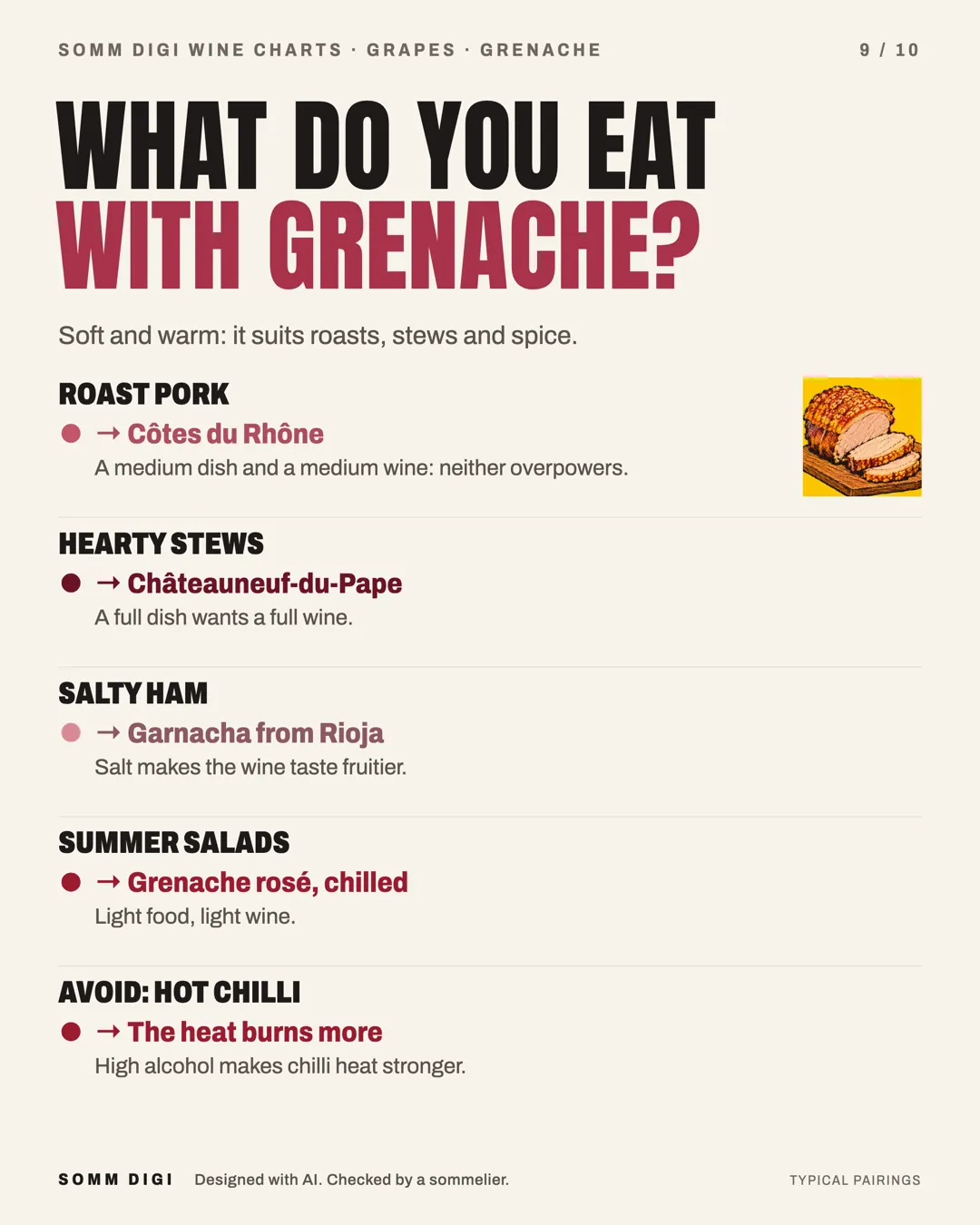
Soft and warm, Grenache suits roasts, stews and spice. Match the weight of the wine to the dish. With roast pork, pour a Côtes du Rhône: a medium dish and a medium wine, so neither overpowers. With hearty stews, a Châteauneuf-du-Pape: a full dish wants a full wine.
Salty ham loves a Garnacha from Rioja, because salt makes the wine taste fruitier. Summer salads call for chilled Grenache rosé: light food, light wine. Grilled vegetables and hard cheese are good matches too.
One match to skip: hot chilli. High alcohol makes chilli heat stronger, so the heat burns more. The pairing chart has all five.

Learn wine the easy way
Wine Easy
The wine book that talks to you like a human: grapes, tasting, pairing and countries A–Z, in 388 full-colour pages.
Grenache questions, answered
How do you pronounce Grenache?
gre-NASH. In Spain it is Garnacha: gar-NA-cha.
Is Grenache red or white?
Red. Its red fruit also makes fresh rosé, dry to medium, drunk chilled and young.
Is Garnacha the same as Grenache?
Yes. Garnacha is the grape's name in Spain, on bottles from Rioja, Navarra and Priorat.
Is Grenache sweet?
Red Grenache is dry. It tastes ripe because ripe Grenache grapes have lots of sugar and little acidity.
Does Grenache age?
The top wines do. In the bottle they gain earth and meat notes, then dried fruit and caramel.
What temperature should Grenache be served at?
15–18 °C (59–64 °F), in a large red wine glass. Rosé goes chilled.
Try next
If you like Grenache / Garnacha
How this page was made. Charts designed with AI and checked by Alper Billik, Advanced Sommelier. Text written from the same chart facts and edited with AI.