
Pinot Noir wine: what does it taste like?
Pinot Noir has a thin skin: it keeps the wine pale and makes it one of the hardest grapes to grow. Here is what it tastes like, where it grows and how to read its label.
Quick answer
Pinot Noir (say it PEE-noh NWAHR) is a red grape that makes light, fresh, silky wine. It is dry, with high acidity and low to medium tannins. Young, it tastes of strawberry, raspberry and red cherry; with age, of mushroom. Serve it at 13–18 °C (55–64 °F) in a large-bowl red glass. New to it? Start with a Bourgogne, then climb the label.

Alper Billik · Advanced Sommelier
Updated November 2026 · Edited with AI
This article may contain affiliate links.
On this page
- Is Pinot Noir red or white?
- Pinot Noir vs Cabernet Sauvignon
- Is Pinot Noir sweet or dry?
- What does Pinot Noir taste like?
- Where does Pinot Noir grow?
- Burgundy Pinot Noir: the Côte d'Or
- How to read a Burgundy Pinot Noir label
- Which Pinot Noir is for you?
- Why is Pinot Noir so hard to grow?
- Should Pinot Noir be chilled?
- Pinot Noir food pairing
- Pinot Noir questions, answered
Is Pinot Noir red or white?
Pinot Noir (say it PEE-noh NWAHR) is a red grape, but a pale one. Its skin is thin, and a thin skin keeps the colour light: pale to medium in the glass.
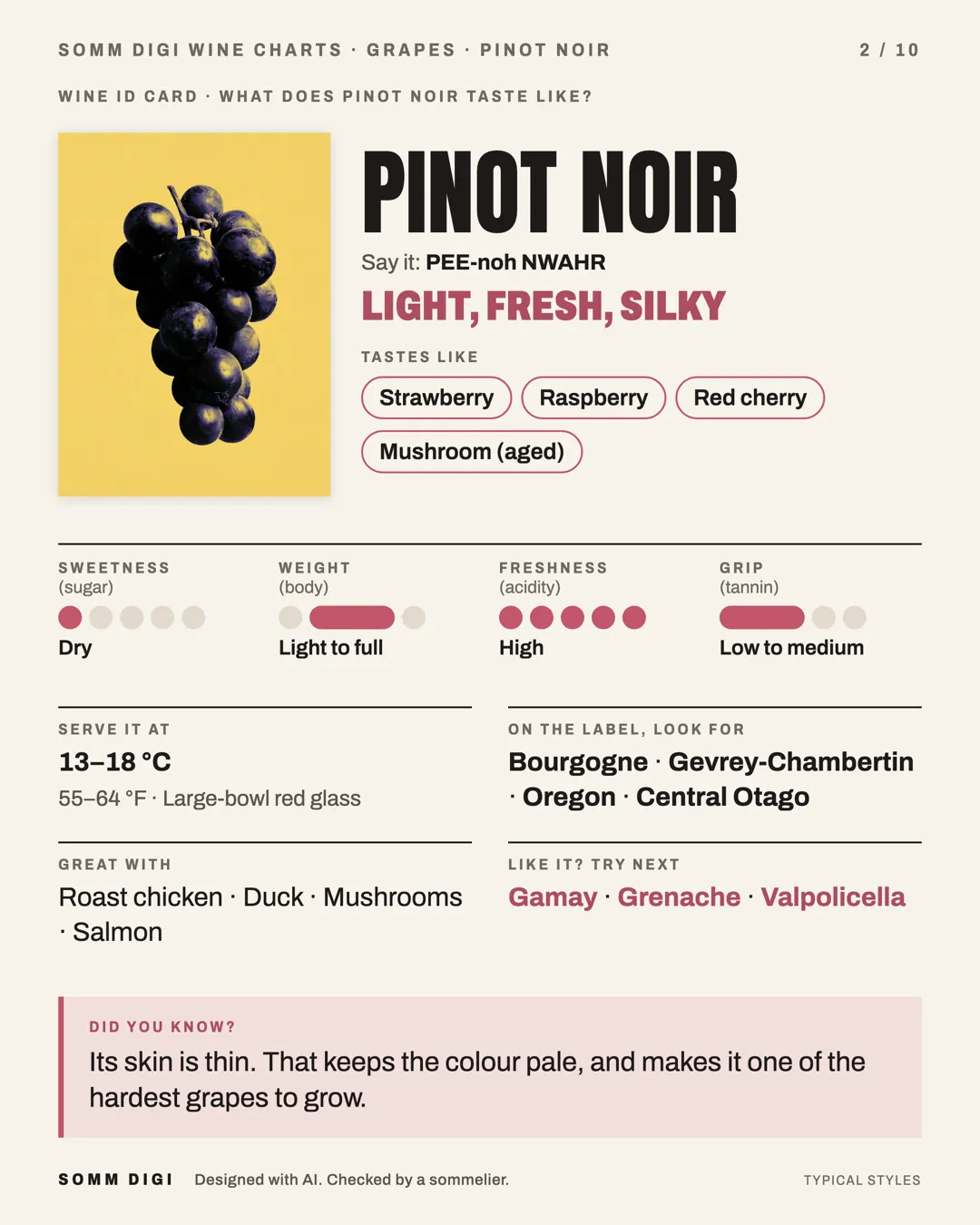
The wine is light, fresh and silky. It is dry, with high acidity and low to medium tannins, and its body runs from light to full. Young, it tastes of strawberry, raspberry and red cherry; with age, of mushroom. The profile card puts the essentials on one page.
Pinot Noir has one more job: it is one of the grapes in Champagne.
Pinot Noir vs Cabernet Sauvignon
These two reds sit at opposite ends. Pinot Noir is light and pale; Cabernet Sauvignon is deep and firm. The difference starts in the skin.
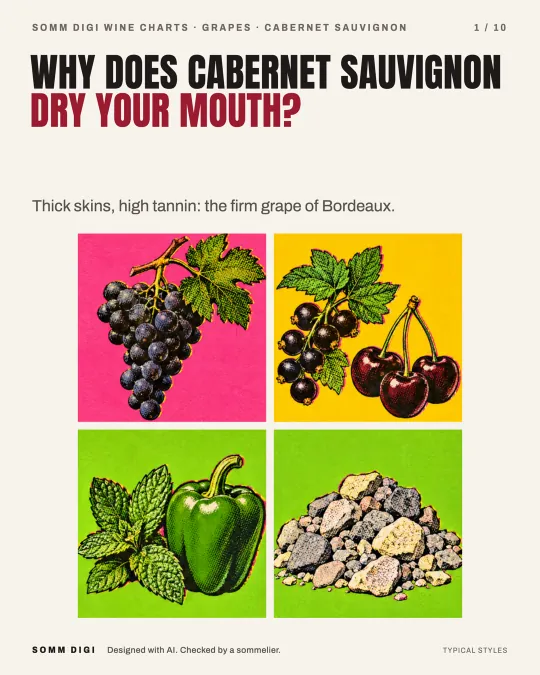
Pinot Noir's thin skin gives pale colour and low to medium tannins, so it feels silky. Cabernet's thick skins give deep colour and high tannin, which is why a young Cabernet can dry your mouth. Both are dry, with high acidity.
The fruit is different too. Pinot Noir tastes of red fruit: strawberry, raspberry, red cherry. Cabernet tastes of blackcurrant and black cherry, with mint and green bell pepper. Pinot Noir needs a cool place; Cabernet wants moderate and warm places with a long season.
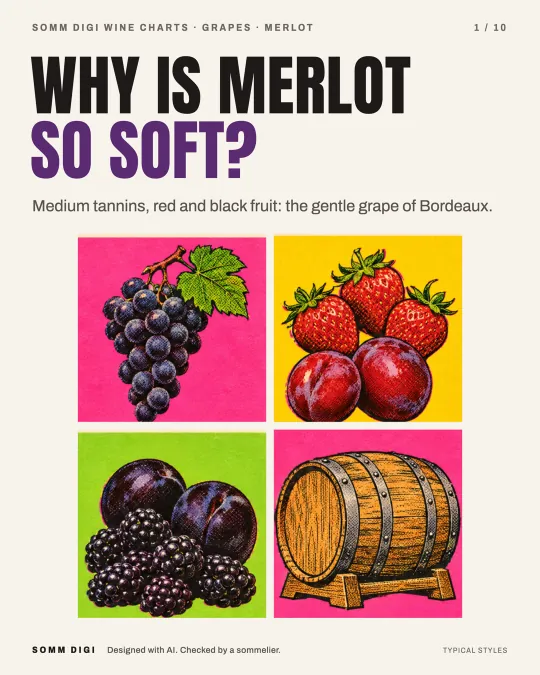
Somewhere between them sits Merlot: soft and plummy, with medium tannins: more than Pinot Noir's low to medium, less than Cabernet's high.
Is Pinot Noir sweet or dry?
Pinot Noir is dry. Its fruit is ripe and red, but the wine carries no sweetness, and high acidity keeps it fresh.
That dryness matters at the table. With a sweet dessert, Pinot Noir turns sharp: sugar in the dish makes a dry wine taste less fruity and more acidic. Pour it with savoury food instead.
What does Pinot Noir taste like?
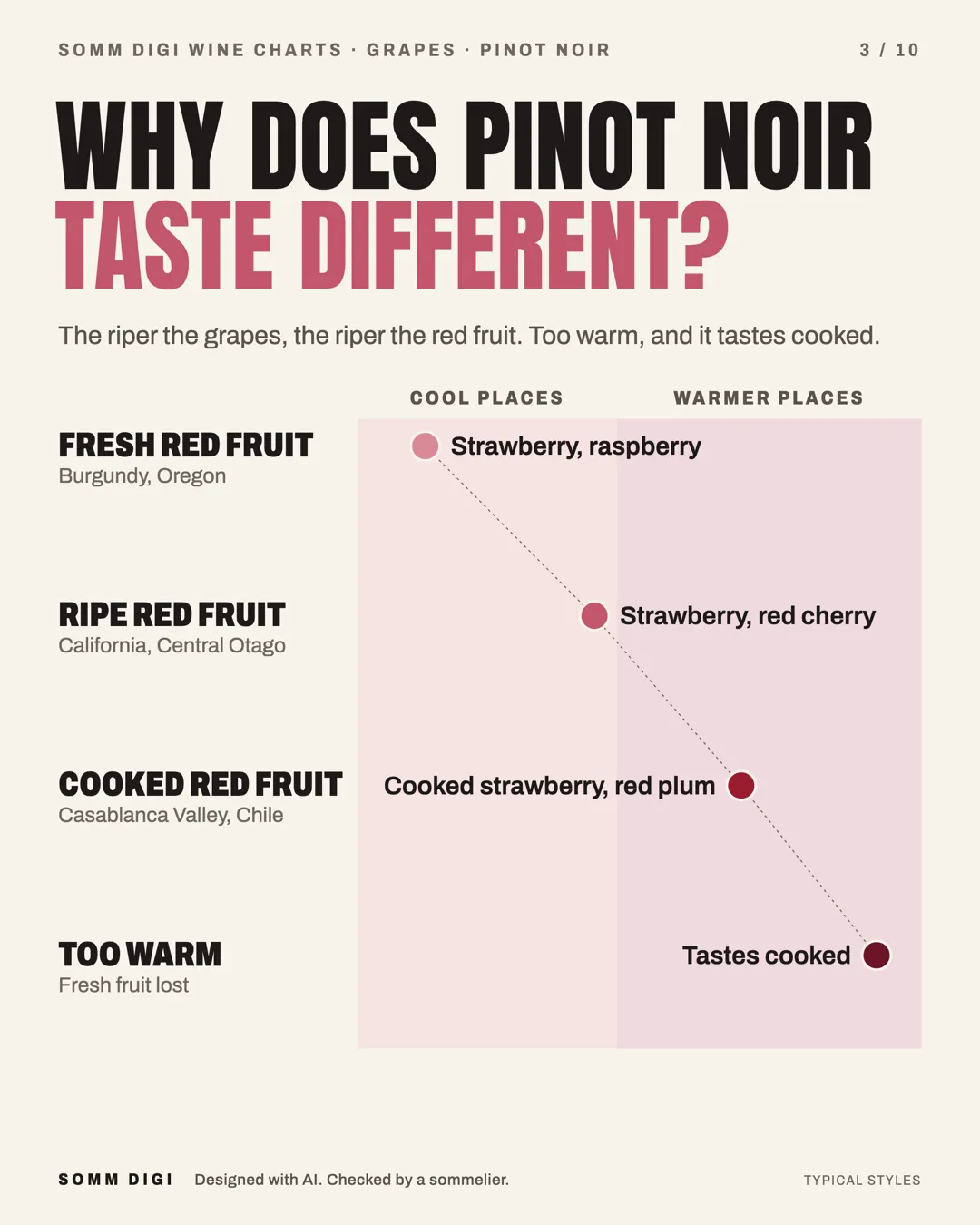
Pinot Noir always tastes of red fruit. How ripe the grapes get decides which red fruit you taste.
In cool places like Burgundy and Oregon, the fruit is fresh: strawberry and raspberry. Riper grapes, in California or Central Otago, taste of strawberry and red cherry.
In warmer places the fruit turns cooked: cooked strawberry and red plum, as in Chile's Casablanca Valley. Too warm, and the fresh fruit is lost. Follow the taste chart from fresh to cooked.
Time adds one more layer. An older Pinot Noir gains its own mushroom and forest-floor notes, which is why it loves mushroom dishes.
Where does Pinot Noir grow?
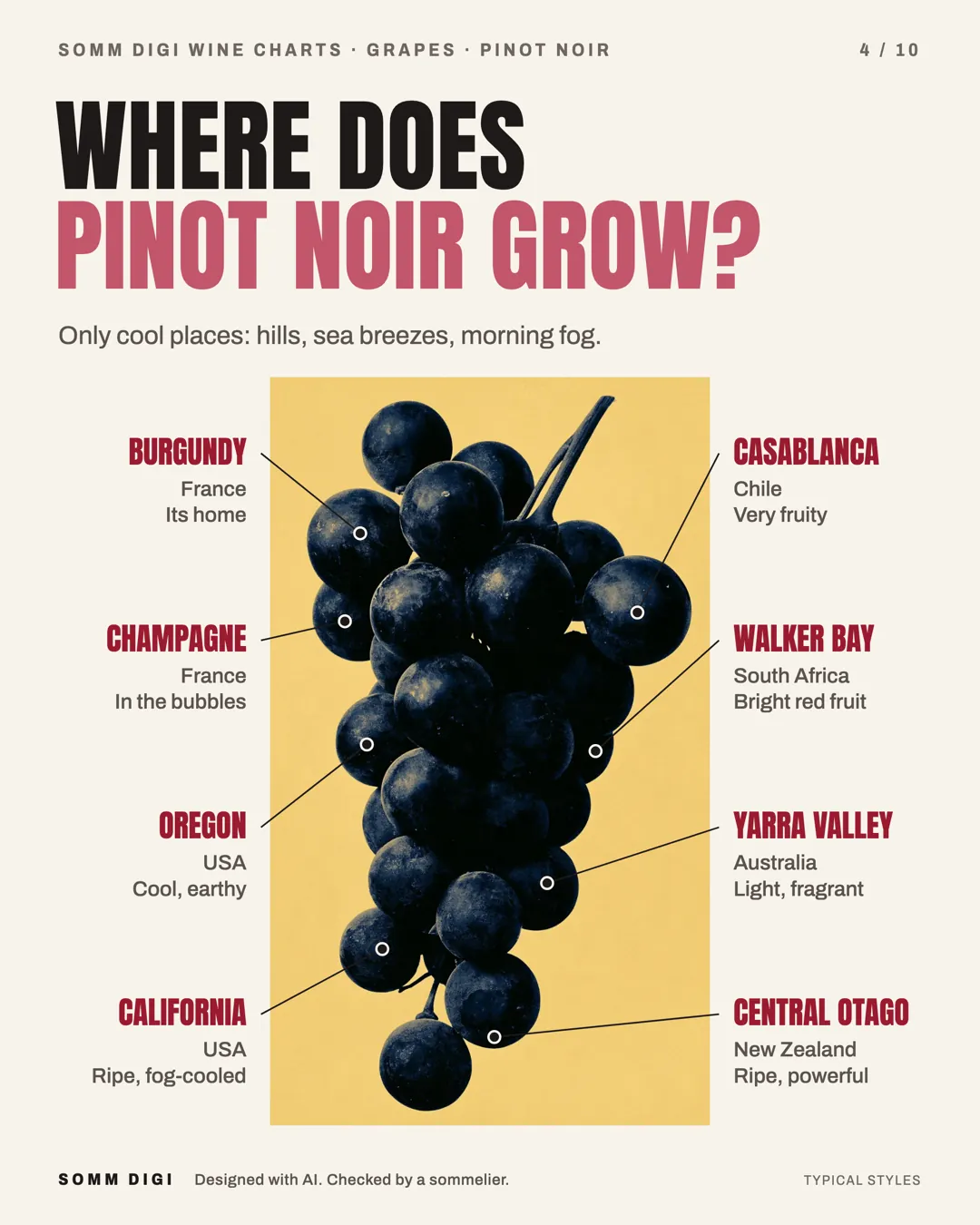
Pinot Noir grows only in cool places: hills, sea breezes, morning fog. Burgundy, in France, is its home, and in Champagne it goes into the bubbles.
In the USA, Oregon makes cool, earthy Pinot Noir, and California a riper, fog-cooled style. Chile's Casablanca is very fruity. South Africa's Walker Bay gives bright red fruit, Australia's Yarra Valley light, fragrant wine, and New Zealand's Central Otago ripe, powerful Pinot Noir. The regions chart shows all eight.
Burgundy Pinot Noir: the Côte d'Or
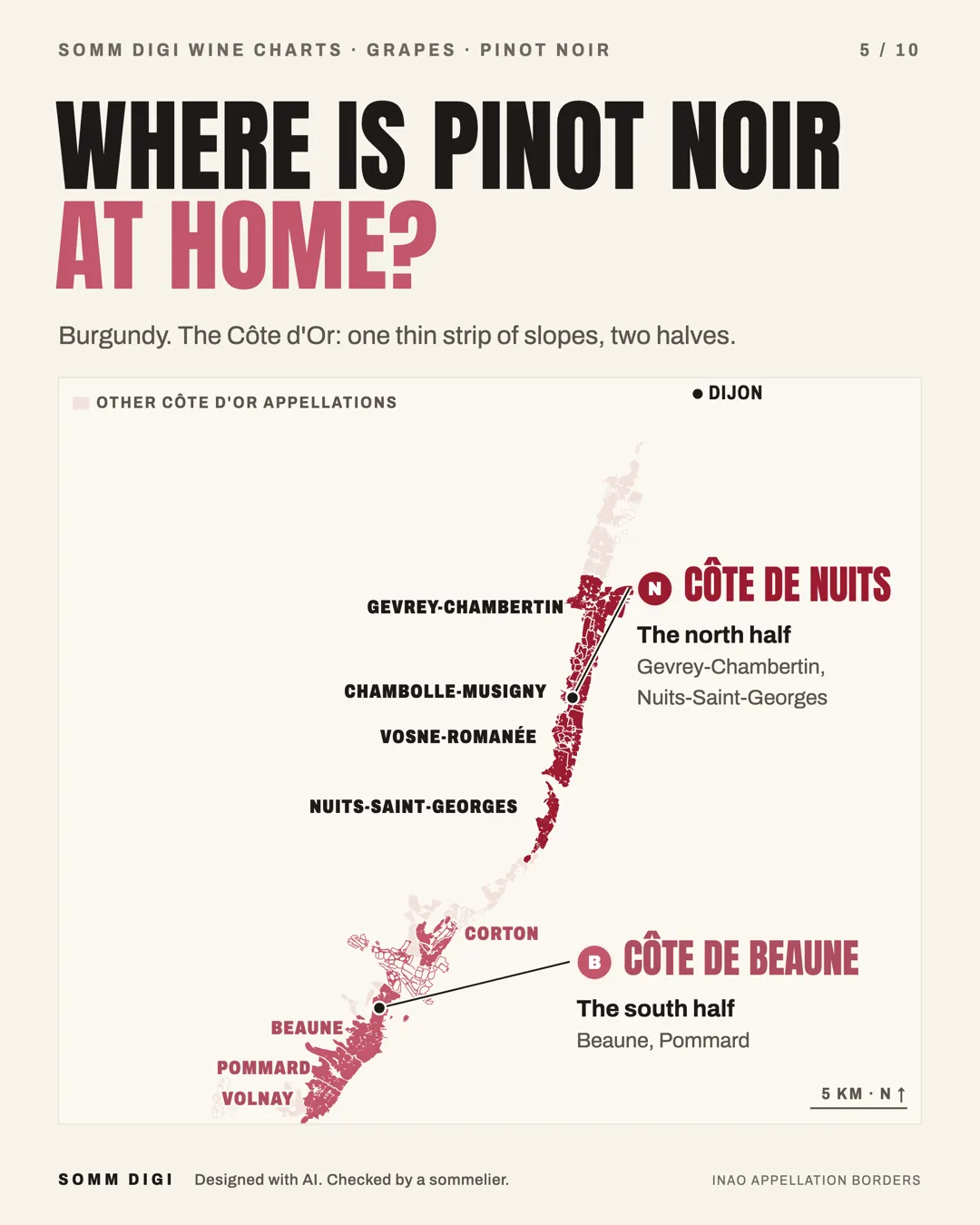
Pinot Noir's home is Burgundy, and its heart is the Côte d'Or: one thin strip of slopes, in two halves.
The north half holds Gevrey-Chambertin, Chambolle-Musigny, Vosne-Romanée and Nuits-Saint-Georges. The south half holds Corton, Savigny, Beaune, Pommard and Volnay. The map shows both halves, with the other Côte d'Or appellations, from Marsannay and Fixin to Monthélie and Saint-Romain.
How to read a Burgundy Pinot Noir label
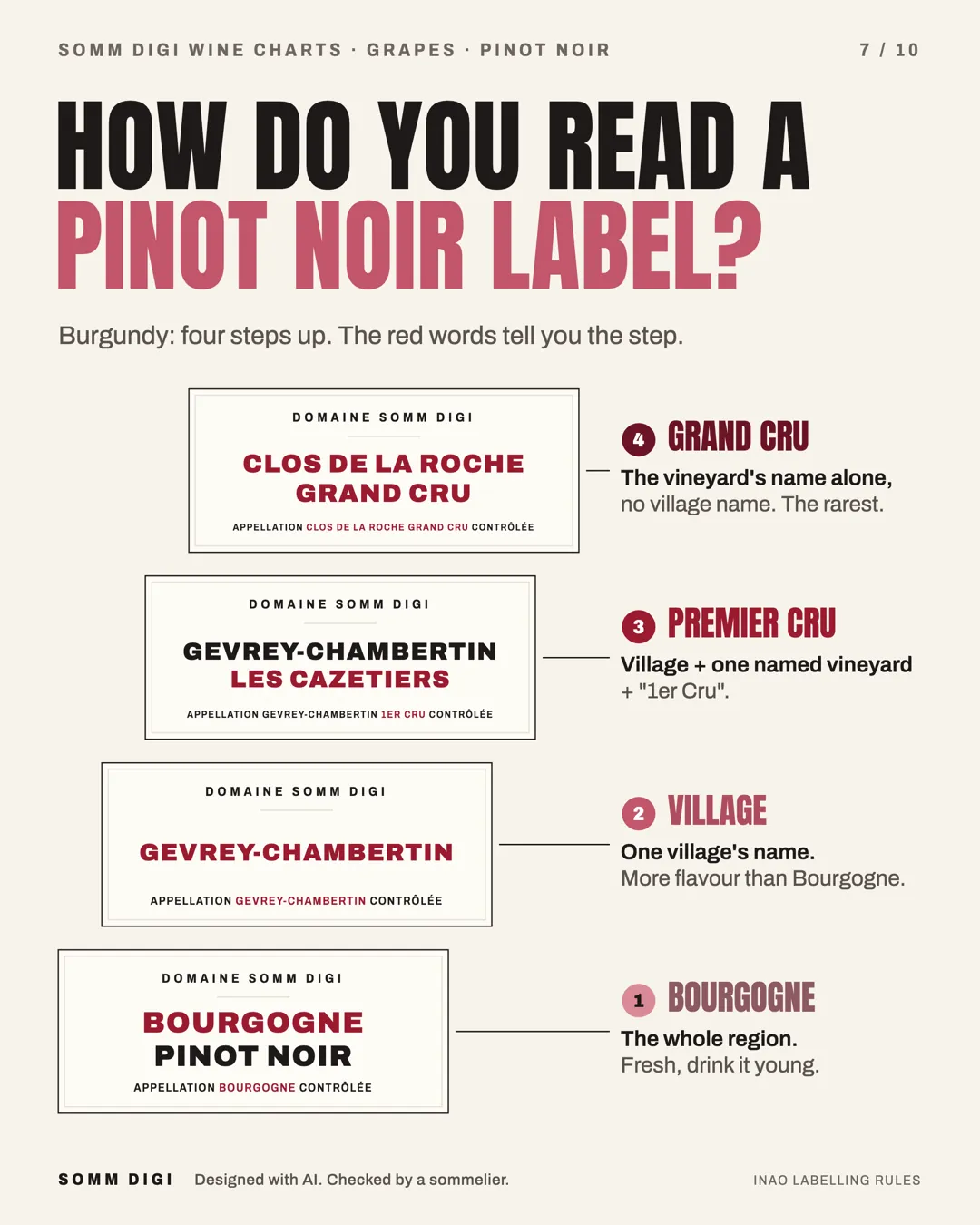
A Burgundy label climbs in four steps, and the words on it tell you which step you are holding.
Bourgogne covers the whole region: fresh, drink it young. A Village wine carries one village's name and has more flavour than Bourgogne. Premier Cru adds one named vineyard to the village name, plus “1er Cru”. Grand Cru gives the vineyard's name alone, with no village name: the rarest step. The label chart shows all four.
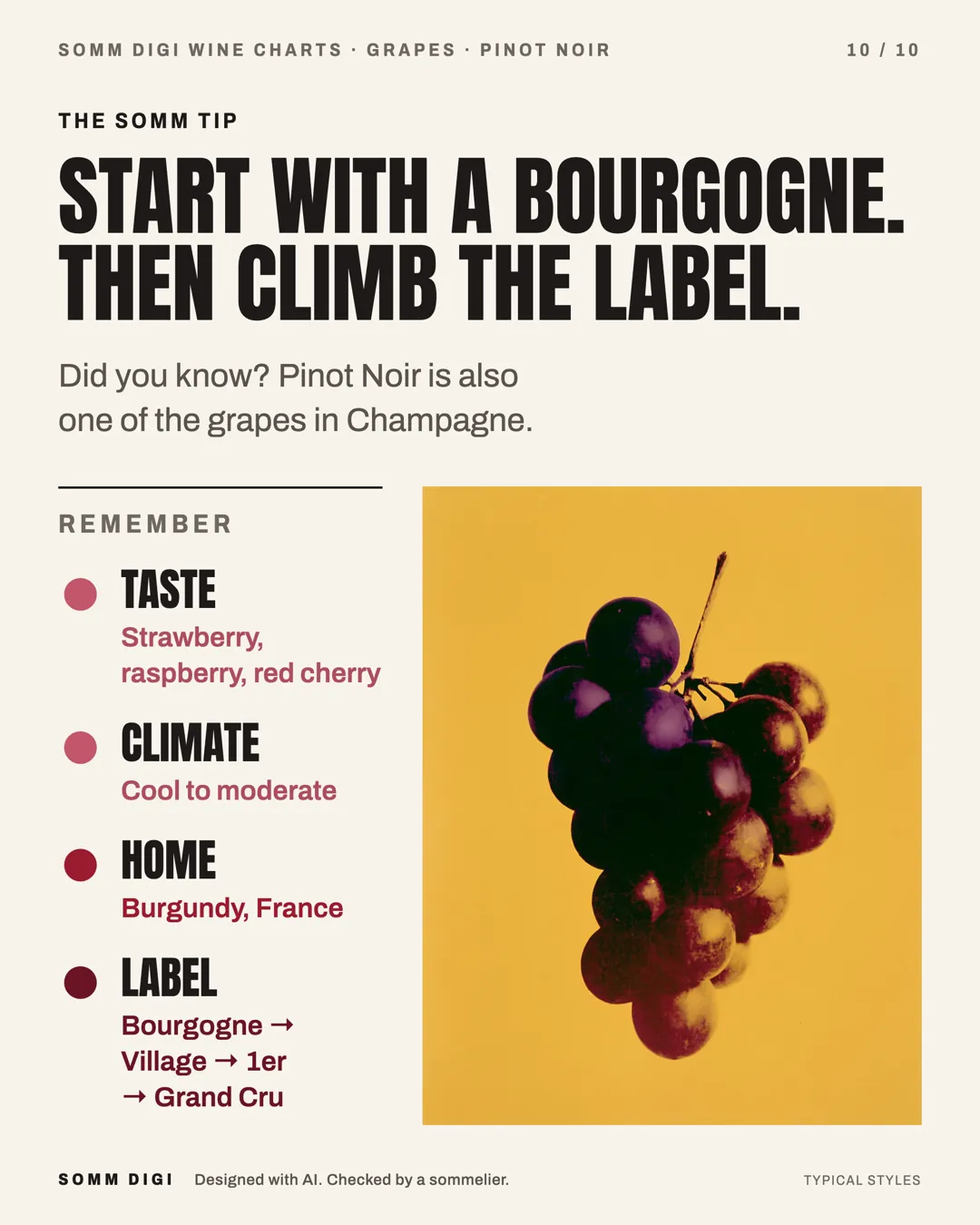
Not sure where to begin? The somm tip keeps it simple: start with a Bourgogne, then climb the label.
Which Pinot Noir is for you?
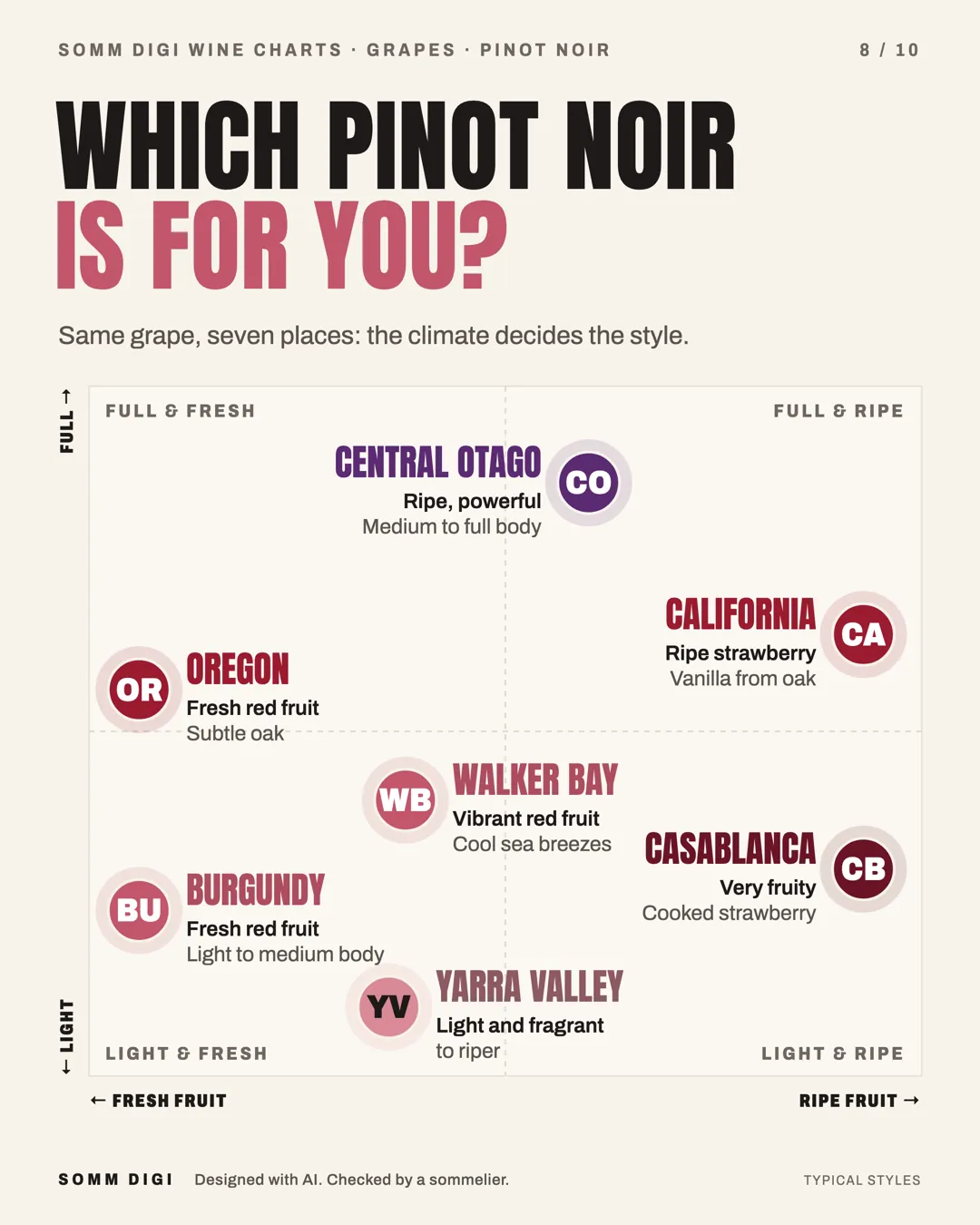
Same grape, seven places: the climate decides the style. Choose by the taste you want, not by the name you know.
For fresh red fruit, choose Burgundy, light to medium in body, or Oregon, with subtle oak. Walker Bay gives vibrant red fruit from cool sea breezes, and the Yarra Valley runs from light and fragrant to riper.
For more power, Central Otago is ripe, with medium to full body. California brings ripe strawberry with vanilla from oak, and Casablanca is very fruity, with cooked strawberry. The styles chart maps all seven.
Why is Pinot Noir so hard to grow?
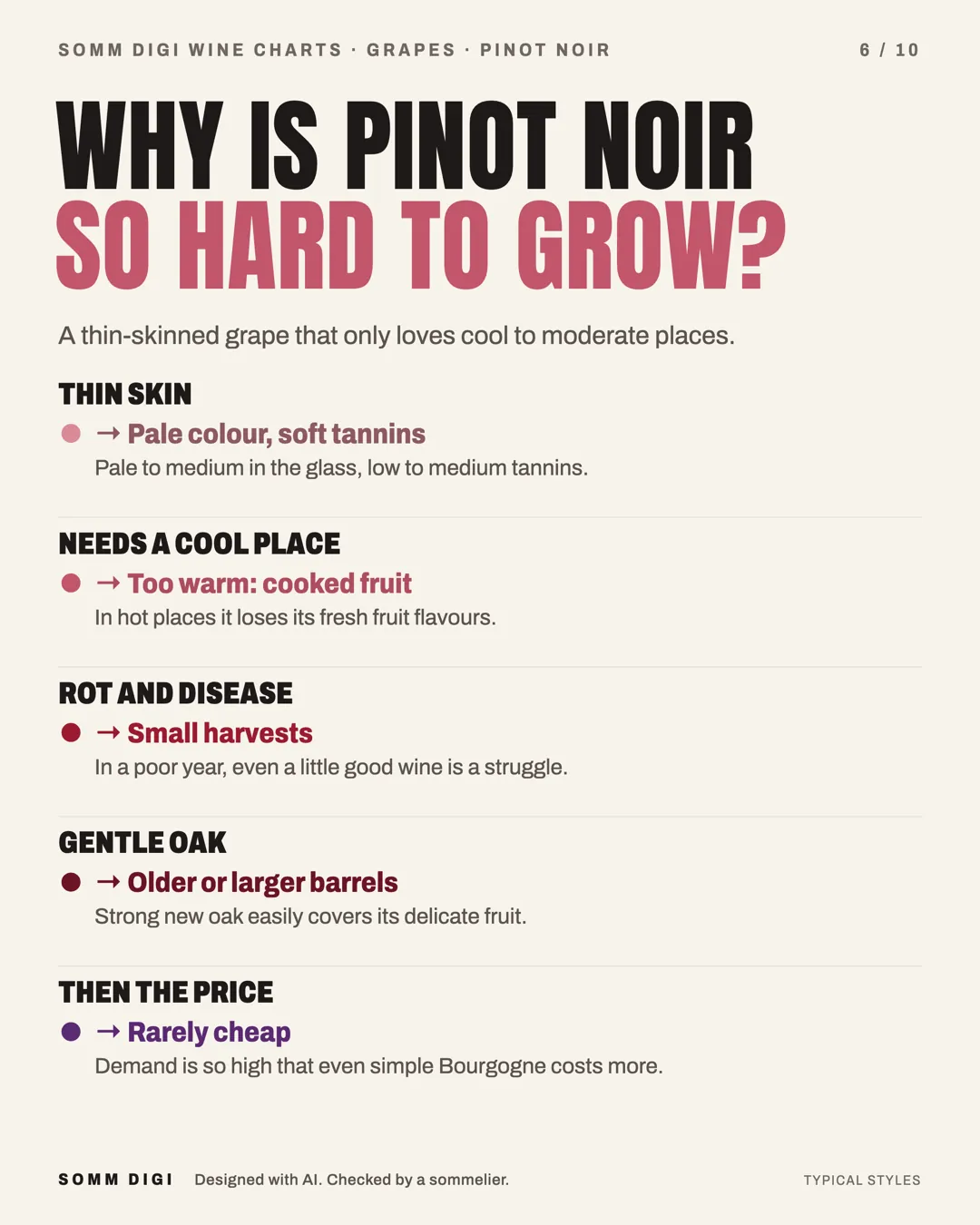
Pinot Noir is a thin-skinned grape that only loves cool to moderate places. The thin skin gives pale colour and soft tannins. Too warm, and it loses its fresh fruit flavours.
Rot and disease mean small harvests: in a poor year, even a little good wine is a struggle. In the winery it needs gentle oak, older or larger barrels, because strong new oak easily covers its delicate fruit.
Then comes the price. Pinot Noir is rarely cheap: demand is so high that even simple Bourgogne costs more. The chart lists all five reasons.
Should Pinot Noir be chilled?
Serve it cool: 13–18 °C (55–64 °F). That range starts lower than Cabernet Sauvignon, Merlot or Syrah, which go at 15–18 °C (59–64 °F).
Which glass?
Pour it into a large-bowl red glass. For shapes chosen for this grape, see the Pinot Noir glasses on universalwineglasses.com, SOMM DIGI's glass site.
Pinot Noir food pairing
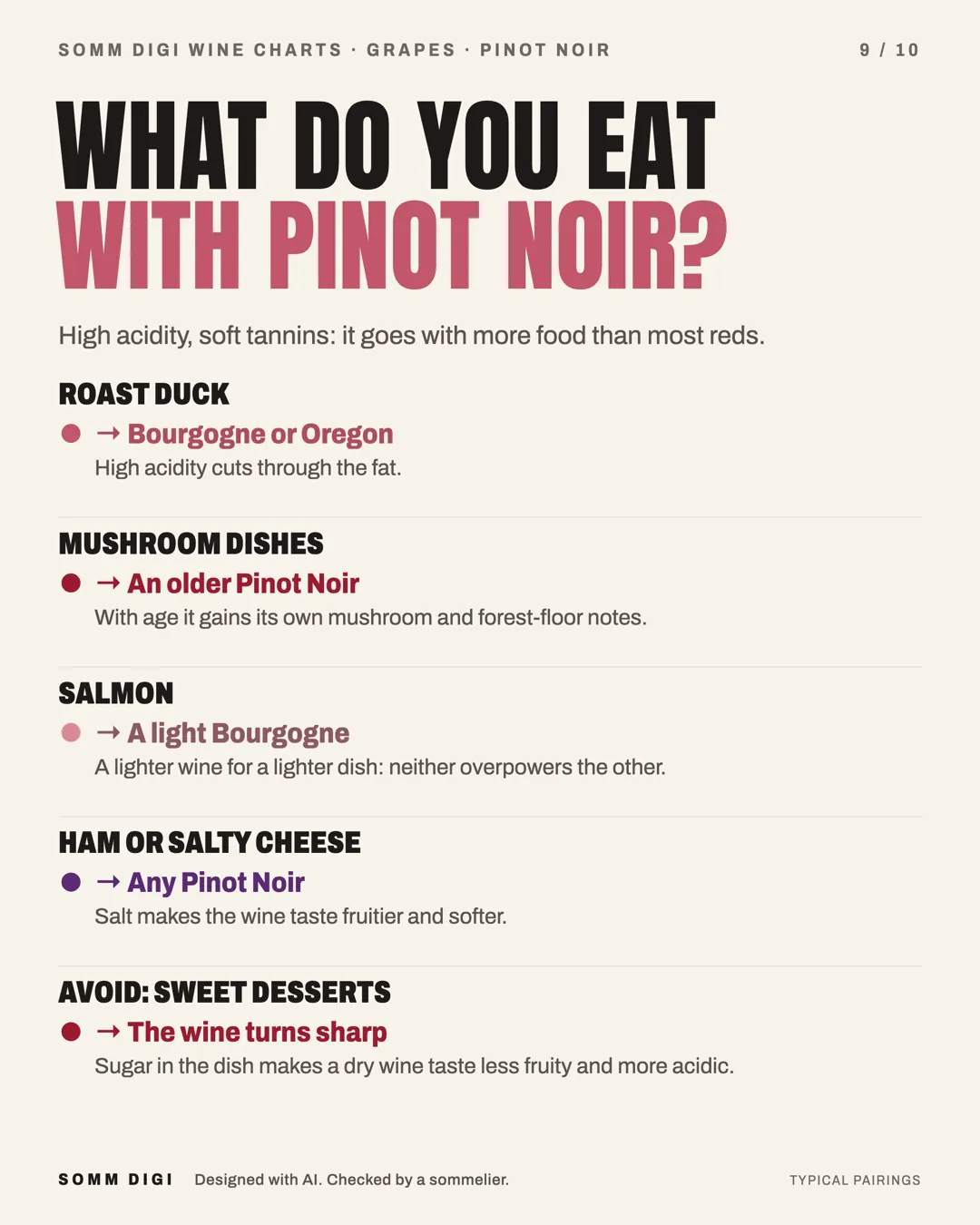
High acidity and soft tannins let Pinot Noir go with more food than most reds. Roast chicken is on its short list, and so are duck, mushrooms and salmon.
With roast duck, pour a Bourgogne or an Oregon Pinot Noir: high acidity cuts through the fat. With mushroom dishes, choose an older bottle, with its own mushroom and forest-floor notes. With salmon, a light Bourgogne: a lighter wine for a lighter dish, so neither overpowers the other.
Ham or salty cheese works with any Pinot Noir, because salt makes the wine taste fruitier and softer. Skip sweet desserts: sugar makes a dry wine taste less fruity and more acidic, so it turns sharp. The pairing chart has all five.

Learn wine the easy way
Wine Easy
The wine book that talks to you like a human: grapes, tasting, pairing and countries A–Z, in 388 full-colour pages.
Pinot Noir questions, answered
How do you pronounce Pinot Noir?
PEE-noh NWAHR.
Is Pinot Noir red or white?
Red, but pale. Its thin skin keeps the colour pale to medium in the glass. It is also one of the grapes in Champagne.
Is Pinot Noir dry?
Yes. It is a dry red with high acidity and low to medium tannins.
What is the difference between Pinot Noir and Cabernet Sauvignon?
Pinot Noir is light, pale and silky, with red fruit. Cabernet Sauvignon is deep and firm, with high tannin and blackcurrant.
Why is Pinot Noir expensive?
It is hard to grow and rot brings small harvests. Demand is so high that even simple Bourgogne costs more.
What temperature should Pinot Noir be served at?
13–18 °C (55–64 °F), in a large-bowl red glass.
Try next
If you like Pinot Noir
How this page was made. Charts designed with AI and checked by Alper Billik, Advanced Sommelier. Text written from the same chart facts and edited with AI.