
Study and careerTasting & aromas
Deductive tasting grid: one page to print
A one-page deductive tasting grid for blind tasting practice: sight, nose, palate, initial and final conclusion, with the scales to circle. Print one sheet per wine.

Alper Billik · Advanced Sommelier
Published November 2026 · 3 min read · Edited with AI
This article may contain affiliate links.
On this page
The short answer: a deductive tasting grid is a sheet that makes you taste in the same order every time: sight, nose, palate, initial conclusion, final conclusion. You describe the wine on fixed scales first, and name it last. Below is my one-page grid to print, and how to practise with it.
The grid
One page, one wine. Circle a word on each scale and write the rest on the lines. The sheet follows the method's order from top left to bottom right.
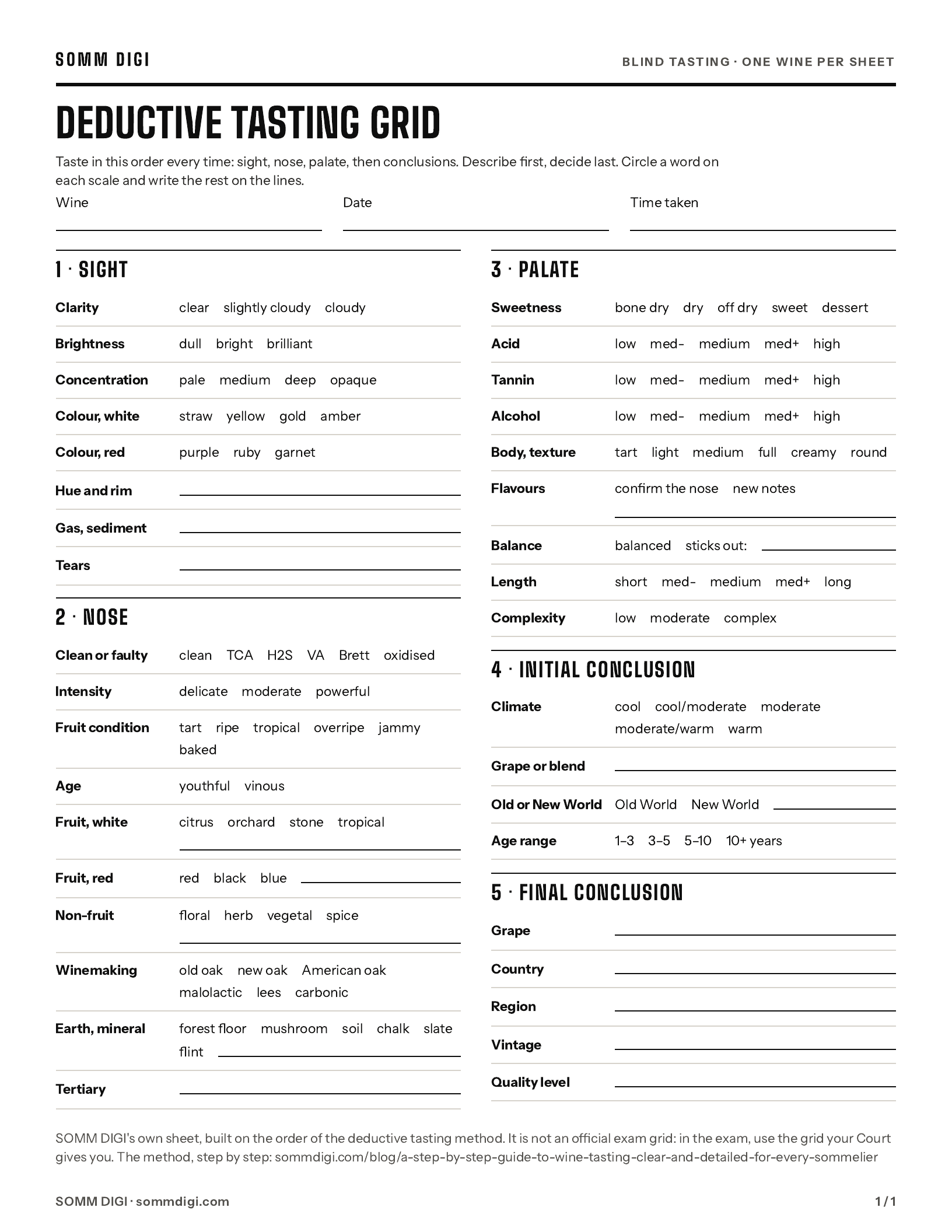
What is on the grid
| Step | What you record |
|---|---|
| 1. Sight | Clarity, brightness, concentration, colour, the hue at the rim, gas, sediment and tears |
| 2. Nose | Clean or faulty first, then intensity, fruit condition, youthful or vinous, fruit, non-fruit, winemaking, earth and mineral, and tertiary notes |
| 3. Palate | Sweetness, acid, tannin, alcohol and body on five-step scales, then flavours, balance, length and complexity |
| 4. Initial conclusion | Climate, two or three possible grapes, Old or New World, and an age range |
| 5. Final conclusion | One answer: grape, country, region, vintage and quality level |
- 1. Sight
- What you recordClarity, brightness, concentration, colour, the hue at the rim, gas, sediment and tears
- 2. Nose
- What you recordClean or faulty first, then intensity, fruit condition, youthful or vinous, fruit, non-fruit, winemaking, earth and mineral, and tertiary notes
- 3. Palate
- What you recordSweetness, acid, tannin, alcohol and body on five-step scales, then flavours, balance, length and complexity
- 4. Initial conclusion
- What you recordClimate, two or three possible grapes, Old or New World, and an age range
- 5. Final conclusion
- What you recordOne answer: grape, country, region, vintage and quality level
Every step, with what each word on the scale means, is in how to taste wine like a sommelier, step by step.
How to practise with it
- One sheet per wine, poured blind by a friend or a colleague. Write the wine's name on the back afterwards, not before.
- Describe first, decide last. Fill sight, nose and palate completely before you write a single grape. The grid stops you guessing early.
- Then time yourself. In the Court of Master Sommeliers Europe's Advanced exam you taste six wines in 25 minutes, about four minutes a wine. Start slowly and bring the time down.
- Keep your sheets. Ten sheets of Sauvignon Blanc side by side show you what you always notice and what you always miss.
- Taste the classics. Work through the grapes candidates meet again and again: see blind tasting for sommeliers.
When the grid is examined
- Introductory: no tasting exam. You are introduced to the method during the course.
- Certified: two wines on the Court's tasting grid in Europe, four wines in the Americas.
- Advanced: six wines in 25 minutes in Europe.
- Master Sommelier Diploma: a practical tasting, as part of the three-part exam.
This sheet is SOMM DIGI's own, for practice. On exam day you use the grid your Court gives you, so read your Court's tasting instructions before you sit the exam. Every level at a glance: the sommelier exam.
Questions people ask
What is deductive tasting?
A way of tasting in a fixed order, from what you see to what you smell and taste, so that the conclusion (grape, place, age, quality) follows from the evidence instead of a first guess.
Is this the Court of Master Sommeliers' official grid?
No. It follows the same order and scale words, but it is SOMM DIGI's own sheet for practice. In the exam, use the grid your Court provides.
How long should I spend on one wine?
As long as you need at first. Then aim for exam pace: about four minutes a wine, the pace of six wines in 25 minutes at the Advanced in Europe.
Can I use it for WSET?
WSET uses its own Systematic Approach to Tasting, with its own words. Use theirs for a WSET exam; the logic, from appearance to conclusions, is the same.
Your exam kit
Where to study for your exam
 My book · AmazonSommelier Prep BookQuick questions and answers for a break at work.Order on Amazon
 My book · AmazonSommelier Level 1 Prep BookLevel 1's key topics in one small book you can carry anywhere.Order on Amazon
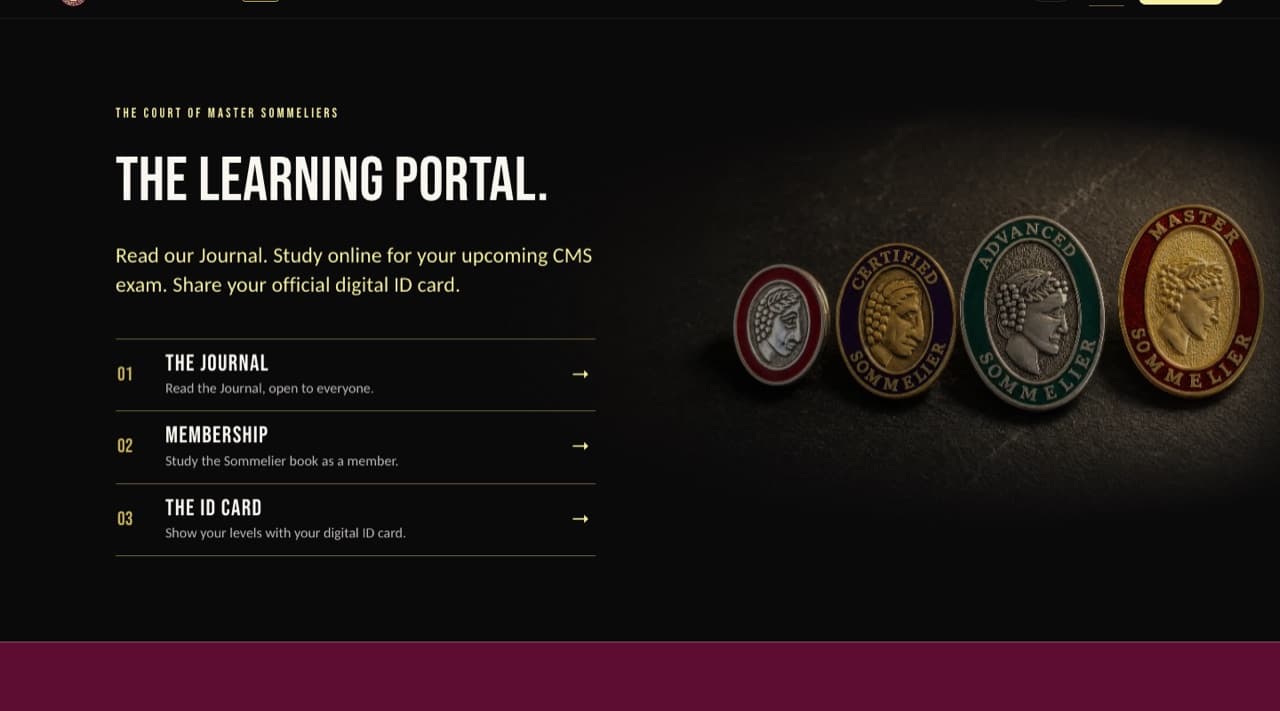
SOMM DIGI built the Court of Master Sommeliers Europe’s Learning Portal, and SOMM DIGI AI. Who is behind this
For sommeliers · next steps