
Study and careerExams & certifications
The sommelier exam: every level explained
What the sommelier exam asks at each of the four levels, how it is marked, what the questions look like, and how I passed Introductory, Certified and Advanced.

Alper Billik · Advanced Sommelier
Published November 2026 · 7 min read · Edited with AI
This article may contain affiliate links.
On this page
The short answer: “the sommelier exam” usually means the exams of the Court of Master Sommeliers, in four levels: Introductory, Certified, Advanced and Master Sommelier. Level 1 is a theory exam. From Certified on, every level tests three things: theory, blind tasting and wine service. You pass the first three levels with 60% in each part; the Master Sommelier Diploma asks for 75%.
I have sat three of the four. I passed the Introductory in Napa in 2012, the Certified in 2014 and the Advanced in Hong Kong in 2019, on my second attempt. This page is what I wish someone had shown me before each one: what is asked, how it is marked, and how to get ready.
My path
Three exams, seven years
2012
Introductory Sommelier
Court of Master Sommeliers, Culinary Institute of America, Napa.
2014
Certified Sommelier
Court of Master Sommeliers. Exam passed in September 2014.
2019
Advanced Sommelier
Court of Master Sommeliers, Hong Kong. Passed on my second attempt.
The four levels at a glance
| Level | What is examined | Pass mark | Before you sit it |
|---|---|---|---|
| 1. Introductory | A multiple-choice theory exam. In Europe, also a short service test | 60% | Nothing: every candidate starts here |
| 2. Certified | Theory, blind tasting and service, all on one day | 60% in each part, passed together | The Introductory. In Europe, within three years of passing it |
| 3. Advanced | Theory, blind tasting of six wines and a 45-minute service test | 60% in each part, passed together | The Certified |
| 4. Master Sommelier Diploma | Theory by oral questioning, blind tasting and service | 75% in each part | The Advanced |
- 1. Introductory
- What is examinedA multiple-choice theory exam. In Europe, also a short service test
- Pass mark60%
- Before you sit itNothing: every candidate starts here
- 2. Certified
- What is examinedTheory, blind tasting and service, all on one day
- Pass mark60% in each part, passed together
- Before you sit itThe Introductory. In Europe, within three years of passing it
- 3. Advanced
- What is examinedTheory, blind tasting of six wines and a 45-minute service test
- Pass mark60% in each part, passed together
- Before you sit itThe Certified
- 4. Master Sommelier Diploma
- What is examinedTheory by oral questioning, blind tasting and service
- Pass mark75% in each part
- Before you sit itThe Advanced
The Court of Master Sommeliers has two bodies, Europe and the Americas, and their formats differ in the details. US candidates sit with the Americas. Always check the latest rules with your Court before you book: the Americas or Europe.
Level 1: the Introductory Sommelier exam
- Americas: 70 multiple-choice questions in 45 minutes, 60% to pass (42 correct). You take it after a two-day course, or online with a live proctor after the self-paced course.
- Europe: two days of course, then a multiple-choice theory paper and a short practical service test on the morning of day three, 60% in each.
- What it covers: grape growing and winemaking, the principal wine regions of the world, spirits and liqueurs, beer and sake, service and food matching.
- No blind tasting exam yet. You taste during the course; tasting is examined from the Certified on.
Test yourself with the Level 1 sommelier practice test: 40 questions with answers, at the same level.
Level 2: the Certified Sommelier exam
- Theory. Americas: 45 questions in 38 minutes, with multiple choice, short answer, simple maths and matching. Europe: 40 multiple-choice and short-answer questions, at a higher level than the Introductory.
- Blind tasting. Americas: four wines. Europe: two wines, described on the Court's tasting grid.
- Service. A practical test on the floor: open, present and pour, answer the guest, suggest a pairing.
- 60% in every part, in one sitting. Fail one part and you sit the exam again.
The depth is the jump. At Level 1 you recognise the right answer in a list; at the Certified you have to write it yourself. Practise with the Certified sommelier practice test, read the Certified theory exam, region by region, and see what the practical exam asks.
Level 3: the Advanced Sommelier exam
- Europe: a five-day course, with the last two and a half days given to the exams.
- Theory: multiple-choice and short-answer questions, much deeper than the Certified.
- Blind tasting: six wines in 25 minutes, about four minutes a wine.
- Service: a 45-minute practical test.
- 60% in each part, all three passed together. The Americas run their own Advanced rules: check them before you plan.
This is where I failed first. On my first attempt, in Austria, I passed the theory and failed the tasting and the service. I passed all three in Hong Kong in 2019. What failing taught me is in how to prepare for the Advanced Sommelier exam.
Level 4: the Master Sommelier Diploma
- Open only to Advanced Sommeliers.
- Three parts: theory, asked out loud by the examiners, blind tasting and practical service.
- 75% in each part. If you pass one or two parts, you can retake the others, but all three must be passed within three years.
- Held once a year, in London and in the USA, according to the Court of Master Sommeliers Europe.
Since the first exam in 1969, fewer than 300 people have earned the title, according to the Court of Master Sommeliers Europe. Pass all three parts and be accepted as a member of the Court, and you may write MS after your name.
What the questions look like
Real exam questions are confidential, and you should not trust anyone who offers them. These six are mine, from my practice tests, two at each of the first three levels. Answer before you open the answer.
Question 1
What is the main red grape of Rioja?
- a)Garnacha
- b)Tempranillo
- c)Monastrell
- d)Mencía
Show answerAnswer
b) Tempranillo. Garnacha, Graciano and Mazuelo often join it. Crianza, Reserva and Gran Reserva tell you about ageing. Level 1.
Question 2
Sake is brewed from which main ingredient?
- a)Barley
- b)Rice
- c)Grapes
- d)Plums
Show answerAnswer
b) Rice. Polished rice, water, yeast and koji, a mould that turns the rice starch into sugar. Level 1.
Question 3
How many Grand Cru climats are there in Chablis?
- a)Five
- b)Seven
- c)Nine
- d)Twelve
Show answerAnswer
b) Seven. Blanchot, Bougros, Les Clos, Grenouilles, Preuses, Valmur and Vaudésir, all within one appellation, Chablis Grand Cru. Certified.
Question 4
How long must vintage Champagne age after bottling before it is sold?
- a)12 months
- b)15 months
- c)24 months
- d)36 months
Show answerAnswer
d) 36 months. 36 months for vintage; 15 months for non-vintage. Certified.
Question 5
Pierce's disease is spread in the vineyard by:
- a)Sharpshooter insects
- b)Nematodes
- c)Phylloxera
- d)Birds
Show answerAnswer
a) Sharpshooter insects. A bacterium, Xylella fastidiosa, is carried from vine to vine by sap-feeding sharpshooters. Advanced.
Question 6
Biodynamic preparation 500 is made from:
- a)Cow manure buried in a cow horn over winter
- b)Ground quartz buried in a horn over summer
- c)Yarrow flowers
- d)Chamomile flowers
Show answerAnswer
a) Cow manure buried in a cow horn over winter. Preparation 500, horn manure, is sprayed on the soil. Preparation 501, horn silica, is made from ground quartz. Advanced.
Twenty more, level by level, are in sommelier exam questions by level. Prefer paper? Print the practice tests and mark them with a pen.
Is the sommelier exam hard?
Each level is harder in a different way. The Introductory is not that hard, but it is not easy either: you need to give it time. The Certified adds tasting and service to the theory, and all three must be passed on the same day. The Advanced is a huge jump in depth: on my first attempt I passed the theory and still failed the tasting and the service. The Master is a different world: fewer than 300 people have passed it.
How to prepare, at any level
- Start from the official scope. Read what your Court lists for your level, so you study what is examined and nothing else.
- Test yourself every few days, not once at the end. Note the topics you miss, study those, then test again. Ten minutes before service beats one long weekend.
- Taste on a grid every day from the Certified on. Use the same order every time until it is automatic. My deductive tasting grid is one page you can print.
- Practise service out loud. Open sparkling wine, decant, talk to a guest, until the steps come without thinking.
- Aim for 80% in practice. The pass mark is 60%, and nerves cost points on the day.
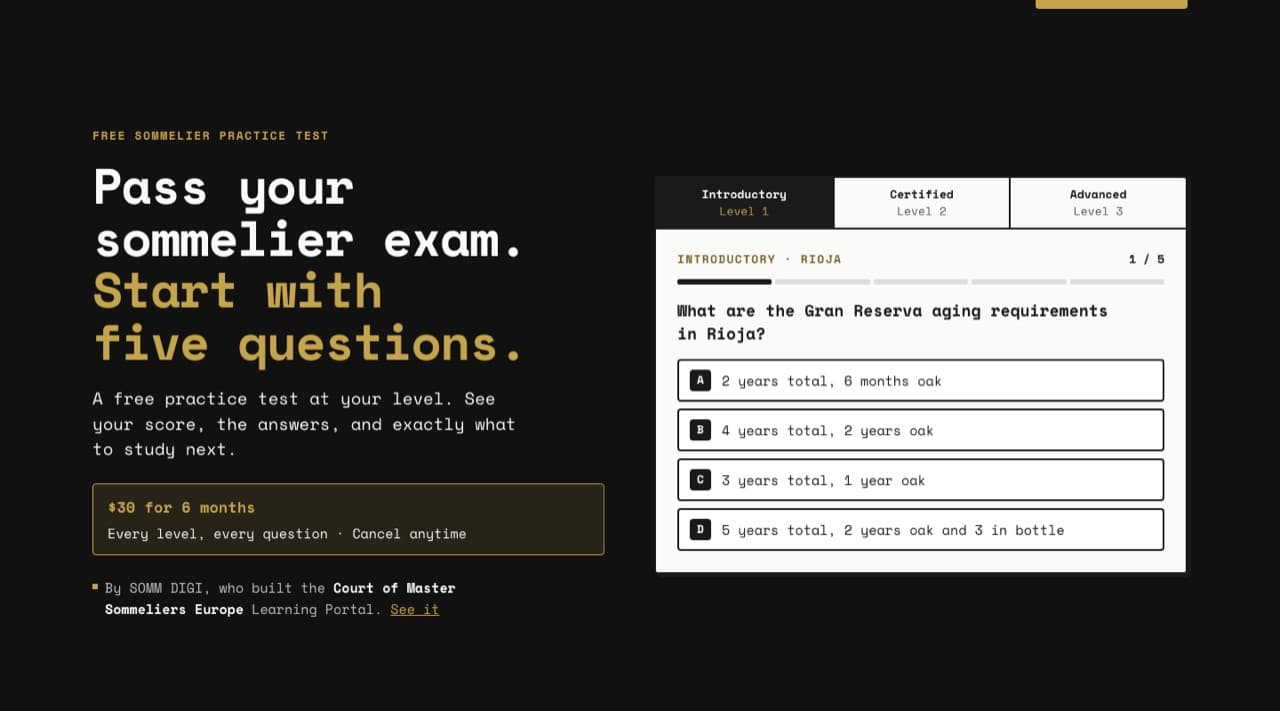
Want a sharp first step? SOMM DIGI AI opens with a five-question test at Introductory, Certified or Advanced level. You see where you stand in a minute, with no account.
Questions people ask
How many levels does the sommelier exam have?
Four, at the Court of Master Sommeliers: Introductory, Certified, Advanced and the Master Sommelier Diploma. You must pass them in order.
What is the pass mark for the sommelier exam?
60% in each part for the Introductory, Certified and Advanced. 75% in each part for the Master Sommelier Diploma.
Is there blind tasting in the sommelier exam?
From the Certified level on. The Introductory has no tasting exam; the Certified asks for four wines in the Americas and two in Europe; the Advanced asks for six wines in 25 minutes in Europe.
Can I take the sommelier exam online?
The Level 1 Introductory, yes, with the Court of Master Sommeliers Americas: a self-paced online course, then a 70-question exam with a live proctor. The higher levels include tasting and service, which are examined in person.
Is the sommelier exam the same as WSET?
No. WSET runs its own qualifications for the wine trade and wine lovers, without a service exam. The Court of Master Sommeliers exams are built for people who serve wine, so service is examined from the Certified on, and in Europe from Level 1.
Where can I find real sommelier exam questions?
Nowhere you should trust: real questions are confidential. Both Courts publish sample questions, and practice tests like the ones on this site train the same knowledge at the same level.
Your exam kit
Where to study for your exam
 My book · AmazonSommelier Prep BookQuick questions and answers for a break at work.Order on Amazon
 My book · AmazonSommelier Level 1 Prep BookLevel 1's key topics in one small book you can carry anywhere.Order on Amazon
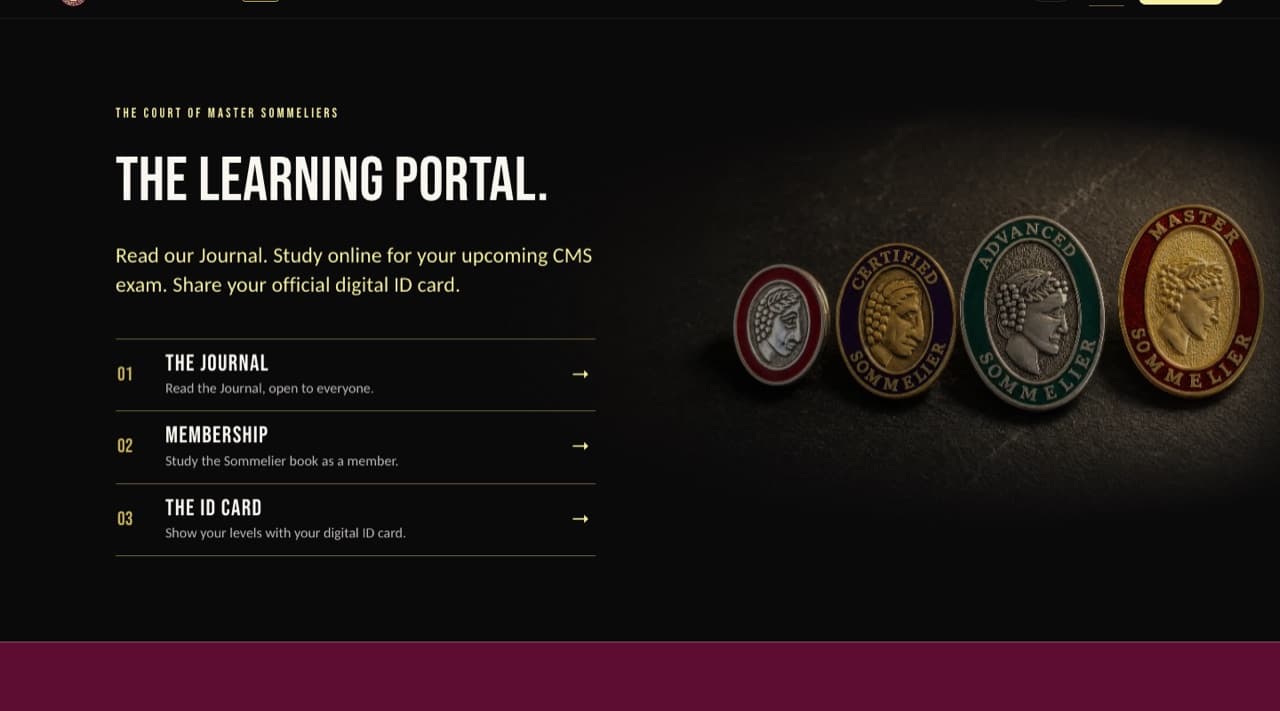
SOMM DIGI built the Court of Master Sommeliers Europe’s Learning Portal, and SOMM DIGI AI. Who is behind this
For sommeliers · next steps