
Merlot wine: why is it so soft?
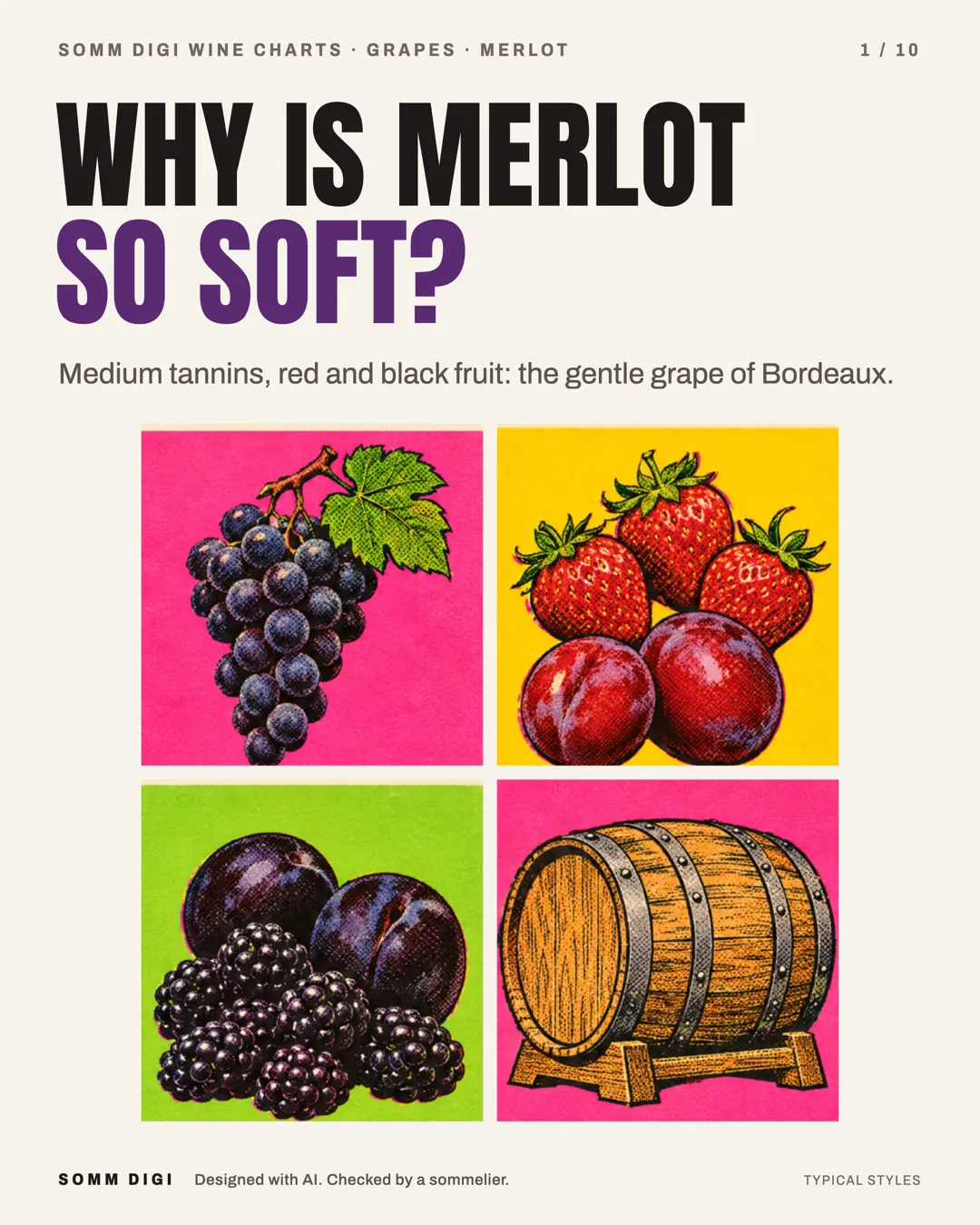
Merlot is the gentle grape of Bordeaux: soft, plummy and easy to enjoy young. Here is where that softness comes from, and how to pick the Merlot you will like.
Quick answer
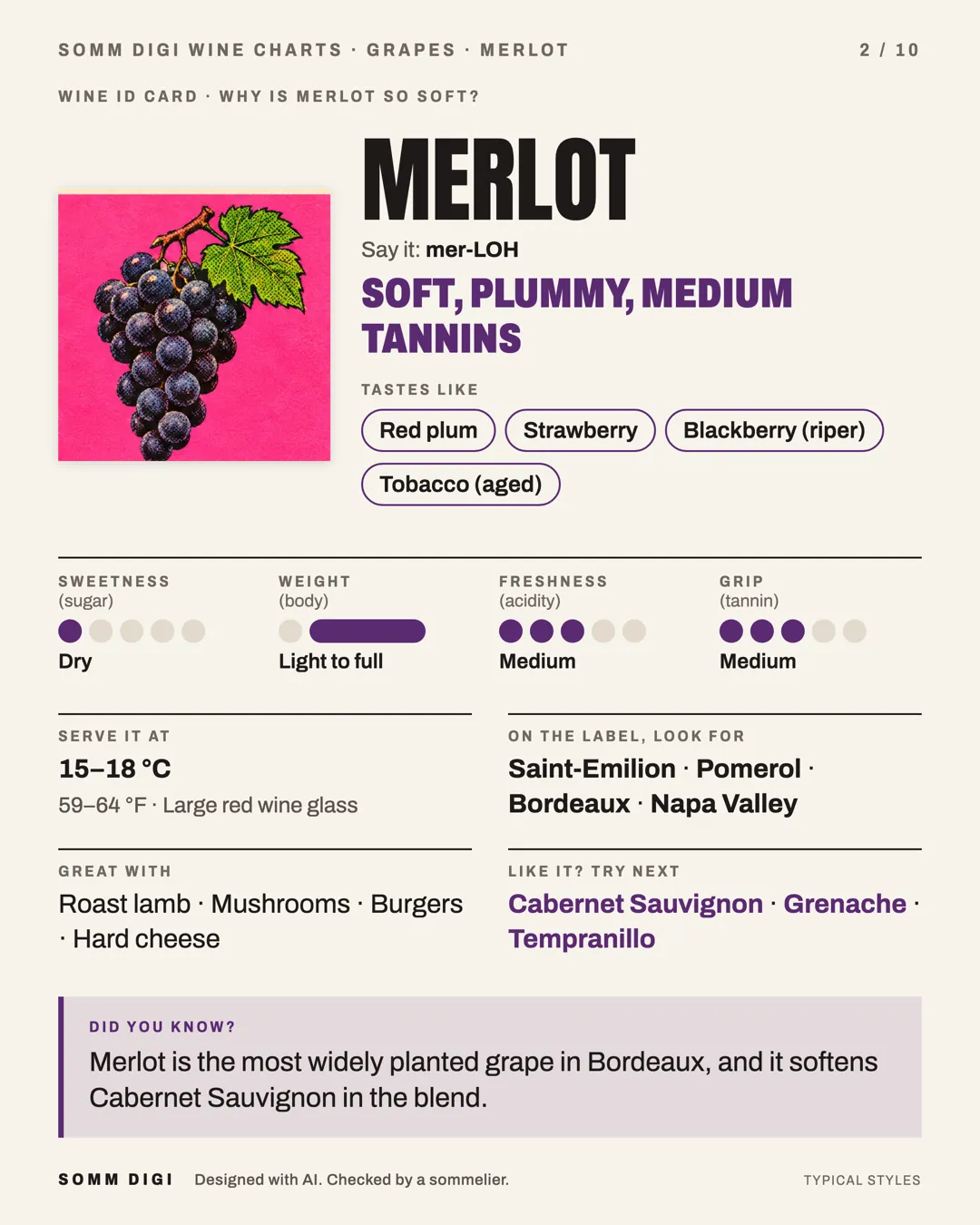
Merlot (say it mer-LOH) is a red grape that makes soft, plummy, dry wine with medium tannins and medium acidity. It tastes of red plum and strawberry, of blackberry when riper, and of tobacco with age. Serve it at 15–18 °C (59–64 °F) in a large red wine glass. Find Cabernet Sauvignon too firm? Try a Merlot.

Alper Billik · Advanced Sommelier
Updated November 2026 · Edited with AI
This article may contain affiliate links.
On this page
- Is Merlot sweet or dry?
- Merlot vs Cabernet Sauvignon
- Why is Merlot so soft?
- Merlot vs Pinot Noir and Malbec
- What does Merlot taste like?
- Where does Merlot grow?
- Saint-Emilion and Pomerol: Merlot's home
- How to find Merlot on a Bordeaux label
- Which Merlot is for you?
- Should Merlot be chilled?
- Merlot food pairing
- Merlot questions, answered
Is Merlot sweet or dry?
Merlot is dry. It is a red grape (say it mer-LOH) that makes soft, plummy wine with medium tannins and medium acidity. Its body runs from light to full.
The softness can feel gentle, but it does not come from sugar. It comes from medium tannins, and that makes Merlot easy to enjoy young. It tastes of red plum and strawberry, of blackberry when riper, and of tobacco with age. The profile card has the essentials.
Merlot vs Cabernet Sauvignon
Both are grapes of Bordeaux, and there they work as a pair. Merlot is the soft one; Cabernet Sauvignon is the firm one.
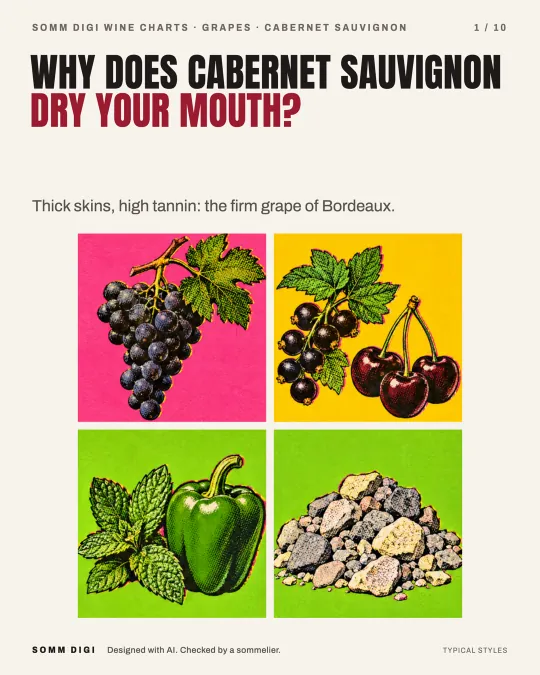
Cabernet has thick skins, high tannin and high acidity, so a young one can dry your mouth. Merlot has medium tannins and medium acidity. Cabernet tastes of blackcurrant, mint and bell pepper; Merlot of red plum and strawberry, and blackberry when riper.
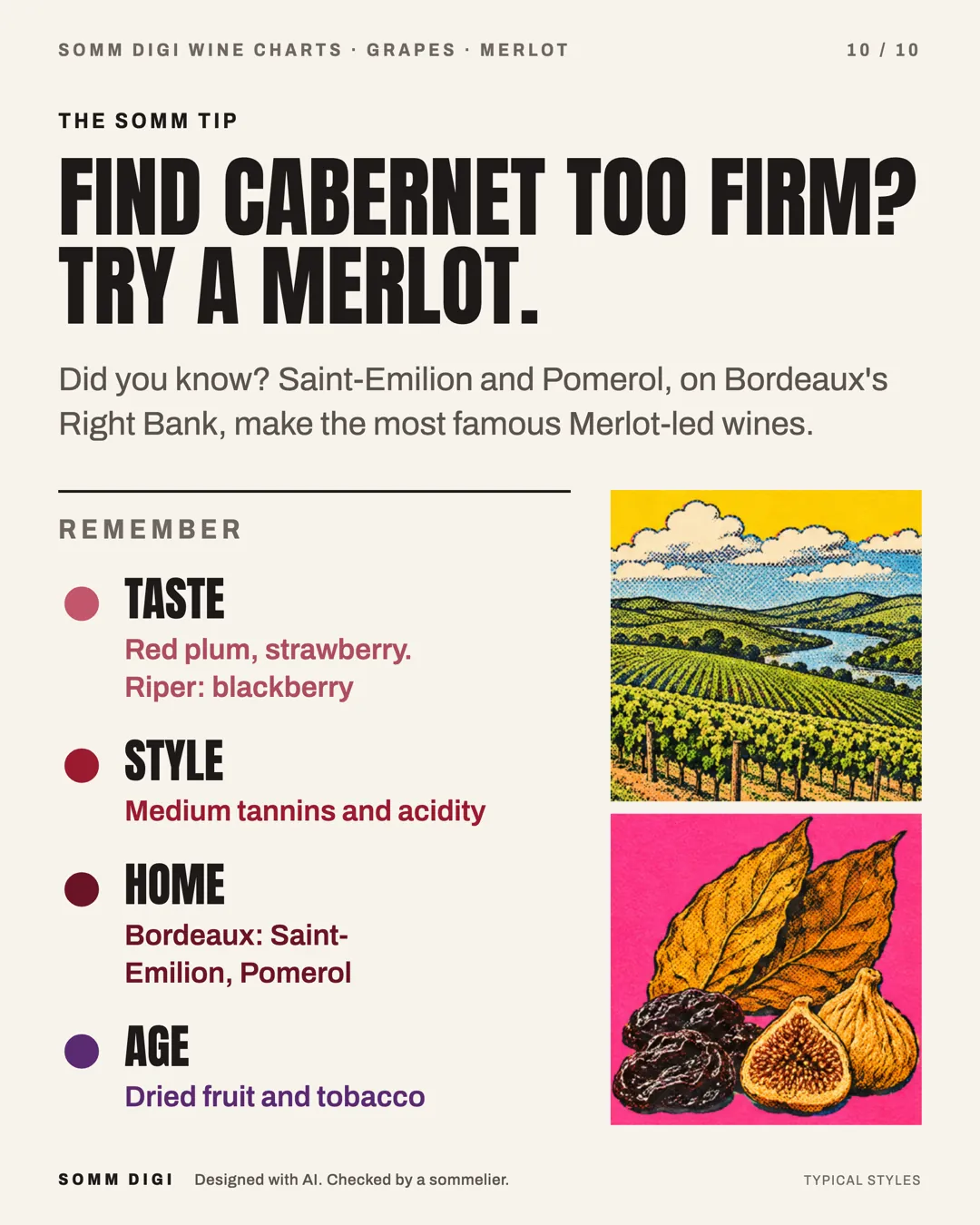
Merlot is the most widely planted grape in Bordeaux, and it softens Cabernet in the blend. It adds red fruit and lowers the tannin, so the wine is softer and ready sooner. In years when Cabernet struggles to ripen, more Merlot goes into the blend. The somm tip turns that into one line.
Why is Merlot so soft?
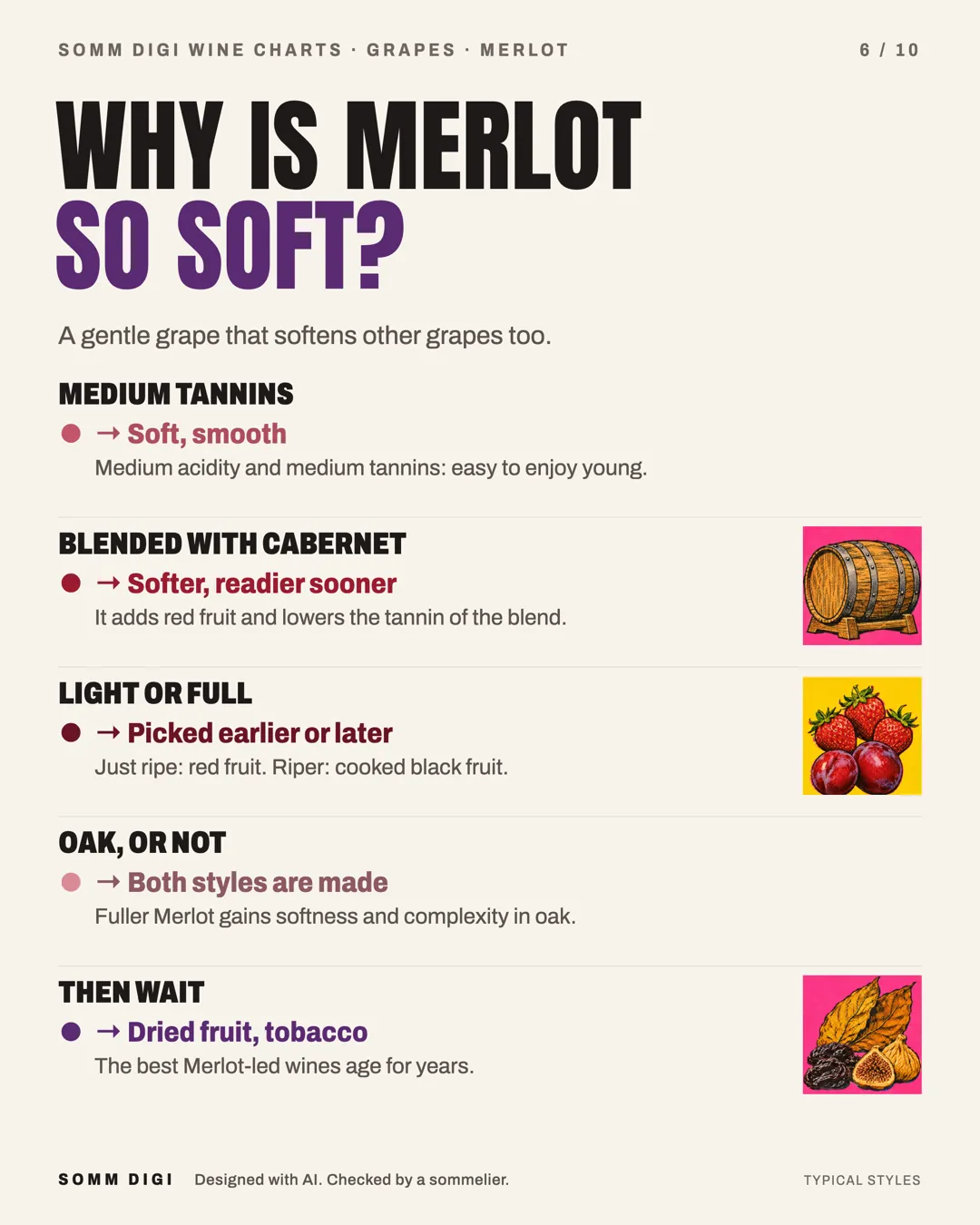
Merlot is a gentle grape that softens other grapes too. Medium acidity and medium tannins make it smooth and easy to enjoy young, and in a blend with Cabernet it brings the tannin down.
The winemaker decides the rest. Picked earlier, Merlot tastes of red fruit; picked later, of cooked black fruit. Both oaked and unoaked styles are made, and fuller Merlot gains softness and complexity in oak.
Then time does its work. The top Merlot-led wines age for years, gaining dried fruit and tobacco. The chart shows all five steps.
Merlot vs Pinot Noir and Malbec
Pinot Noir is light, fresh and silky: a thin skin, pale colour, low to medium tannins and high acidity, with strawberry, raspberry and red cherry. Choose it when you want something fresher than Merlot.
Malbec goes the other way. It is deep in colour and full, with high tannin and black fruit: blackberry and black plum. Its home is Mendoza, in Argentina. Merlot sits softer than both Malbec and Cabernet.
What does Merlot taste like?
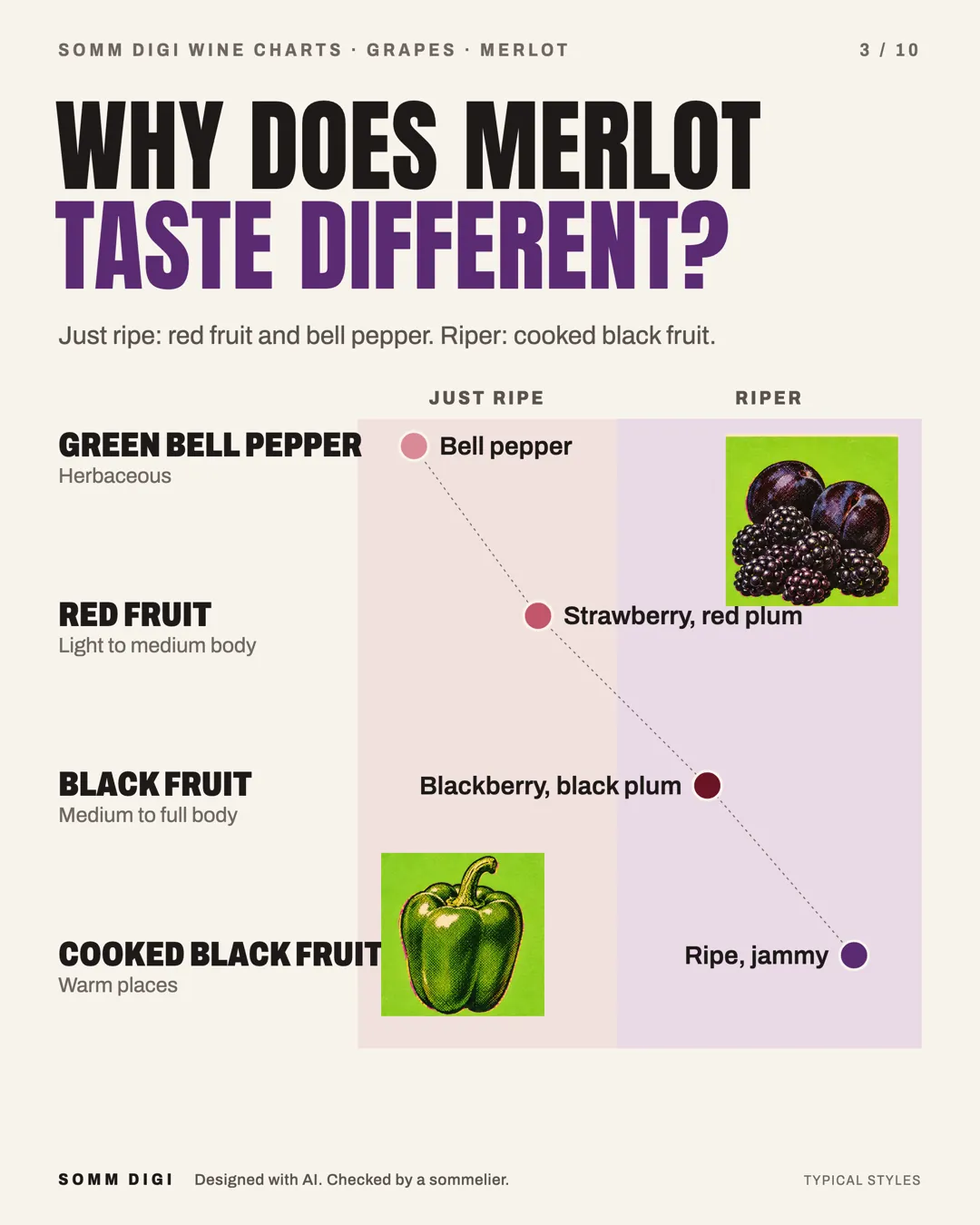
Merlot's taste follows ripeness. Just ripe, it gives red fruit; riper, it gives black fruit.
Just-ripe grapes can taste of green bell pepper, a herbaceous note. They also give red fruit, strawberry and red plum, in a light to medium body.
Riper grapes move to black fruit, blackberry and black plum, with medium to full body. In warm places the fruit turns ripe and jammy: cooked black fruit. The taste chart follows the grapes from just ripe to riper.
Time adds one more layer: the top Merlot-led wines move on to dried fruit and tobacco.
Where does Merlot grow?
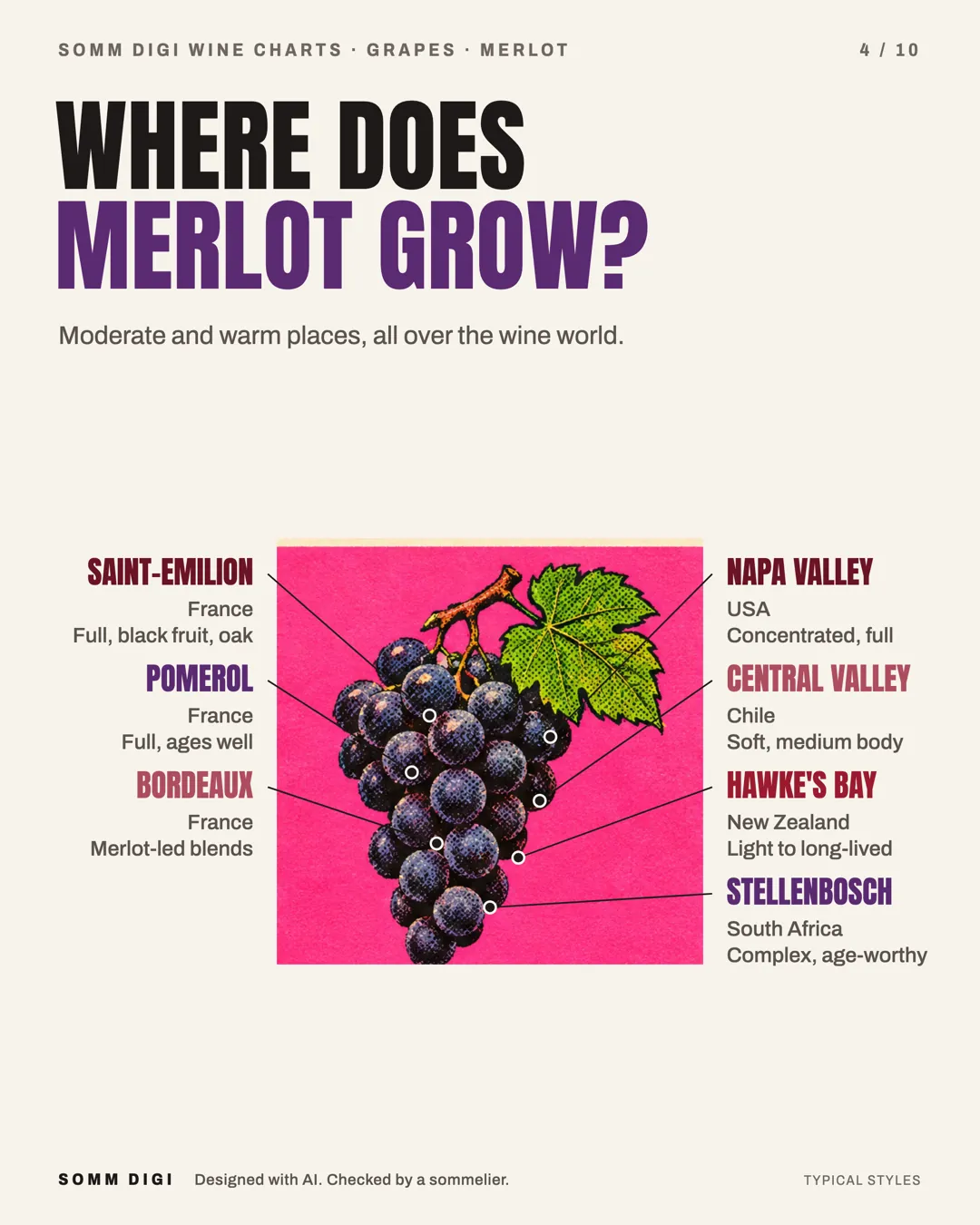
Merlot grows in moderate and warm places, all over the wine world. In France, Saint-Emilion is full, with black fruit and oak, and Pomerol is full and ages well. Wines labelled Bordeaux are Merlot-led blends.
In the USA, Napa Valley Merlot is concentrated and full. Chile's Central Valley makes soft, medium-bodied Merlot. Hawke's Bay, in New Zealand, runs from light to long-lived, and Stellenbosch, in South Africa, is complex and age-worthy. The regions chart shows all seven.
Saint-Emilion and Pomerol: Merlot's home
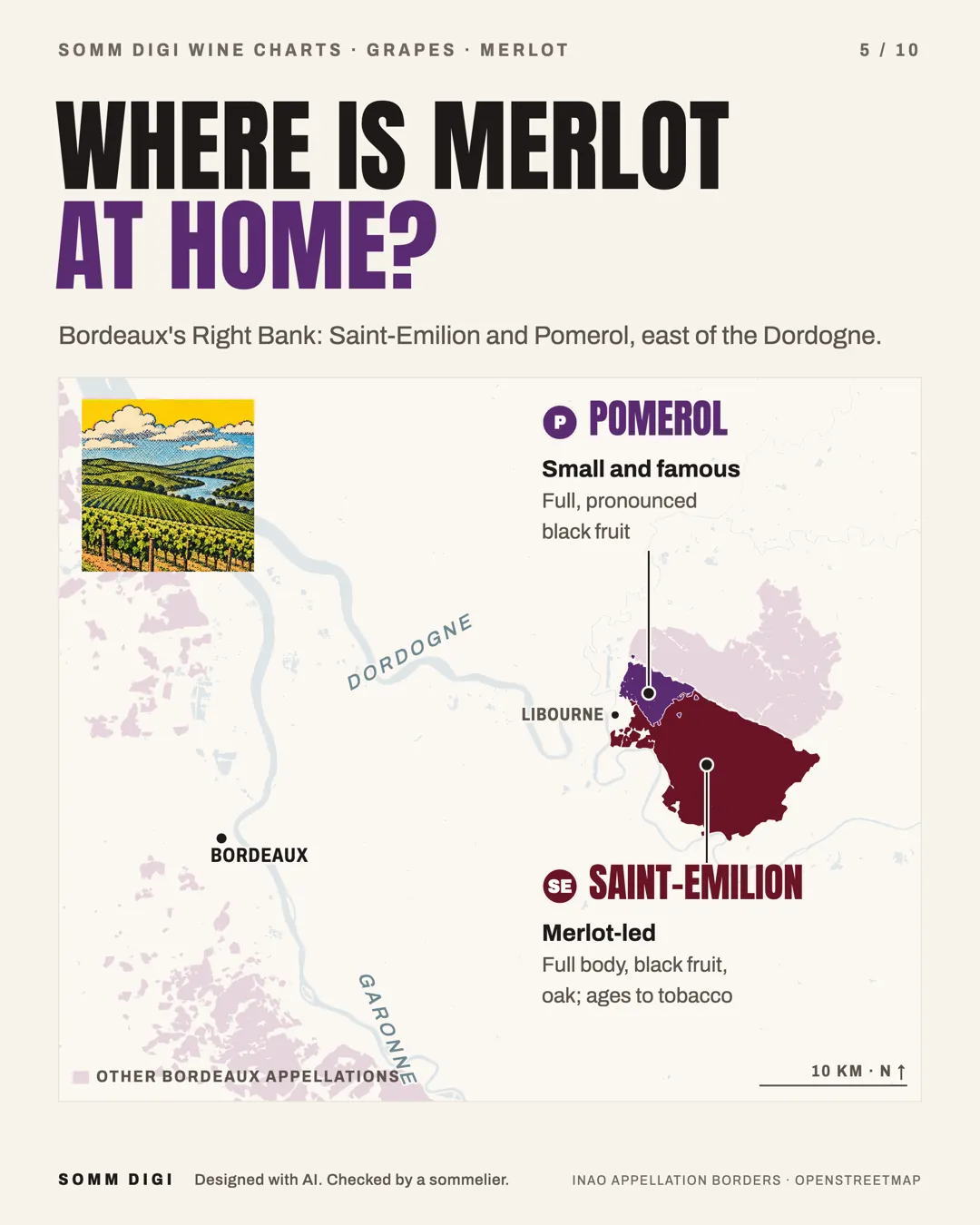
Merlot's home is Bordeaux's Right Bank: Saint-Emilion and Pomerol, east of the Dordogne.
Saint-Emilion is Merlot-led, with full body, black fruit and oak, and it ages to tobacco. Pomerol is small and famous: full, with pronounced black fruit. These two make the most famous Merlot-led wines. The map also shows Lalande-de-Pomerol and the Montagne, Lussac, Puisseguin and Saint-Georges Saint-Emilion names, with the Left Bank across the river.
How to find Merlot on a Bordeaux label
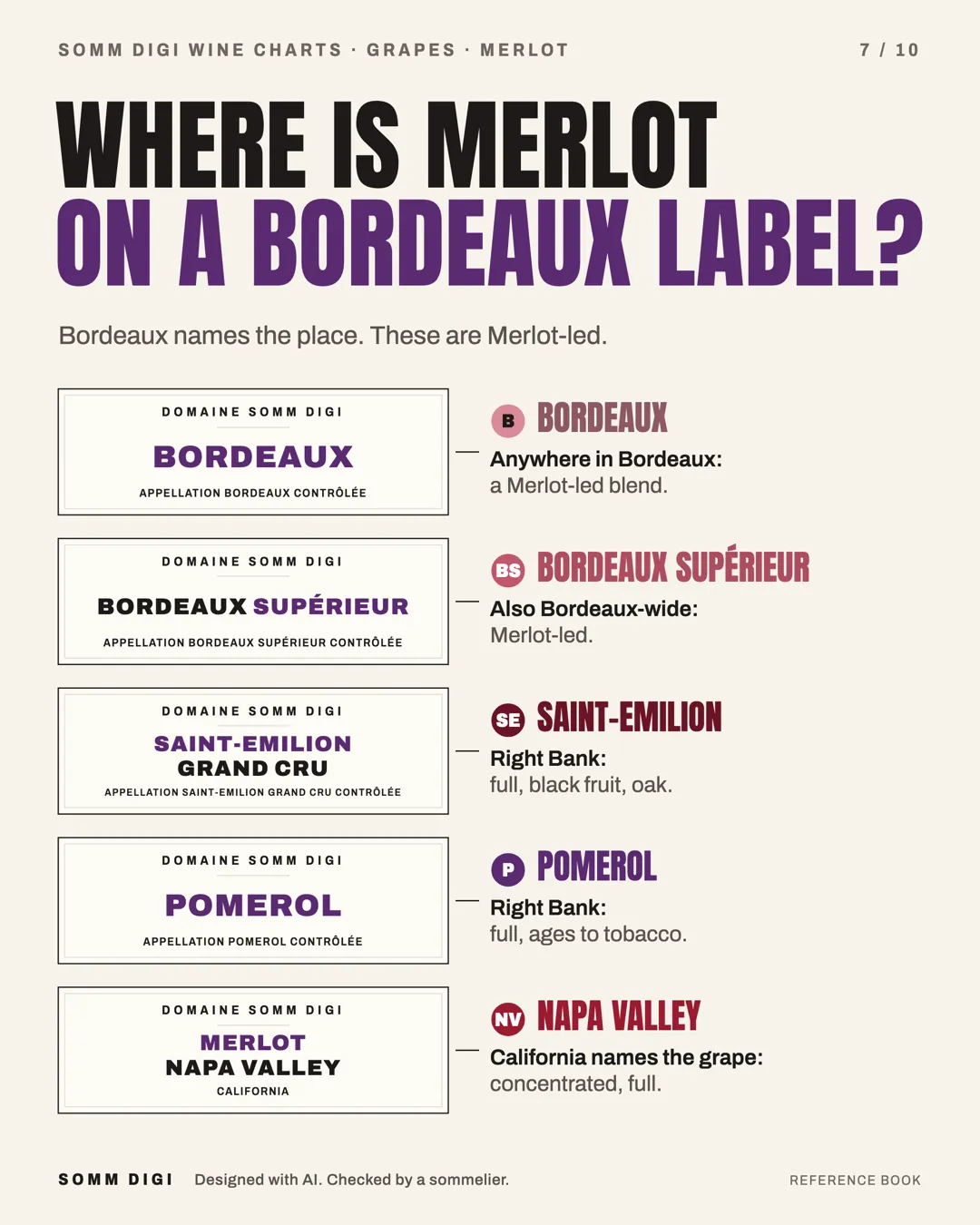
Bordeaux labels name the place, not the grape. These names tell you the wine is Merlot-led.
Bordeaux and Bordeaux Supérieur cover the whole region, and both are Merlot-led blends.
Saint-Emilion, on the Right Bank, is full, with black fruit and oak. Pomerol, also on the Right Bank, is full and ages to tobacco. California does it the other way: a Napa Valley label names the grape, for concentrated, full Merlot. The label chart has all five.
Which Merlot is for you?
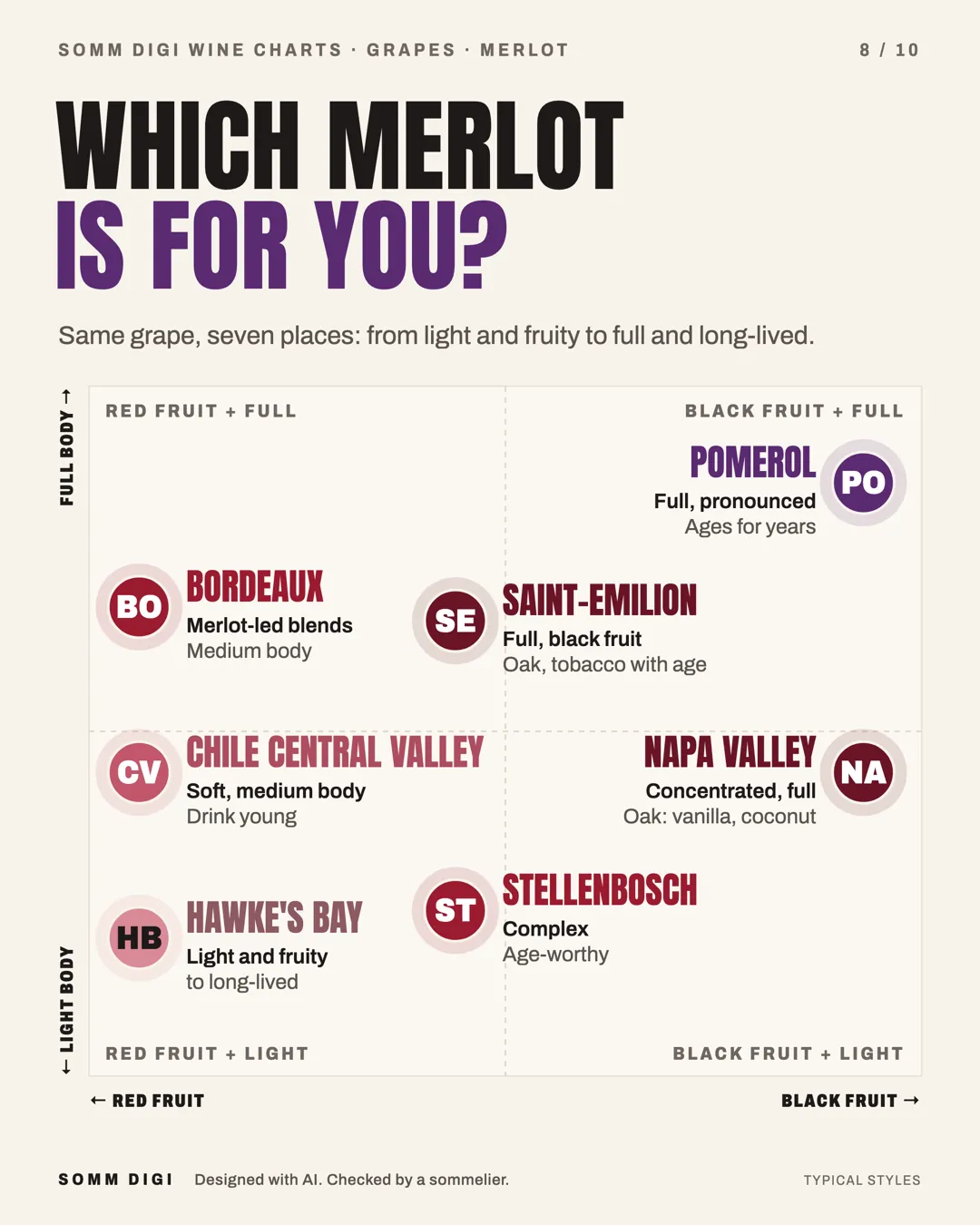
Same grape, seven places: from light and fruity to full and long-lived. Start with the style you like.
For soft and easy, choose Chile's Central Valley: medium body, made to drink young. Hawke's Bay runs from light and fruity to long-lived, and Bordeaux gives Merlot-led blends with medium body. Stellenbosch is complex and age-worthy.
For full and rich, Napa Valley is concentrated, with vanilla and coconut from oak. Saint-Emilion is full, with black fruit, oak and tobacco with age, and Pomerol is full and pronounced, ageing for years. The styles chart maps all seven.
Should Merlot be chilled?
Not like a white. Serve Merlot at 15–18 °C (59–64 °F), the same as Cabernet Sauvignon. A white like Pinot Grigio goes much colder, at 7–10 °C (45–50 °F).
Which glass?
A large red wine glass suits it. For a closer look at one shape, see the Bordeaux glass on universalwineglasses.com, SOMM DIGI's glass site.
Merlot food pairing
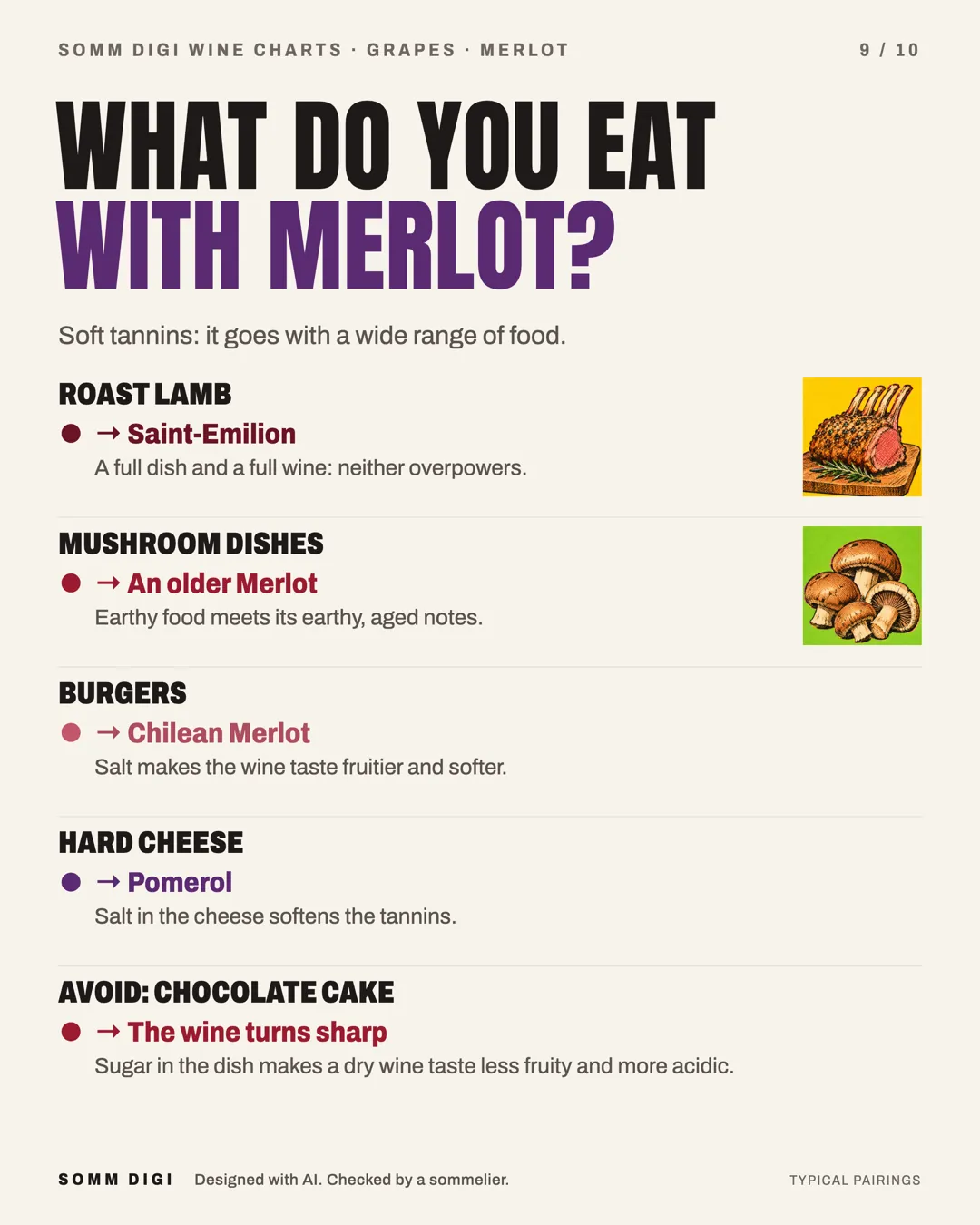
Soft tannins let Merlot go with a wide range of food, from roast lamb to burgers.
With roast lamb, pour a Saint-Emilion: a full dish and a full wine, so neither overpowers. With mushroom dishes, an older Merlot, because earthy food meets its earthy, aged notes. With burgers, a Chilean Merlot: salt makes the wine taste fruitier and softer.
Hard cheese loves Pomerol, as salt in the cheese softens the tannins. Skip chocolate cake: sugar makes a dry wine taste less fruity and more acidic, so the wine turns sharp. The pairing chart has all five.
Learn wine the easy way
Wine Easy
The wine book that talks to you like a human: grapes, tasting, pairing and countries A–Z, in 388 full-colour pages.
Merlot questions, answered
How do you pronounce Merlot?
mer-LOH.
Is Merlot sweet?
No. Merlot is a dry red. Its softness comes from medium tannins, not sugar.
What is the difference between Merlot and Cabernet Sauvignon?
Merlot is soft and plummy, with medium tannins. Cabernet Sauvignon is firm, with high tannin. In Bordeaux, Merlot softens Cabernet in the blend.
Where is Merlot from?
Bordeaux. It is the most widely planted grape there, and its home is the Right Bank: Saint-Emilion and Pomerol.
Does Merlot age well?
The top Merlot-led wines age for years and gain dried fruit and tobacco.
What do you eat with Merlot?
Roast lamb, mushroom dishes, burgers or hard cheese. Avoid chocolate cake.
Try next
If you like Merlot
How this page was made. Charts designed with AI and checked by Alper Billik, Advanced Sommelier. Text written from the same chart facts and edited with AI.