
Study and careerTasting & aromas
Where wine aromas come from
Why a wine can smell of lime, pepper, violets or vanilla: the three families of aromas, the compounds behind the famous ones, and how to train your nose.

Alper Billik · Advanced Sommelier
Updated October 2026 · 5 min read · Edited with AI
This article may contain affiliate links.
On this page
The short answer: wine contains hundreds of volatile compounds, molecules light enough to float from the glass to your nose. Many are the very same molecules found in fruit, flowers and spices, which is why a wine with no lime in it can smell of lime. They come from three places: the grape (primary), the winemaking (secondary) and time (tertiary).
Swirling helps: it spreads the wine over the glass, so more of these compounds evaporate. You smell them twice, once through the nose, and again from the back of the mouth as you taste. That second route is why aroma and flavour feel like one thing.
The three families: a wine's story
| Family | Comes from | Typical notes |
|---|---|---|
| Primary | The grape and where it grew | Fruit, flowers, herbs, pepper, green notes |
| Secondary | Fermentation and the cellar | Butter and cream (malolactic), bread dough (lees), banana (carbonic maceration), vanilla and toast (oak) |
| Tertiary | Age, in barrel and bottle | Leather, tobacco, forest floor, dried fruit; for whites honey, nuts, petrol |
- Primary
- Comes fromThe grape and where it grew
- Typical notesFruit, flowers, herbs, pepper, green notes
- Secondary
- Comes fromFermentation and the cellar
- Typical notesButter and cream (malolactic), bread dough (lees), banana (carbonic maceration), vanilla and toast (oak)
- Tertiary
- Comes fromAge, in barrel and bottle
- Typical notesLeather, tobacco, forest floor, dried fruit; for whites honey, nuts, petrol
Read a glass in that order and you are reading its life: the vineyard, the cellar, then the years. It is also the order of the sommelier's tasting grid. See how to taste step by step.
Primary aromas: the grape
- Terpenes (floral, grapey): linalool (orange blossom, lavender-like) and geraniol (rose) make Muscat, Gewürztraminer and Riesling so perfumed. Rose oxide gives Gewürztraminer its lychee note.
- Rotundone (black pepper): the peppery note of cool-climate Syrah and of Grüner Veltliner.
- Methoxypyrazines (green pepper, grass): the green streak of Sauvignon Blanc, Cabernet Sauvignon, Cabernet Franc and Carmenère. They fall as grapes ripen in the sun, so they are strongest in cool or shaded sites.
- Norisoprenoids: beta-ionone (violet), found in many reds, and beta-damascenone (cooked apple, rose, honey).
Secondary aromas: fermentation and the cellar
- Thiols (grapefruit, passion fruit, blackcurrant leaf): compounds such as 3MH and 4MMP sit in the grape as odourless precursors; yeast sets them free during fermentation. They are the signature of Sauvignon Blanc, above all from Marlborough.
- Esters (fruity): made by yeast. Isoamyl acetate smells of banana and pear drops: think young Beaujolais made by carbonic maceration.
- Diacetyl (butter): made during malolactic conversion, which turns sharp malic acid into softer lactic acid. Hence buttery Chardonnay. More in malolactic fermentation and Chardonnay.
- Lees: ageing on dead yeast gives bread dough, biscuit and brioche, as in Champagne and Muscadet sur lie.
- Oak: vanillin (vanilla), whisky lactone (coconut, stronger in American oak), eugenol (clove) and guaiacol (smoke, from toasted barrels).
Tertiary aromas: the gift of time
- Aged reds: fresh fruit turns to dried fruit, then leather, tobacco, mushroom and forest floor.
- Aged whites: honey, nuts, toast, chamomile. In aged Riesling, a compound called TDN brings the famous petrol note.
- Oxidative ageing: acetaldehyde gives bruised apple and nutty notes, the signature of fino sherry. In an unfortified table wine, too much of it is a fault.
When aromas go wrong
Some compounds are faults: TCA (wet cardboard), hydrogen sulfide (rotten egg), ethyl acetate and acetic acid (nail polish, vinegar), Brett's 4-ethylphenol (sticking plaster). The line is often about amount: a trace adds complexity, too much takes over. See wine faults explained.
What the aromas tell you
| You smell | It often means |
|---|---|
| Tart red fruit (cranberry, sour cherry) | A cooler climate or a high-acid grape such as Sangiovese |
| Jammy, baked fruit | A warm climate or very ripe grapes |
| Blackcurrant with green pepper | Cabernet Sauvignon or Cabernet Franc from a cooler site or year |
| Grapefruit and passion fruit | Sauvignon Blanc, often New Zealand |
| Rose and lychee | Gewürztraminer |
| Black pepper | Cool-climate Syrah, or Grüner Veltliner in a white |
| Petrol and honey | Aged Riesling |
| Butter and toast | Oaked Chardonnay with malolactic conversion |
- Tart red fruit (cranberry, sour cherry)
- It often meansA cooler climate or a high-acid grape such as Sangiovese
- Jammy, baked fruit
- It often meansA warm climate or very ripe grapes
- Blackcurrant with green pepper
- It often meansCabernet Sauvignon or Cabernet Franc from a cooler site or year
- Grapefruit and passion fruit
- It often meansSauvignon Blanc, often New Zealand
- Rose and lychee
- It often meansGewürztraminer
- Black pepper
- It often meansCool-climate Syrah, or Grüner Veltliner in a white
- Petrol and honey
- It often meansAged Riesling
- Butter and toast
- It often meansOaked Chardonnay with malolactic conversion
How to train your nose
- Smell the real thing. Lemons, green apples, black pepper, a rose, vanilla pods. Your memory of the fruit is your reference.
- Use the Wine Aroma Wheel, created by Ann C. Noble at UC Davis. It moves from broad words (fruity, spicy) to precise ones (strawberry, black pepper).
- Compare two wines at once. A Sauvignon Blanc next to a Chardonnay teaches more than either alone.
- Say it simply. "Fresh lemon and a little flint" is a perfect note. One smell at a time, like strawberry in wine, builds your library.
Quick quiz: aromas
Question 1
Which compound gives cool-climate Syrah its black pepper note?
- a)Linalool
- b)Rotundone
- c)Vanillin
- d)Diacetyl
Show answerAnswer
b) Rotundone. Rotundone is the black pepper compound, also found in Grüner Veltliner.
Question 2
Green bell pepper in Sauvignon Blanc and Cabernet comes from:
- a)Methoxypyrazines
- b)Esters
- c)Thiols
- d)Lactones
Show answerAnswer
a) Methoxypyrazines. Methoxypyrazines give green pepper and grassy notes.
Question 3
Butter in Chardonnay is mostly from:
- a)New oak
- b)Malolactic conversion
- c)Botrytis
- d)Carbonic maceration
Show answerAnswer
b) Malolactic conversion. Malolactic bacteria produce diacetyl, the buttery compound.
Question 4
The petrol note in aged Riesling is called:
- a)TCA
- b)TDN
- c)IBMP
- d)4MMP
Show answerAnswer
b) TDN. TDN develops with age and gives Riesling its petrol character.
Question 5
Brioche and bread dough in Champagne are which kind of aroma?
- a)Primary
- b)Secondary (lees)
- c)A fault
- d)Tertiary (oxidation)
Show answerAnswer
b) Secondary (lees). They come from ageing on the lees, the dead yeast, in the cellar.
Question 6
Coconut notes are strongest from:
- a)French oak
- b)American oak
- c)Stainless steel
- d)Concrete eggs
Show answerAnswer
b) American oak. American oak carries more whisky lactone, the coconut compound.
Questions people ask
Why does wine smell like fruit if there is no fruit in it?
Grapes, yeast and oak make many of the same aroma molecules found in other fruits, flowers and spices. Your nose recognises the molecule, so you smell lemon, rose or pepper.
What are primary, secondary and tertiary aromas?
Primary come from the grape, secondary from winemaking (fermentation, lees, malolactic, oak), and tertiary from ageing in barrel and bottle.
What is the difference between aroma and bouquet?
Traditionally, aroma means the smells of the grape and young wine, and bouquet the more complex smells that develop with age. Today many tasters simply say aroma for both.
How can I get better at smelling wine?
Smell real fruits and spices, use an aroma wheel or aroma cards, compare wines side by side, and keep short notes. Practice and memory matter more than a special nose.
Your exam kit
Where to study for your exam

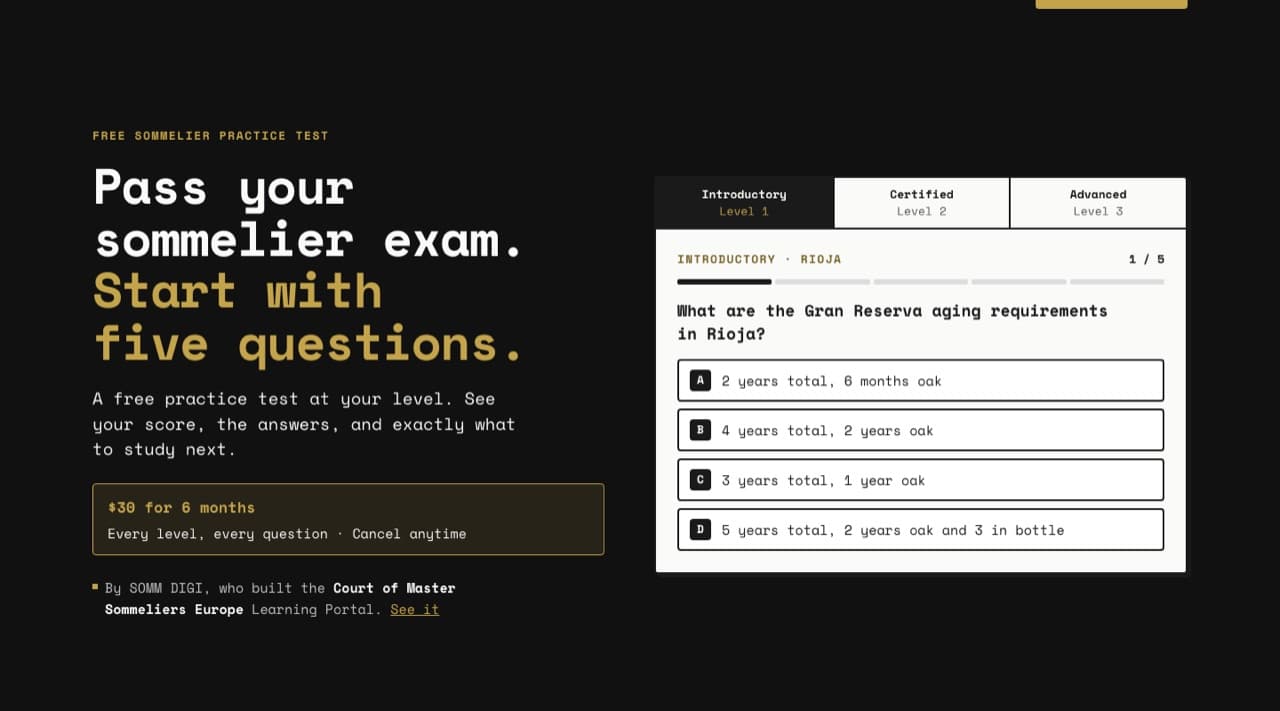
 My book · AmazonSommelier Prep BookQuick questions and answers for a break at work.Order on Amazon
 My book · AmazonSommelier Level 1 Prep BookLevel 1's key topics in one small book you can carry anywhere.Order on Amazon
SOMM DIGI built the Court of Master Sommeliers Europe’s Learning Portal, and SOMM DIGI AI. Who is behind this
For sommeliers · next steps