
Study and careerSparkling
Sparkling wine for the Level 1 sommelier exam
Traditional, tank and ancestral methods, Crémant, Prosecco, Franciacorta, Cava, Sekt and the New World, the label terms to know, and an eight-question quiz.

Alper Billik · Advanced Sommelier
Updated October 2026 · 5 min read · Edited with AI
This article may contain affiliate links.
On this page
The short answer: for Level 1, sparkling wine outside Champagne comes down to three methods and the wines that use them. Traditional method (second fermentation in the bottle): Crémant, Cava, Franciacorta, Cap Classique. Tank or Charmat method: Prosecco and Asti. Ancestral method (one fermentation finished in the bottle): pét-nat and a few French classics. Learn each wine's region, grapes and method, and the local words for "traditional method".
1. The three methods
- Traditional method (*méthode traditionnelle*): a still base wine gets sugar and yeast (liqueur de tirage) and ferments again in its own bottle. It ages on the lees, giving toast and brioche, then is riddled, disgorged and topped up with the dosage.
- Tank method (Charmat, or *metodo Martinotti* in Italy): the second fermentation happens in a sealed pressure tank, then the wine is filtered and bottled. Fresh, fruity, floral, made to drink young.
- Ancestral method: bottled before the first fermentation ends; the bubbles come from that one fermentation. See the ancestral method.
2. France beyond Champagne
- Crémant: traditional-method sparkling wine from other French regions, aged at least nine months on its lees. Crémant d'Alsace, de Bourgogne, de Loire, de Limoux, de Bordeaux, de Die, du Jura and de Savoie, plus Crémant de Luxembourg.
- Grapes follow the region: Pinot Blanc and Auxerrois in Alsace; Chardonnay and Pinot Noir in Burgundy; Chenin Blanc in the Loire.
- Limoux: Blanquette de Limoux (mostly Mauzac) and Crémant de Limoux; also a méthode ancestrale wine.
- Vouvray and Saumur: sparkling Chenin Blanc from the Loire.
More on one of them: Crémant de Bourgogne.
3. Italy
| Wine | Region | Grapes | Method | Style |
|---|---|---|---|---|
| Prosecco DOC | Veneto, Friuli Venezia Giulia | Glera | Tank | Light, pear, apple, flowers |
| Conegliano Valdobbiadene Prosecco Superiore DOCG | Veneto hills | Glera | Tank | Finer Prosecco |
| Franciacorta DOCG | Lombardy | Chardonnay, Pinot Nero, Pinot Bianco, Erbamat | Traditional | Rich, toasty; Satèn is the softer style |
| Asti DOCG | Piedmont | Moscato Bianco | Tank | Sweet, grapey, low alcohol |
| Lambrusco | Emilia-Romagna | Lambrusco varieties | Mostly tank | Red and frothy, dry (secco) to sweet |
| Trento DOC | Trentino | Chardonnay, Pinot Nero | Traditional | Mountain-fresh, toasty |
- Prosecco DOC
- RegionVeneto, Friuli Venezia Giulia
- GrapesGlera
- MethodTank
- StyleLight, pear, apple, flowers
- Conegliano Valdobbiadene Prosecco Superiore DOCG
- RegionVeneto hills
- GrapesGlera
- MethodTank
- StyleFiner Prosecco
- Franciacorta DOCG
- RegionLombardy
- GrapesChardonnay, Pinot Nero, Pinot Bianco, Erbamat
- MethodTraditional
- StyleRich, toasty; Satèn is the softer style
- Asti DOCG
- RegionPiedmont
- GrapesMoscato Bianco
- MethodTank
- StyleSweet, grapey, low alcohol
- Lambrusco
- RegionEmilia-Romagna
- GrapesLambrusco varieties
- MethodMostly tank
- StyleRed and frothy, dry (secco) to sweet
- Trento DOC
- RegionTrentino
- GrapesChardonnay, Pinot Nero
- MethodTraditional
- StyleMountain-fresh, toasty
Prosecco's sweetness terms confuse everyone: Brut is the driest, then Extra Dry, then Dry, which is sweeter still. More in Prosecco grapes, regions and styles and Franciacorta.
4. Spain, Germany, Austria and more
- Cava (Spain): traditional method, mostly from Penedès in Catalonia, from Macabeo, Xarel·lo and Parellada (Chardonnay and Pinot Noir allowed). At least nine months on the lees. Citrus, apple, a toasty edge.
- Sekt (Germany): made by tank or traditional method. Deutscher Sekt is from German grapes; Sekt b.A. comes from one of the quality regions, such as Mosel or Rheingau. Riesling and the Pinots are the best.
- Sekt (Austria): Austrian Sekt g.U. has three levels: Klassik, Reserve, Große Reserve, with Grüner Veltliner, Welschriesling, Riesling, Chardonnay and Pinot Noir.
- England: traditional-method sparkling wine from Chardonnay, Pinot Noir and Pinot Meunier on chalk and greensand in the south.
- Portugal and Hungary: Bairrada (Baga, traditional method) and Hungarian sparkling from Furmint and other local grapes.
5. The New World
- Australia: cool-climate traditional-method wines, with Tasmania the star; and Sparkling Shiraz, deep red, fruity and full, often with some sweetness.
- New Zealand: traditional-method Chardonnay and Pinot Noir, from Marlborough and other cool regions.
- United States: traditional-method wines from cool parts of California such as Carneros and Anderson Valley.
- South Africa: Cap Classique, the local name for traditional-method sparkling wine.
- South America: Brazil's sparkling wines from the Serra Gaúcha; see Mexico, Brazil and Uruguay.
6. Label words to know
| Term | Meaning |
|---|---|
| Méthode traditionnelle / classique | Traditional method (France) |
| Metodo Classico | Traditional method (Italy) |
| Cap Classique | Traditional method (South Africa) |
| Klassische Flaschengärung | Traditional bottle fermentation (Germany, Austria) |
| Spumante | Fully sparkling (Italy) |
| Frizzante | Lightly sparkling (Italy) |
| Crémant | Traditional-method sparkling wine from a French region outside Champagne |
| Brut Nature, Extra Brut, Brut | Bone dry to dry, by added sugar |
- Méthode traditionnelle / classique
- MeaningTraditional method (France)
- Metodo Classico
- MeaningTraditional method (Italy)
- Cap Classique
- MeaningTraditional method (South Africa)
- Klassische Flaschengärung
- MeaningTraditional bottle fermentation (Germany, Austria)
- Spumante
- MeaningFully sparkling (Italy)
- Frizzante
- MeaningLightly sparkling (Italy)
- Crémant
- MeaningTraditional-method sparkling wine from a French region outside Champagne
- Brut Nature, Extra Brut, Brut
- MeaningBone dry to dry, by added sugar
7. With food
- Prosecco: light starters, fresh fruit, salads.
- Cava: tapas, fried food, seafood.
- Franciacorta and Crémant: richer dishes, cream sauces, roast chicken.
- Asti: fruit tarts and light desserts.
- Sparkling Shiraz: barbecue and roast meats.
Quick quiz: sparkling wine for Level 1
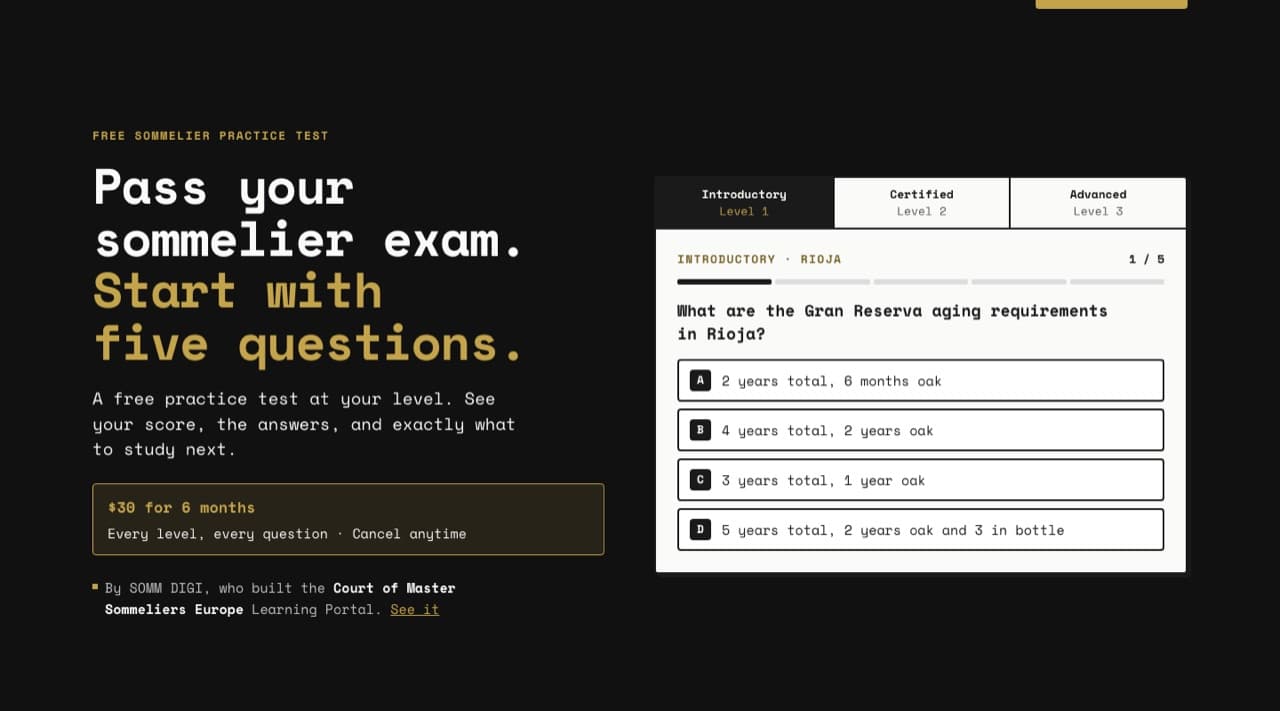
Level 1 practice test
Take it as a real test
8 questions, one at a time. The answer and why after each one, then your score and your weakest topics.
Question 1
Which sparkling wine is made by the tank (Charmat) method?
- a)Franciacorta
- b)Prosecco
- c)Cava
- d)Crémant de Loire
Show answerAnswer
b) Prosecco. Prosecco's second fermentation happens in a sealed tank.
Question 2
Is Franciacorta made by the same method as Champagne?
- a)Yes, traditional method
- b)No, tank method
- c)No, ancestral method
- d)No, it is still wine
Show answerAnswer
a) Yes, traditional method. Second fermentation in the bottle, then lees ageing.
Question 3
What is Prosecco's main grape?
- a)Moscato Bianco
- b)Glera
- c)Macabeo
- d)Garganega
Show answerAnswer
b) Glera. Glera, in Veneto and Friuli Venezia Giulia.
Question 4
Cava comes mostly from which region?
- a)Rioja
- b)Penedès, Catalonia
- c)Rías Baixas
- d)Jerez
Show answerAnswer
b) Penedès, Catalonia. Most Cava is made in Penedès, around Sant Sadurní d'Anoia.
Question 5
Which grapes are traditional in Cava?
- a)Macabeo, Xarel·lo, Parellada
- b)Glera, Verdiso, Bianchetta
- c)Mauzac, Chenin Blanc, Chardonnay
- d)Tempranillo, Garnacha, Graciano
Show answerAnswer
a) Macabeo, Xarel·lo, Parellada. The classic Cava trio.
Question 6
Asti DOCG comes from which Italian region?
- a)Lombardy
- b)Veneto
- c)Piedmont
- d)Emilia-Romagna
Show answerAnswer
c) Piedmont. Sweet, low-alcohol Moscato from Piedmont.
Question 7
What does Cap Classique mean?
- a)A sweet style
- b)Traditional method in South Africa
- c)A tank-method wine
- d)A sparkling red
Show answerAnswer
b) Traditional method in South Africa. South Africa's term for bottle-fermented sparkling wine.
Question 8
A guest wants something light, fruity and not too dry. Which do you suggest?
- a)Brut Nature Champagne
- b)Extra Dry Prosecco
- c)Extra Brut Cava
- d)Vintage Franciacorta
Show answerAnswer
b) Extra Dry Prosecco. Extra Dry Prosecco is fruity, with a touch of sweetness.
Next: Champagne vs sparkling wine and the sparkling wine quiz. For daily questions, SOMM DIGI AI has 3,000+ exam-prep questions.
Questions people ask
What sparkling wines do I need to know for Level 1, apart from Champagne?
Crémant, Cava, Prosecco, Franciacorta, Asti, Sekt, Cap Classique and the sparkling wines of Australia and New Zealand, each with its method, region and grapes.
What is the difference between Prosecco and Cava?
Prosecco is made from Glera in north-east Italy by the tank method; Cava is made mostly in Catalonia from Macabeo, Xarel·lo and Parellada by the traditional method.
Is Extra Dry sweeter than Brut?
Yes. Extra Dry has more sugar than Brut, and Dry has more again.
What is Crémant?
Traditional-method sparkling wine from a French region outside Champagne, such as Alsace, Burgundy or the Loire, aged at least nine months on its lees.
Your exam kit
Where to study for your exam

 My book · AmazonSommelier Level 1 Prep BookLevel 1's key topics in one small book you can carry anywhere.Order on Amazon
 My book · AmazonSommelier Prep BookQuick questions and answers for a break at work.Order on Amazon
SOMM DIGI built the Court of Master Sommeliers Europe’s Learning Portal, and SOMM DIGI AI. Who is behind this
For sommeliers · next steps