
Study and careerRhône
The Rhône for the Level 1 sommelier exam
A one-page Rhône study sheet that follows the Court's Level 1 syllabus: climate, north and south, grapes, blends, styles, appellations, label terms and vins doux naturels, then an eight-question quiz.

Alper Billik · Advanced Sommelier
Updated October 2026 · 7 min read · Edited with AI
This article may contain affiliate links.
On this page
The short answer: for Level 1, the Rhône is two regions under one name. The north is narrow, steep and makes Syrah and a few white grapes, mostly on their own. The south is wide and warm and makes blends, led by Grenache. Learn the crus of each half, the Côtes du Rhône ladder and the two sweet vins doux naturels, and you have the exam covered. This sheet follows the Court of Master Sommeliers' Introductory syllabus for the Rhône, heading by heading.
1. Climatic influences
- Northern Rhône: moderate continental climate: cold winters, warm summers. Vines grow on steep slopes above the river, often terraced, which catch the sun and drain well.
- Southern Rhône: Mediterranean: hot, dry summers, mild winters, lots of sun. The land opens out into plains, terraces and low hills.
- The mistral: a strong, cold wind from the north that blows down the valley. It dries the vines after rain and keeps rot away in both halves; in the south it also tempers the heat.
- Stones and soils: granite and schist in the north; in the south a mix of clay, limestone, sand and the famous galets roulés, big rounded river stones found in parts of Châteauneuf-du-Pape.
2. Districts and sub-districts
- Northern Rhône: from just south of Vienne to Valence. Eight crus, north to south: Côte-Rôtie, Condrieu, Château-Grillet, Saint-Joseph, Crozes-Hermitage, Hermitage, Cornas, Saint-Péray.
- Southern Rhône: from Montélimar to below Avignon. The crus: Châteauneuf-du-Pape, Gigondas, Vacqueyras, Vinsobres, Rasteau, Cairanne, Beaumes-de-Venise, Lirac, Tavel and, since 2024, Laudun.
- Across both: the regional Côtes du Rhône and Côtes du Rhône Villages. Around the south sit other Rhône appellations such as Ventoux, Luberon, Costières de Nîmes and Grignan-les-Adhémar; in the side valley of the Drôme, the sparkling Clairette de Die.
3. Principal grapes and their wines
| Grape | Colour | Where and what |
|---|---|---|
| Syrah | Red | The only red grape of the north: Côte-Rôtie, Hermitage, Crozes-Hermitage, Saint-Joseph, Cornas. A partner in southern blends. |
| Grenache | Red | The lead grape of the south: Châteauneuf-du-Pape, Gigondas, Vacqueyras, Côtes du Rhône, Tavel rosé |
| Mourvèdre | Red | A southern blending grape for structure |
| Cinsault, Carignan | Red | Southern blends and rosé |
| Viognier | White | Condrieu and Château-Grillet, alone; a little in Côte-Rôtie |
| Marsanne, Roussanne | White | White Hermitage, Crozes-Hermitage, Saint-Joseph, Saint-Péray; southern whites |
| Grenache Blanc, Clairette, Bourboulenc | White | Southern whites, including white Châteauneuf-du-Pape |
| Muscat à Petits Grains | White | Muscat de Beaumes-de-Venise; Clairette de Die Tradition |
- Syrah
- ColourRed
- Where and whatThe only red grape of the north: Côte-Rôtie, Hermitage, Crozes-Hermitage, Saint-Joseph, Cornas. A partner in southern blends.
- Grenache
- ColourRed
- Where and whatThe lead grape of the south: Châteauneuf-du-Pape, Gigondas, Vacqueyras, Côtes du Rhône, Tavel rosé
- Mourvèdre
- ColourRed
- Where and whatA southern blending grape for structure
- Cinsault, Carignan
- ColourRed
- Where and whatSouthern blends and rosé
- Viognier
- ColourWhite
- Where and whatCondrieu and Château-Grillet, alone; a little in Côte-Rôtie
- Marsanne, Roussanne
- ColourWhite
- Where and whatWhite Hermitage, Crozes-Hermitage, Saint-Joseph, Saint-Péray; southern whites
- Grenache Blanc, Clairette, Bourboulenc
- ColourWhite
- Where and whatSouthern whites, including white Châteauneuf-du-Pape
- Muscat à Petits Grains
- ColourWhite
- Where and whatMuscat de Beaumes-de-Venise; Clairette de Die Tradition
4. Blends of the southern Rhône
- GSM: Grenache, Syrah, Mourvèdre, the classic southern red blend, often with Cinsault or Carignan.
- Grenache brings body, warmth (alcohol) and red fruit.
- Syrah brings colour, dark fruit and pepper.
- Mourvèdre brings tannin, dark, savoury depth and helps the wine age.
- Châteauneuf-du-Pape allows 13 grape varieties, red and white, in its wines. Most are Grenache-led.
5. Styles of wine
- Northern reds: Syrah with black fruit, black pepper, olive, smoked meat and violet. Côte-Rôtie may co-ferment up to 20% Viognier for perfume; Hermitage and Crozes-Hermitage may add up to 15%, Saint-Joseph up to 10%, of Marsanne and Roussanne; Cornas is Syrah alone.
- Northern whites: Condrieu, rich, perfumed Viognier (apricot, peach, blossom); white Hermitage, broad and nutty Marsanne and Roussanne that ages.
- Southern reds: ripe, warm, spicy blends with herbs of the garrigue.
- Rosé: Tavel, a dry, deeply coloured rosé, and the only Rhône cru that makes rosé alone.
- Sparkling: Saint-Péray (also still) and Clairette de Die.
- Sweet: the vins doux naturels of Rasteau and Muscat de Beaumes-de-Venise (see section 8).
6. Principal AOPs
| Appellation | Half | Colour | Grape to say first |
|---|---|---|---|
| Côte-Rôtie | North | Red | Syrah (with up to 20% Viognier) |
| Condrieu | North | White | Viognier |
| Hermitage | North | Red and white | Syrah; Marsanne and Roussanne |
| Crozes-Hermitage | North | Red and white | Syrah; Marsanne and Roussanne |
| Cornas | North | Red | Syrah only |
| Châteauneuf-du-Pape | South | Red and white | Grenache-led blend |
| Gigondas | South | Red and rosé (white from 2023) | Grenache |
| Vacqueyras | South | Red, white, rosé | Grenache |
| Tavel | South | Rosé only | Grenache |
| Lirac | South | Red, white, rosé | Grenache |
- Côte-Rôtie
- HalfNorth
- ColourRed
- Grape to say firstSyrah (with up to 20% Viognier)
- Condrieu
- HalfNorth
- ColourWhite
- Grape to say firstViognier
- Hermitage
- HalfNorth
- ColourRed and white
- Grape to say firstSyrah; Marsanne and Roussanne
- Crozes-Hermitage
- HalfNorth
- ColourRed and white
- Grape to say firstSyrah; Marsanne and Roussanne
- Cornas
- HalfNorth
- ColourRed
- Grape to say firstSyrah only
- Châteauneuf-du-Pape
- HalfSouth
- ColourRed and white
- Grape to say firstGrenache-led blend
- Gigondas
- HalfSouth
- ColourRed and rosé (white from 2023)
- Grape to say firstGrenache
- Vacqueyras
- HalfSouth
- ColourRed, white, rosé
- Grape to say firstGrenache
- Tavel
- HalfSouth
- ColourRosé only
- Grape to say firstGrenache
- Lirac
- HalfSouth
- ColourRed, white, rosé
- Grape to say firstGrenache
7. Labelling terms
- Côtes du Rhône: the regional appellation, the broad base of the pyramid.
- Côtes du Rhône Villages: from a smaller set of villages, with stricter rules.
- Côtes du Rhône Villages + village name: for example Séguret or Sablet; one step closer to the top.
- Cru: the top tier, each with its own appellation. The label shows only the cru's name (Gigondas, Hermitage), not Côtes du Rhône.
- Vin doux naturel (VDN): a sweet, fortified wine; see below.
8. VDN and VDL production
- Vin doux naturel (VDN): the grapes start fermenting, then neutral grape spirit is added (mutage). The yeast stops, so natural grape sugar stays in the wine, which is sweet and higher in alcohol.
- Rhône VDNs: Muscat de Beaumes-de-Venise (white Muscat à Petits Grains, fresh, floral, grapey) and Rasteau (Grenache-based; Rasteau also makes dry red under the same cru).
- Vin de liqueur (VDL): the spirit is added to grape juice before it ferments, or at its very start. Classic French examples are Pineau des Charentes, Floc de Gascogne and Macvin du Jura.
- The one-line difference: VDN = spirit added during fermentation; VDL = spirit added before.
How to study the Rhône
- Draw a line from Vienne to Avignon. Put the eight northern crus in order at the top, the southern crus around Orange and Avignon at the bottom.
- North = one grape, south = a blend. Then learn the exceptions: the Viognier in Côte-Rôtie, the white grapes allowed in Hermitage, the 13 grapes of Châteauneuf.
- Learn the colours: Tavel is rosé only, Condrieu white only, Cornas red only.
- Taste three: a Crozes-Hermitage, a Côtes du Rhône and a Muscat de Beaumes-de-Venise. Then take the quiz below and my Level 1 practice test.
Quick quiz: the Rhône for Level 1
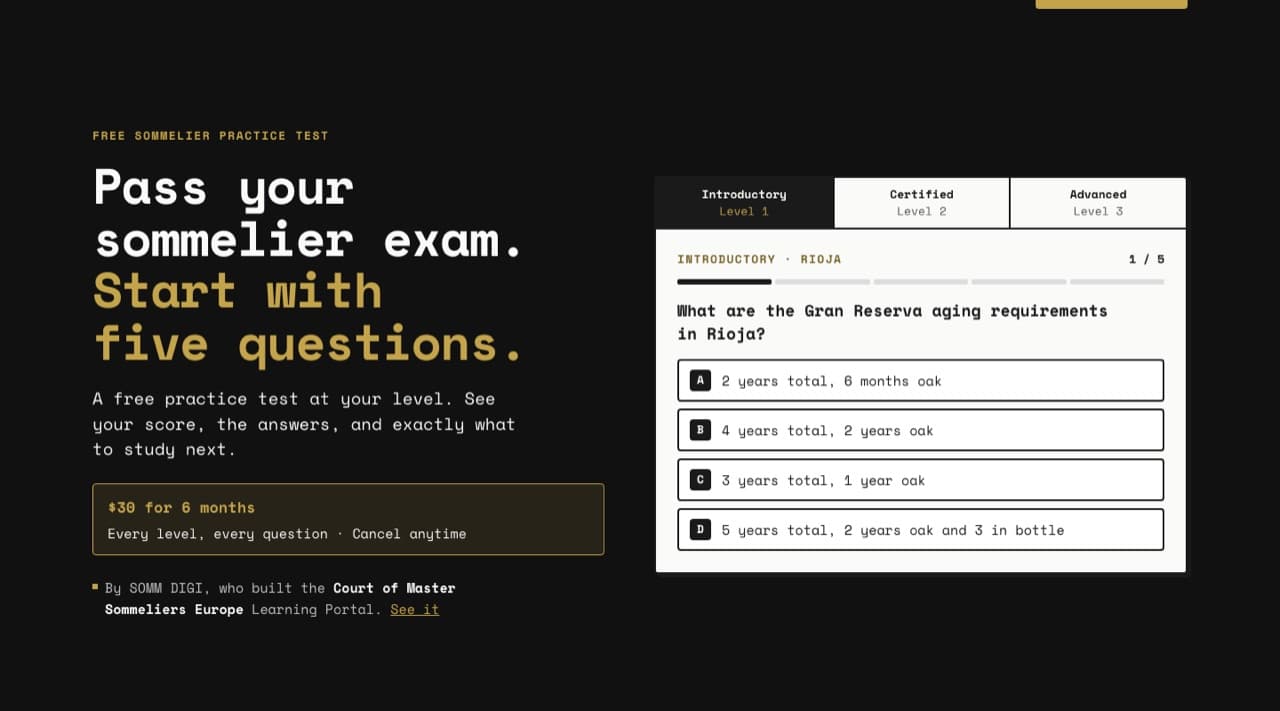
Level 1 practice test
Take it as a real test
8 questions, one at a time. The answer and why after each one, then your score and your weakest topics.
Question 1
What is the only red grape of the northern Rhône?
- a)Grenache
- b)Syrah
- c)Mourvèdre
- d)Pinot Noir
Show answerAnswer
b) Syrah. Syrah alone makes the red wines of Côte-Rôtie, Hermitage, Crozes-Hermitage, Saint-Joseph and Cornas.
Question 2
Condrieu is made from which grape?
- a)Marsanne
- b)Roussanne
- c)Viognier
- d)Clairette
Show answerAnswer
c) Viognier. Condrieu is white wine from Viognier alone.
Question 3
Which Rhône cru makes only rosé?
- a)Lirac
- b)Tavel
- c)Gigondas
- d)Vacqueyras
Show answerAnswer
b) Tavel. Tavel is a rosé-only appellation; Lirac, its neighbour, makes all three colours.
Question 4
Which grape leads most southern Rhône red blends?
- a)Syrah
- b)Carignan
- c)Grenache
- d)Cinsault
Show answerAnswer
c) Grenache. Grenache is the backbone of Châteauneuf-du-Pape, Gigondas and Côtes du Rhône.
Question 5
Which northern Rhône red may include up to 20% Viognier?
- a)Cornas
- b)Hermitage
- c)Côte-Rôtie
- d)Saint-Joseph
Show answerAnswer
c) Côte-Rôtie. Côte-Rôtie may co-ferment Syrah with Viognier; Cornas allows no white grapes.
Question 6
How is a vin doux naturel made?
- a)By drying the grapes on straw mats
- b)By adding grape spirit during fermentation
- c)By adding sugar before bottling
- d)By freezing the grapes on the vine
Show answerAnswer
b) By adding grape spirit during fermentation. Mutage stops the fermentation and keeps natural sugar in the wine.
Question 7
Muscat de Beaumes-de-Venise is best described as:
- a)A dry red
- b)A sweet, fortified white
- c)A sparkling rosé
- d)A dry white
Show answerAnswer
b) A sweet, fortified white. It is a vin doux naturel from Muscat à Petits Grains.
Question 8
Which is the top tier of the Rhône's appellation ladder?
- a)Côtes du Rhône
- b)Côtes du Rhône Villages
- c)Côtes du Rhône Villages with a village name
- d)The crus, such as Hermitage and Gigondas
Show answerAnswer
d) The crus, such as Hermitage and Gigondas. The crus sit above the three Côtes du Rhône levels and carry only their own name.
Ready for more? The Rhône for the Certified exam adds the great sites and estates; the Dentelles de Montmirail explains Gigondas; fortified wines for Level 1 puts the VDNs next to Port and Sherry. For daily questions on every region, SOMM DIGI AI has 3,000+ exam-prep questions.
Questions people ask
What do I need to know about the Rhône for the Level 1 sommelier exam?
The difference between north and south, the crus of each half, the main grapes and which wines they make, the southern blends, the Côtes du Rhône ladder, and how a vin doux naturel is made.
What is the difference between the northern and southern Rhône?
The north is continental and steep and makes Syrah reds and Viognier, Marsanne and Roussanne whites. The south is Mediterranean and makes Grenache-led blends, plus Tavel rosé and sweet Muscat.
How many grapes are allowed in Châteauneuf-du-Pape?
Thirteen varieties, red and white. Most wines are led by Grenache.
How many crus does the Rhône have?
Eighteen since Laudun was approved in 2024: eight in the north and ten in the south.
Your exam kit
Where to study for your exam

 My book · AmazonSommelier Level 1 Prep BookLevel 1's key topics in one small book you can carry anywhere.Order on Amazon
 My book · AmazonSommelier Prep BookQuick questions and answers for a break at work.Order on Amazon
SOMM DIGI built the Court of Master Sommeliers Europe’s Learning Portal, and SOMM DIGI AI. Who is behind this
For sommeliers · next steps