
Study and careerRhône
The Rhône for the Certified Sommelier exam
The northern sites, the southern crus and their colours, the estates of Châteauneuf-du-Pape and the sweet wines: the Rhône as the Court's Certified syllabus asks for it, with a quiz.

Alper Billik · Advanced Sommelier
Updated October 2026 · 6 min read · Edited with AI
This article may contain affiliate links.
On this page
The short answer: at Certified level the Rhône questions go one step past north versus south. You need the northern crus in order with their sites and producers, every southern cru with the colours it may make, the great estates of Châteauneuf-du-Pape, and the sweet wines. If the basics are shaky, start with the Rhône for Level 1.
The northern Rhône, north to south
| Cru | Wines | Rules to know | Producers |
|---|---|---|---|
| Côte-Rôtie | Red | Syrah, up to 20% Viognier co-fermented | E. Guigal, Jamet, René Rostaing |
| Condrieu | White | Viognier only | Georges Vernay, Yves Cuilleron |
| Château-Grillet | White | Viognier; a single-estate appellation | Château-Grillet |
| Saint-Joseph | Red and white | Syrah, up to 10% Marsanne and Roussanne | Gonon, Jean-Louis Chave |
| Crozes-Hermitage | Red and white | Syrah, up to 15% Marsanne and Roussanne; the biggest northern cru | Alain Graillot, Domaine Combier |
| Hermitage | Red and white | Syrah, up to 15% Marsanne and Roussanne; white from Marsanne and Roussanne | Jean-Louis Chave, M. Chapoutier, Paul Jaboulet Aîné |
| Cornas | Red | Syrah only | Auguste Clape, Thierry Allemand |
| Saint-Péray | White, still and sparkling | Marsanne and Roussanne | Alain Voge |
- Côte-Rôtie
- WinesRed
- Rules to knowSyrah, up to 20% Viognier co-fermented
- ProducersE. Guigal, Jamet, René Rostaing
- Condrieu
- WinesWhite
- Rules to knowViognier only
- ProducersGeorges Vernay, Yves Cuilleron
- Château-Grillet
- WinesWhite
- Rules to knowViognier; a single-estate appellation
- ProducersChâteau-Grillet
- Saint-Joseph
- WinesRed and white
- Rules to knowSyrah, up to 10% Marsanne and Roussanne
- ProducersGonon, Jean-Louis Chave
- Crozes-Hermitage
- WinesRed and white
- Rules to knowSyrah, up to 15% Marsanne and Roussanne; the biggest northern cru
- ProducersAlain Graillot, Domaine Combier
- Hermitage
- WinesRed and white
- Rules to knowSyrah, up to 15% Marsanne and Roussanne; white from Marsanne and Roussanne
- ProducersJean-Louis Chave, M. Chapoutier, Paul Jaboulet Aîné
- Cornas
- WinesRed
- Rules to knowSyrah only
- ProducersAuguste Clape, Thierry Allemand
- Saint-Péray
- WinesWhite, still and sparkling
- Rules to knowMarsanne and Roussanne
- ProducersAlain Voge
The principal northern sites
- Côte-Rôtie: terraced slopes facing south-east over the river at Ampuis. The two halves are the Côte Brune (darker, firmer wines) and the Côte Blonde (lighter soils, softer wines).
- Guigal's "La-La"s: La Mouline from the Côte Blonde; La Landonne and La Turque from the Côte Brune. They are single-site wines, not appellations.
- Hermitage: one south-facing hill above Tain-l'Hermitage, granite on its western end. Its named sites (lieux-dits) include Les Bessards, Le Méal, L'Hermite and Les Greffieux; most great Hermitage blends several of them.
- Hermitage La Chapelle (Paul Jaboulet Aîné) is named after the small chapel on top of the hill, not after a vineyard.
- Vin de paille: a little sweet Hermitage is made from grapes dried on straw, a rarity worth knowing for service.
The southern Rhône crus and their colours
| Cru | Colours | Style | Producers |
|---|---|---|---|
| Châteauneuf-du-Pape | Red, white | Full, warm, Grenache-led; 13 grapes allowed | See the estates below |
| Gigondas | Red, rosé; white from 2023 | Firm, herbal Grenache under the Dentelles | Château de Saint Cosme, Domaine Santa Duc |
| Vacqueyras | Red, white, rosé | Grenache-led, a touch rounder than Gigondas | Domaine Le Sang des Cailloux, Montirius |
| Vinsobres | Red | Grenache with Syrah, from the cooler north of the south | Domaine Jaume |
| Rasteau | Dry red; sweet VDN | Ripe Grenache; fortified Grenache | Domaine La Soumade |
| Cairanne | Red, white | Cru since 2016 | Domaine Marcel Richaud |
| Beaumes-de-Venise | Red | Dry reds from the foot of the Dentelles | Domaine de Durban |
| Muscat de Beaumes-de-Venise | Sweet white VDN | Muscat à Petits Grains | Domaine de Durban |
| Lirac | Red, white, rosé | Across the river from Châteauneuf | Domaine de la Mordorée |
| Tavel | Rosé only | Dry, deep and gastronomic | Château d'Aquéria, Domaine de la Mordorée |
| Laudun | Red, white | Cru from the 2024 vintage | Too new to have a canon |
- Châteauneuf-du-Pape
- ColoursRed, white
- StyleFull, warm, Grenache-led; 13 grapes allowed
- ProducersSee the estates below
- Gigondas
- ColoursRed, rosé; white from 2023
- StyleFirm, herbal Grenache under the Dentelles
- ProducersChâteau de Saint Cosme, Domaine Santa Duc
- Vacqueyras
- ColoursRed, white, rosé
- StyleGrenache-led, a touch rounder than Gigondas
- ProducersDomaine Le Sang des Cailloux, Montirius
- Vinsobres
- ColoursRed
- StyleGrenache with Syrah, from the cooler north of the south
- ProducersDomaine Jaume
- Rasteau
- ColoursDry red; sweet VDN
- StyleRipe Grenache; fortified Grenache
- ProducersDomaine La Soumade
- Cairanne
- ColoursRed, white
- StyleCru since 2016
- ProducersDomaine Marcel Richaud
- Beaumes-de-Venise
- ColoursRed
- StyleDry reds from the foot of the Dentelles
- ProducersDomaine de Durban
- Muscat de Beaumes-de-Venise
- ColoursSweet white VDN
- StyleMuscat à Petits Grains
- ProducersDomaine de Durban
- Lirac
- ColoursRed, white, rosé
- StyleAcross the river from Châteauneuf
- ProducersDomaine de la Mordorée
- Tavel
- ColoursRosé only
- StyleDry, deep and gastronomic
- ProducersChâteau d'Aquéria, Domaine de la Mordorée
- Laudun
- ColoursRed, white
- StyleCru from the 2024 vintage
- ProducersToo new to have a canon
The principal estates of Châteauneuf-du-Pape
- Château Rayas: almost pure Grenache from sandy soils; the most perfumed, least typical great Châteauneuf.
- Château de Beaucastel (Perrin family): known for a high share of Mourvèdre and for using the full range of permitted grapes.
- Domaine du Vieux Télégraphe (Brunier family): from the stony La Crau plateau, covered in galets roulés.
- Clos des Papes (Avril family), Château La Nerthe, Domaine du Pégau and Henri Bonneau: classic names a guest may ask for.
- Why it matters: Châteauneuf-du-Pape was among the first French AOCs, recognised on 15 May 1936. Baron Le Roy, of Château Fortia, led the growers' fight for its rules and later became the first president of the INAO.
VDN and VDL of the Rhône
- Muscat de Beaumes-de-Venise: VDN from Muscat à Petits Grains, mostly white, fresh and floral. Serve chilled.
- Rasteau VDN: Grenache-based, fortified during fermentation, made in several colours and styles.
- How a VDN is made: mutage, adding neutral grape spirit while the must is fermenting, keeps natural sugar in the wine.
- VDL (vin de liqueur): spirit added before fermentation. Know the definition and the classic French examples (Pineau des Charentes, Macvin du Jura) even though the Rhône's sweet wines are VDNs.
The appellation ladder and the law
- Côtes du Rhône: regional AOP, north and south, mostly southern Grenache blends.
- Côtes du Rhône Villages: stricter rules, from a defined list of villages.
- Côtes du Rhône Villages + village name: for example Séguret, Sablet or Plan de Dieu. Villages that prove themselves can be promoted to cru, as Rasteau, Cairanne and Laudun were.
- Crus: eighteen communal appellations, eight in the north and ten in the south.
Classic pairings for service
- Northern Syrah (Hermitage, Cornas, Côte-Rôtie): lamb, duck, venison, mushrooms.
- Southern blends (Châteauneuf, Gigondas): grilled meats, daube, ratatouille.
- Condrieu: lobster, scallops, creamy sauces, mildly spiced dishes.
- Tavel: Provençal food, grilled fish, charcuterie, a tagine.
- Muscat de Beaumes-de-Venise: fruit tarts, melon, blue cheese.
Quick quiz: the Rhône for Certified
Certified practice test
Take it as a real test
8 questions, one at a time. The answer and why after each one, then your score and your weakest topics.
Question 1
Which two Côte-Rôtie hillsides are traditionally named?
- a)Côte d'Or and Côte de Nuits
- b)Côte Brune and Côte Blonde
- c)Côte Rouge and Côte Blanche
- d)Les Bessards and Le Méal
Show answerAnswer
b) Côte Brune and Côte Blonde. Côte Brune and Côte Blonde; Les Bessards and Le Méal are on the hill of Hermitage.
Question 2
Which northern Rhône cru allows no white grapes in its red?
- a)Hermitage
- b)Saint-Joseph
- c)Crozes-Hermitage
- d)Cornas
Show answerAnswer
d) Cornas. Cornas is Syrah alone.
Question 3
Château-Grillet is:
- a)A sweet Muscat
- b)A single-estate Viognier appellation
- c)A Châteauneuf-du-Pape estate
- d)A Syrah lieu-dit in Hermitage
Show answerAnswer
b) A single-estate Viognier appellation. It is a tiny white-wine appellation owned by one estate.
Question 4
Which southern cru makes red wine only?
- a)Vacqueyras
- b)Lirac
- c)Vinsobres
- d)Gigondas
Show answerAnswer
c) Vinsobres. Vinsobres is red only; the others also make white or rosé.
Question 5
Which Châteauneuf-du-Pape estate is known for almost pure Grenache from sandy soils?
- a)Château de Beaucastel
- b)Château Rayas
- c)Vieux Télégraphe
- d)Château La Nerthe
Show answerAnswer
b) Château Rayas. Rayas is the classic sandy-soil Grenache estate.
Question 6
Rasteau makes:
- a)Only sweet VDN
- b)Dry red and a Grenache VDN
- c)Only white wine
- d)Only rosé
Show answerAnswer
b) Dry red and a Grenache VDN. Rasteau is a cru for dry red and also a VDN appellation.
Question 7
Which became the Rhône's eighteenth cru in 2024?
- a)Cairanne
- b)Séguret
- c)Laudun
- d)Plan de Dieu
Show answerAnswer
c) Laudun. Laudun, on the west bank, for red and white wines from the 2024 vintage.
Question 8
What is the difference between a VDN and a VDL?
- a)VDN is sparkling, VDL still
- b)VDN spirit is added during fermentation, VDL spirit before it
- c)VDN is red, VDL white
- d)There is none
Show answerAnswer
b) VDN spirit is added during fermentation, VDL spirit before it. Timing of the spirit is the whole difference.
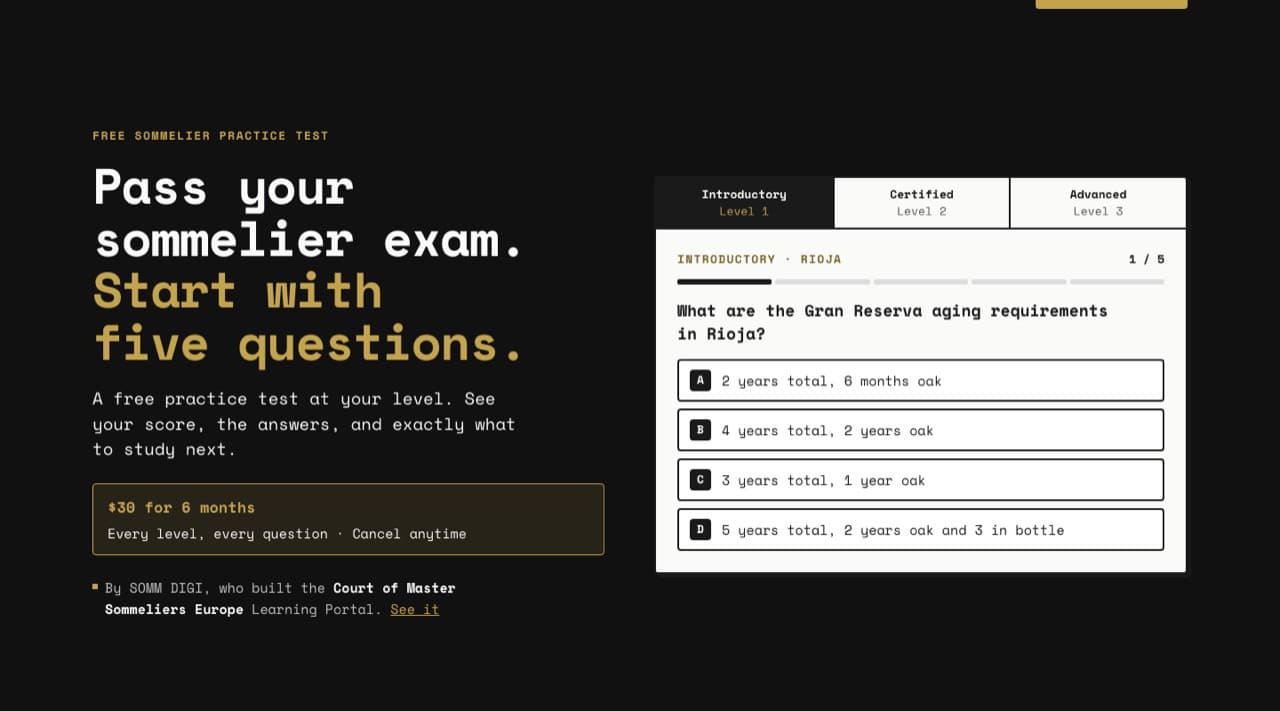
Practise the whole Certified theory with my Certified Sommelier practice test and read what the theory exam covers. For the land behind Gigondas, see the Dentelles de Montmirail. SOMM DIGI AI quizzes you on every cru, free to start.
Questions people ask
What Rhône topics come up at Certified level?
The Court's syllabus lists the principal estates of Châteauneuf-du-Pape, the VDN and VDL wines and their grapes, the southern appellations with their grapes and styles, and the principal sites of Hermitage and Côte-Rôtie.
How many crus are in the Rhône Valley?
Eighteen: eight in the north and ten in the south, the newest being Laudun from the 2024 vintage.
Which Rhône crus make white wine?
In the north: Condrieu, Château-Grillet, Saint-Joseph, Crozes-Hermitage, Hermitage and Saint-Péray. In the south: Châteauneuf-du-Pape, Vacqueyras, Lirac, Cairanne, Laudun and, since 2023, Gigondas, plus the sweet Muscat de Beaumes-de-Venise.
Is Tavel a red or a rosé?
Rosé only, and dry. It is mostly Grenache with Cinsault and other southern grapes.
Your exam kit
Where to study for your exam

 My book · AmazonSommelier Prep BookQuick questions and answers for a break at work.Order on Amazon
 My book · AmazonSommelier Level 1 Prep BookLevel 1's key topics in one small book you can carry anywhere.Order on Amazon
SOMM DIGI built the Court of Master Sommeliers Europe’s Learning Portal, and SOMM DIGI AI. Who is behind this
For sommeliers · next steps