
Study and careerAlsace
Alsace for the Advanced sommelier exam
The figures an Advanced candidate needs: yields for AOC Alsace and Grand Cru, sugar and alcohol for VT and SGN, the Grand Cru exceptions, Crémant rules and two producers to know cold.

Alper Billik · Advanced Sommelier
Updated October 2026 · 6 min read · Edited with AI
This article may contain affiliate links.
On this page
The short answer: at Advanced level, Alsace is about numbers and exceptions. Know the yields of each tier, the sugar and potential alcohol for Vendanges Tardives and Sélection de Grains Nobles, which Grand Crus break the four-grape rule, how Crémant d'Alsace is made, and the main sites of the principal producers. Every figure below comes from the official French specifications as they stand in 2026. Still building the basics? Start with Alsace for Level 1.
1. Yields: AOC Alsace and Grand Cru
French specifications give two figures: the rendement (the normal yield) and the rendement butoir (the ceiling that can be reached in a generous year). Both are in hectolitres per hectare.
| Wine | Yield (hl/ha) | Ceiling (hl/ha) |
|---|---|---|
| AOC Alsace, white | 80 | 96 |
| AOC Alsace, rosé | 75 | 90 |
| AOC Alsace, red | 60 | 66 |
| AOC Alsace + communal name, white | 72 | 79 |
| AOC Alsace + lieu-dit, white | 68 | 75 |
| Alsace Grand Cru, white | 50 | 60 |
| Alsace Grand Cru, red (Pinot Noir) | 40 | 48 |
| Vendanges Tardives, AOC Alsace | 55 | 66 |
| Sélection de Grains Nobles | 40 | 48 |
- AOC Alsace, white
- Yield (hl/ha)80
- Ceiling (hl/ha)96
- AOC Alsace, rosé
- Yield (hl/ha)75
- Ceiling (hl/ha)90
- AOC Alsace, red
- Yield (hl/ha)60
- Ceiling (hl/ha)66
- AOC Alsace + communal name, white
- Yield (hl/ha)72
- Ceiling (hl/ha)79
- AOC Alsace + lieu-dit, white
- Yield (hl/ha)68
- Ceiling (hl/ha)75
- Alsace Grand Cru, white
- Yield (hl/ha)50
- Ceiling (hl/ha)60
- Alsace Grand Cru, red (Pinot Noir)
- Yield (hl/ha)40
- Ceiling (hl/ha)48
- Vendanges Tardives, AOC Alsace
- Yield (hl/ha)55
- Ceiling (hl/ha)66
- Sélection de Grains Nobles
- Yield (hl/ha)40
- Ceiling (hl/ha)48
Within the 80 hl/ha for white AOC Alsace, each grape has its own maximum: 100 for Pinot Blanc, Auxerrois, Chasselas and Sylvaner; 90 for Riesling and Muscat; 80 for Gewurztraminer and Pinot Gris. Grand Cru VT is held to the Grand Cru figure of 50 hl/ha.
2. VT and SGN: sugar and potential alcohol
| Grapes | VT: sugar (g/l of must) | VT: potential alcohol | SGN: sugar (g/l of must) | SGN: potential alcohol |
|---|---|---|---|---|
| Gewurztraminer, Pinot Gris | 270 | 16% | 306 | 18.2% |
| Riesling, Muscat | 244 | 14.5% | 276 | 16.4% |
- Gewurztraminer, Pinot Gris
- VT: sugar (g/l of must)270
- VT: potential alcohol16%
- SGN: sugar (g/l of must)306
- SGN: potential alcohol18.2%
- Riesling, Muscat
- VT: sugar (g/l of must)244
- VT: potential alcohol14.5%
- SGN: sugar (g/l of must)276
- SGN: potential alcohol16.4%
- The VT figures rose in 2016, from 257 and 235 g/l, because warmer seasons had made those levels easy. Many older books still print the old numbers.
- Only four grapes: Gewurztraminer, Pinot Gris, Riesling and Muscat; the vintage and the grape must be on the label.
- Hand-picked, never enriched (no sugar added).
- Aged until 1 June of the second year after the harvest; they reach the consumer from that date.
- Codified on 1 March 1984, after centuries of use in their German form.
- VT is about over-ripeness and does not require noble rot; SGN is a stricter selection of over-ripe grapes, usually concentrated by noble rot.
- One exception: no VT or SGN from Pinot Gris in the Kaefferkopf Grand Cru.
3. Alsace Grand Cru: the rules and the exceptions
- 51 appellations, created by decrees of 1975, 1983, 1992 and 2007 (Kaefferkopf, the last). Each is its own AOC.
- Grapes: one of Gewurztraminer, Muscat, Pinot Gris or Riesling, or a blend of the Muscats.
- Minimum ripeness: 195 g/l of sugar (12.5% potential) for Gewurztraminer and Pinot Gris; 170 g/l (11%) for the others.
- Hand harvest, no oak chips, and no sale before 1 November of the year after the harvest.
| Grand Cru | Exception |
|---|---|
| Zotzenberg (Mittelbergheim) | Sylvaner allowed as a single variety |
| Altenberg de Bergheim | Blends allowed: Riesling 50–70%, Gewurztraminer and Pinot Gris 10–25% each |
| Kaefferkopf (Ammerschwihr) | Blends allowed: Gewurztraminer 60–80%, Riesling 10–40%, Pinot Gris up to 30% |
| Hengst (Wintzenheim) | Red Grand Cru from Pinot Noir, since 2022 |
| Kirchberg de Barr | Red Grand Cru from Pinot Noir, since 2022 |
| Vorbourg (Rouffach, Westhalten) | Red Grand Cru from Pinot Noir, since 2024 |
- Zotzenberg (Mittelbergheim)
- ExceptionSylvaner allowed as a single variety
- Altenberg de Bergheim
- ExceptionBlends allowed: Riesling 50–70%, Gewurztraminer and Pinot Gris 10–25% each
- Kaefferkopf (Ammerschwihr)
- ExceptionBlends allowed: Gewurztraminer 60–80%, Riesling 10–40%, Pinot Gris up to 30%
- Hengst (Wintzenheim)
- ExceptionRed Grand Cru from Pinot Noir, since 2022
- Kirchberg de Barr
- ExceptionRed Grand Cru from Pinot Noir, since 2022
- Vorbourg (Rouffach, Westhalten)
- ExceptionRed Grand Cru from Pinot Noir, since 2024
Village by village, with the clos sites: the Alsace Grand Cru and clos map.
4. Below Grand Cru: communal names and lieux-dits
- 13 communal names may follow “Alsace”: Bergheim, Blienschwiller, Coteaux du Haut-Koenigsbourg, Côtes de Barr, Côte de Rouffach, Klevener de Heiligenstein, Ottrott, Rodern, Saint-Hippolyte, Scherwiller, Vallée Noble, Val Saint Grégoire, Wolxheim.
- Each has its own grapes and colour. Ottrott, Rodern and Saint-Hippolyte are for red Pinot Noir only; Bergheim is Gewurztraminer; Coteaux du Haut-Koenigsbourg, Scherwiller and Wolxheim are Riesling; Klevener de Heiligenstein is Savagnin Rose; Côte de Rouffach is white and red.
- Lieu-dit wines carry a named site; Pinot Gris and Pinot Noir from a lieu-dit must be hand-picked.
- Edelzwicker is a blend of white grapes and cannot be used with a communal name or a lieu-dit.
5. Crémant d'Alsace
- AOC since 1976. White or rosé sparkling wine, by second fermentation in the bottle.
- Grapes: Pinot Blanc, Auxerrois, Chardonnay, Pinot Gris, Pinot Noir and Riesling for white; Pinot Noir only for rosé.
- Hand harvest, and no more than 100 litres of must per 150 kg of grapes.
- At least 9 months on the lees in bottle, and no sale before 12 months from tirage.
- Yield: 80 hl/ha, ceiling 96.
- History: the specification credits Julien Dopff, who saw the method at the 1900 Paris exhibition, with the first Alsace trials.
6. Soils in one minute
- Mountain side (the Vosges substrate): granite, gneiss, schist and sandstone. Shallow, free-draining, acidic soils.
- Sub-Vosges hills: limestone, marl and conglomerates, with brown calcareous soils that hold water well.
- Edge of the plain: colluvial and alluvial sand and gravel.
- Grand Cru examples: Brand and Sommerberg on granite; Kastelberg on schist; Rangen on volcanic-sedimentary rock; Kessler on sandstone; Rosacker on shelly Muschelkalk limestone; Zotzenberg on dense marl over limestone.
The full soil-by-soil guide, with how each tends to show in the glass: Alsace terroir.
7. Principal producers and sites
| Producer | Base | Sites to know |
|---|---|---|
| Domaine Zind-Humbrecht | Turckheim | Grand Crus Rangen (Clos Saint Urbain), Brand, Hengst, Goldert, Sommerberg; Clos Windsbuhl, Clos Jebsal, Clos Häuserer |
| Maison Trimbach | Ribeauvillé | Clos Sainte Hune (1.67 ha in the Rosacker Grand Cru, Hunawihr); Cuvée Frédéric Emile from Geisberg and Osterberg |
- Domaine Zind-Humbrecht
- BaseTurckheim
- Sites to knowGrand Crus Rangen (Clos Saint Urbain), Brand, Hengst, Goldert, Sommerberg; Clos Windsbuhl, Clos Jebsal, Clos Häuserer
- Maison Trimbach
- BaseRibeauvillé
- Sites to knowClos Sainte Hune (1.67 ha in the Rosacker Grand Cru, Hunawihr); Cuvée Frédéric Emile from Geisberg and Osterberg
Zind-Humbrecht in depth: the story of Domaine Zind-Humbrecht.
Advanced practice questions
Question 1
What is the minimum sugar for Riesling Sélection de Grains Nobles?
- a)235 g/l
- b)244 g/l
- c)276 g/l
- d)306 g/l
Show answerAnswer
c) 276 g/l. 276 g/l (16.4% potential). 306 g/l is for Gewurztraminer and Pinot Gris SGN; 244 g/l is Riesling VT.
Question 2
What is the minimum potential alcohol for Gewurztraminer Vendanges Tardives?
- a)14%
- b)14.5%
- c)16%
- d)18.2%
Show answerAnswer
c) 16%. 16% (270 g/l). Riesling and Muscat VT need 14.5%.
Question 3
What is the base yield for a white Alsace Grand Cru?
- a)40 hl/ha
- b)50 hl/ha
- c)68 hl/ha
- d)80 hl/ha
Show answerAnswer
b) 50 hl/ha. 50 hl/ha, with a ceiling of 60. 80 hl/ha is white AOC Alsace.
Question 4
Which Grand Cru may be made from Sylvaner?
- a)Rangen
- b)Schlossberg
- c)Zotzenberg
- d)Brand
Show answerAnswer
c) Zotzenberg. Zotzenberg, in Mittelbergheim, allows Sylvaner as a single variety.
Question 5
Which three Grand Crus may make red wine from Pinot Noir?
- a)Hengst, Kirchberg de Barr, Vorbourg
- b)Rangen, Brand, Schlossberg
- c)Kaefferkopf, Zotzenberg, Altenberg de Bergheim
- d)Geisberg, Osterberg, Rosacker
Show answerAnswer
a) Hengst, Kirchberg de Barr, Vorbourg. Hengst and Kirchberg de Barr since 2022, Vorbourg since 2024.
Question 6
How long must Crémant d'Alsace spend on its lees in bottle, at least?
- a)6 months
- b)9 months
- c)15 months
- d)36 months
Show answerAnswer
b) 9 months. 9 months on lees, and it cannot be sold until 12 months after tirage.
Question 7
Which Grand Cru sits on volcanic-sedimentary rock?
- a)Rangen
- b)Kessler
- c)Goldert
- d)Rosacker
Show answerAnswer
a) Rangen. The Rangen, at Thann, is the volcanic Grand Cru. Kessler is sandstone, Goldert oolitic limestone, Rosacker Muschelkalk.
Question 8
Clos Sainte Hune lies within which Grand Cru?
- a)Schlossberg
- b)Rosacker
- c)Geisberg
- d)Hengst
Show answerAnswer
b) Rosacker. Trimbach's 1.67-hectare Clos Sainte Hune is in the Rosacker, at Hunawihr.
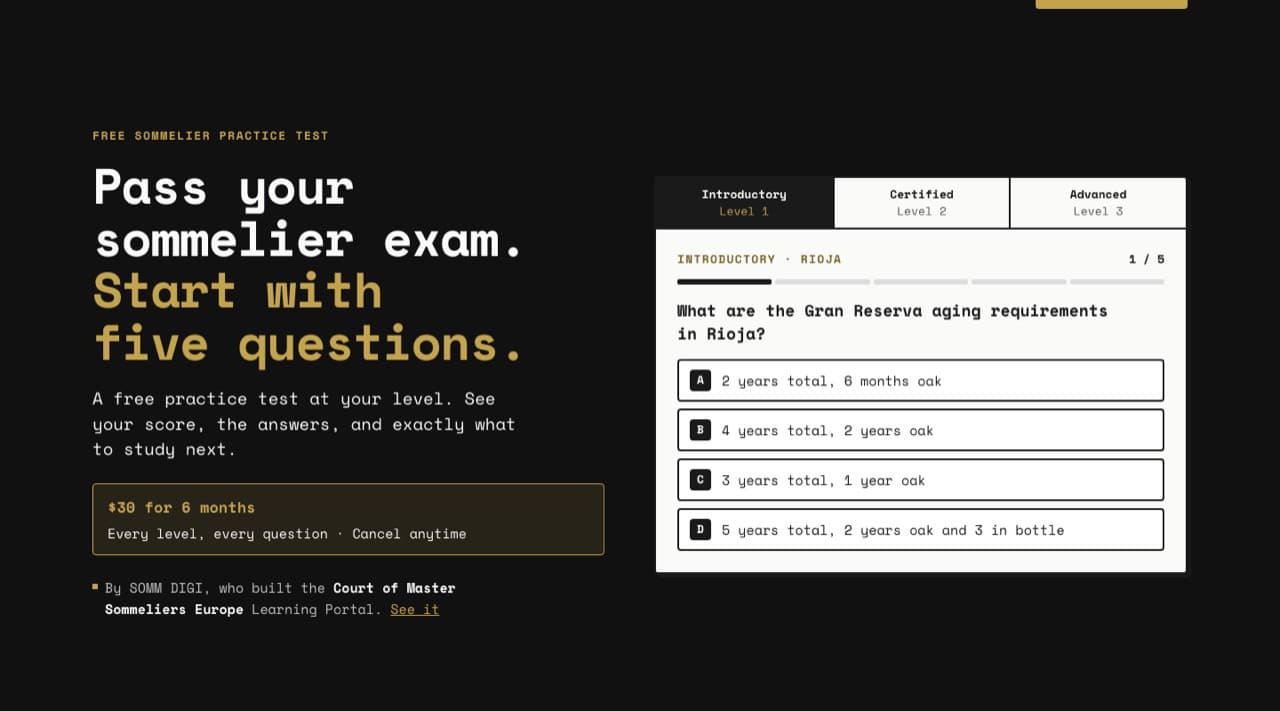
For more Advanced-level questions on any region, SOMM DIGI AI has 3,000+ exam-prep questions, free to start. Also read how to study for and pass the Advanced exam.
Questions people ask
What are the VT and SGN sugar levels in Alsace?
Vendanges Tardives: 244 g/l for Riesling and Muscat, 270 g/l for Gewurztraminer and Pinot Gris. Sélection de Grains Nobles: 276 and 306 g/l.
What are the yields for Alsace Grand Cru?
50 hl/ha for white wines, with a ceiling of 60, and 40 hl/ha for red Pinot Noir, with a ceiling of 48.
When did the VT sugar levels change?
The specification was amended in 2016, raising VT from 235 to 244 g/l (Riesling, Muscat) and from 257 to 270 g/l (Gewurztraminer, Pinot Gris).
Can a Grand Cru be a blend?
Only in Altenberg de Bergheim and Kaefferkopf, with set proportions, and as a blend of the Muscats in any Grand Cru. Everywhere else it is one grape.
Your exam kit
Where to study for your exam

 My book · AmazonSommelier Prep BookQuick questions and answers for a break at work.Order on Amazon
 My book · AmazonSommelier Level 1 Prep BookLevel 1's key topics in one small book you can carry anywhere.Order on Amazon
SOMM DIGI built the Court of Master Sommeliers Europe’s Learning Portal, and SOMM DIGI AI. Who is behind this
For sommeliers · next steps