
AI and marketingFor sommeliers
Studying Alsace at every sommelier level, with AI
What the Court of Master Sommeliers expects on Alsace at Introductory, Certified, Advanced and Master level, the pages to read for each, and the AI prompts that turn it into practice.

Alper Billik · Advanced Sommelier
Updated October 2026 · 4 min read · Edited with AI
This article may contain affiliate links.
On this page
The short answer: Alsace grows with you. At Introductory it is climate, grapes and three appellations. At Certified you add the Grand Cru grapes and sites. At Advanced come the numbers: yields, VT and SGN sugar levels, producers, Crémant. At Master level it is villages, clos, soils, vintages and the latest changes in the law. Below is the plan for each level, the page to read, and prompts to practise with an AI chat.
How to use AI for this without getting fooled
- Use it to quiz you, not to replace the book. AI can sound sure and still be wrong, above all on numbers.
- Check every figure against the official specification or your course material. Alsace's VT sugar levels changed in 2016, and older sources still print the old ones.
- Ask for one thing at a time: one grape, one Grand Cru, one rule.
- Say it back. Ask the AI to correct your own explanation; that is where the learning happens.
Introductory (Level 1)
The syllabus: climate and the importance of the Vosges; sub-districts; the best vineyards and soil variety; grapes; the appellations (Grand Cru, Crémant, communale, lieu-dit); VT and SGN; labelling terms. Read Alsace for Level 1, then take the 15-question Alsace quiz.
- “Explain in five sentences how the Vosges shape Alsace's climate.”
- “Quiz me with ten multiple-choice questions on Alsace grapes. One at a time, wait for my answer.”
- “What is the difference between AOC Alsace, a communal name and a lieu-dit on an Alsace label?”
- “Give me three Alsace label terms a guest might ask about, and how I would explain each.”
Certified Sommelier
The syllabus adds one line for Alsace: identify Grand Cru varietals and sites. Know which grapes a Grand Cru may use, the exceptions (Sylvaner in Zotzenberg, blends in Altenberg de Bergheim and Kaefferkopf, red Pinot Noir in Hengst, Kirchberg de Barr and Vorbourg), and the best-known sites by village. Read Alsace Grand Crus and clos, village by village.
- “Which grapes are allowed in Alsace Grand Cru, and which Grand Crus are the exceptions?”
- “Name ten Alsace Grand Crus and ask me for the village of each.”
- “I am serving a Riesling from the Rangen. What should I tell the guest about the site in two sentences?”
Advanced Sommelier
The syllabus: yields per hectare for AOC Alsace and Grand Cru; required sugar levels for VT and SGN; principal producers and sites; Crémant production styles and grapes. All the figures, with their sources, are in Alsace for the Advanced exam. Two to have cold: Grand Cru white yields are 50 hl/ha, and Riesling VT needs 244 g/l of sugar.
- “Make me a flashcard table: wine tier, yield, ceiling yield. I'll fill it in, you correct me.”
- “Quiz me on VT and SGN sugar and potential alcohol by grape, mixing the order.”
- “Walk me through how Crémant d'Alsace is made, step by step, and the legal minimums.”
- “Give me the main Grand Cru and clos sites of Domaine Zind-Humbrecht and Maison Trimbach.”
For the producer side, read Domaine Zind-Humbrecht. The Advanced theory exam mixes multiple-choice and short-answer questions; practise writing short answers by hand, against the clock.
Master Sommelier
The syllabus: plantings by variety; specific villages with Grand Cru and clos sites; soil diversity; yields for each quality level; minimum potential alcohol for VT and SGN; vintages; principal producers and sites; the latest developments. At this level theory is tested by oral questioning and the pass mark is 75%, so you must be able to talk, not just tick boxes. Read Alsace terroir and the village map.
- “Act as an examiner. Ask me oral questions on Alsace for ten minutes, follow up when my answer is thin.”
- “Describe the soil of five Grand Crus and ask me to name each.”
- “What has changed in the Alsace rules since 2020? List each change with the year, and tell me which source to check it in.”
- “Ask me the minimum potential alcohol for VT and SGN for each grape.”
Vintages and planting figures move every year. Take them from the regional wine council and recent official texts, never from memory or from an AI answer alone.
Where SOMM DIGI AI fits
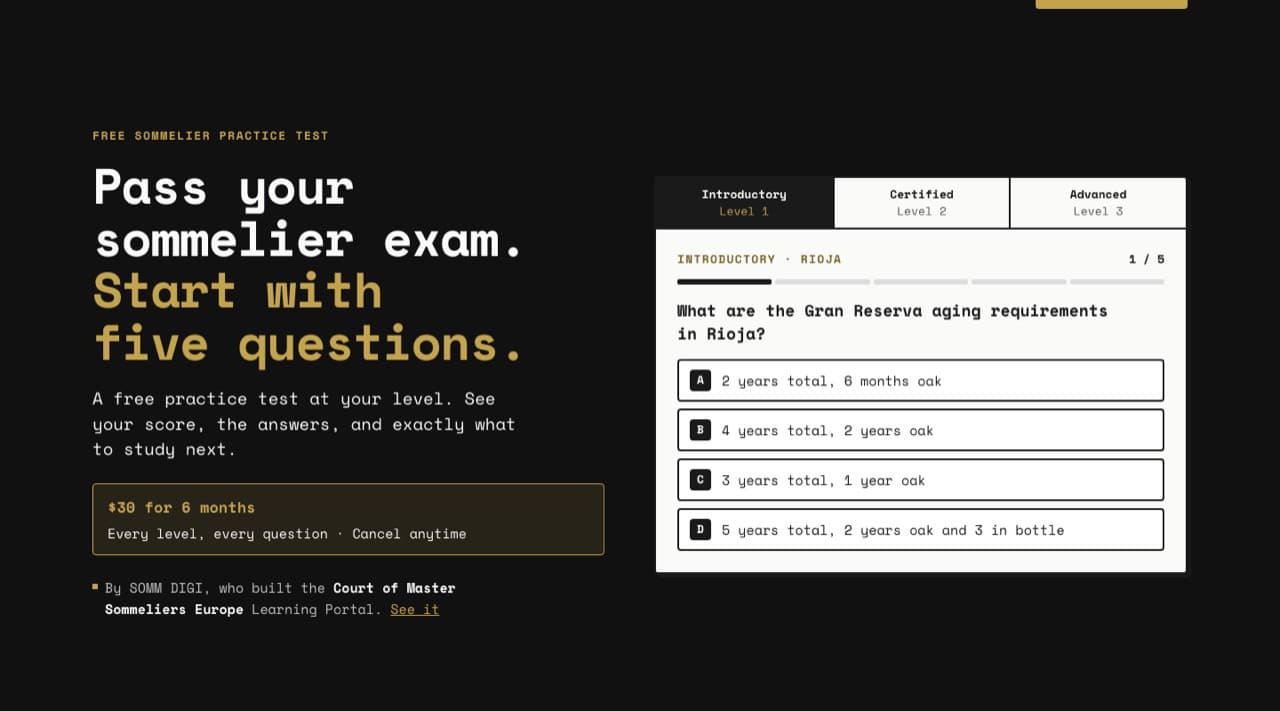
SOMM DIGI AI is built for this kind of practice. It does not run its own AI model: it teaches today's best AI to talk wine like a sommelier, with 3,000+ exam-prep questions, 35 flashcard decks and 14 tools in one app. It is free to start. The prompts above work there, and in any general AI chat too.
Questions people ask
How much Alsace is on the Level 1 sommelier exam?
The Court publishes topics, not question counts. For Alsace at Introductory level that means the climate, sub-districts, soils, grapes, the appellations, VT and SGN, and the label terms.
Can I trust AI for wine exam figures?
Use it to practise, not as the answer key. Check every number against the official specification or your course material.
What is the hardest Alsace topic?
For most candidates, the Grand Cru map: 51 names, many villages, and a few look-alikes such as the two Altenbergs and the two Kirchbergs.
Is SOMM DIGI AI free?
It is free to start, with 3,000+ exam-prep questions inside.
Your exam kit
Where to study for your exam
 My book · AmazonSommelier Prep BookQuick questions and answers for a break at work.Order on Amazon
 My book · AmazonSommelier Level 1 Prep BookLevel 1's key topics in one small book you can carry anywhere.Order on Amazon
SOMM DIGI built the Court of Master Sommeliers Europe’s Learning Portal, and SOMM DIGI AI. Who is behind this
For wine businesses · next steps