
Chardonnay wine: what does it taste like?
One Chardonnay tastes of lemon and wet stones, another of pineapple, vanilla and butter. Same grape: the climate and the oak decide which one is in your glass.
Quick answer
Chardonnay (say it shar-doh-NAY) is a white grape that makes dry wine, from crisp and lemony to rich and toasty. Cool places give apple and lemon; warm places give peach and pineapple. The buttery taste comes from a second, natural fermentation, not from butter. Serve it unoaked at 7–10 °C (45–50 °F), oaked at 10–13 °C (50–55 °F). Want it crisp? Look for Chablis.

Alper Billik · Advanced Sommelier
Updated November 2026 · Edited with AI
This article may contain affiliate links.
On this page
- What is Chardonnay?
- Is Chardonnay sweet or dry?
- What does Chardonnay taste like?
- Why does Chardonnay taste like butter?
- Oaked vs unoaked Chardonnay
- Chardonnay vs Sauvignon Blanc
- Where does Chardonnay grow?
- Pinot Grigio vs Chardonnay
- Burgundy: Chardonnay's home
- How to read a Chablis label
- Should Chardonnay be chilled?
- Chardonnay food pairing
- Chardonnay questions, answered
What is Chardonnay?
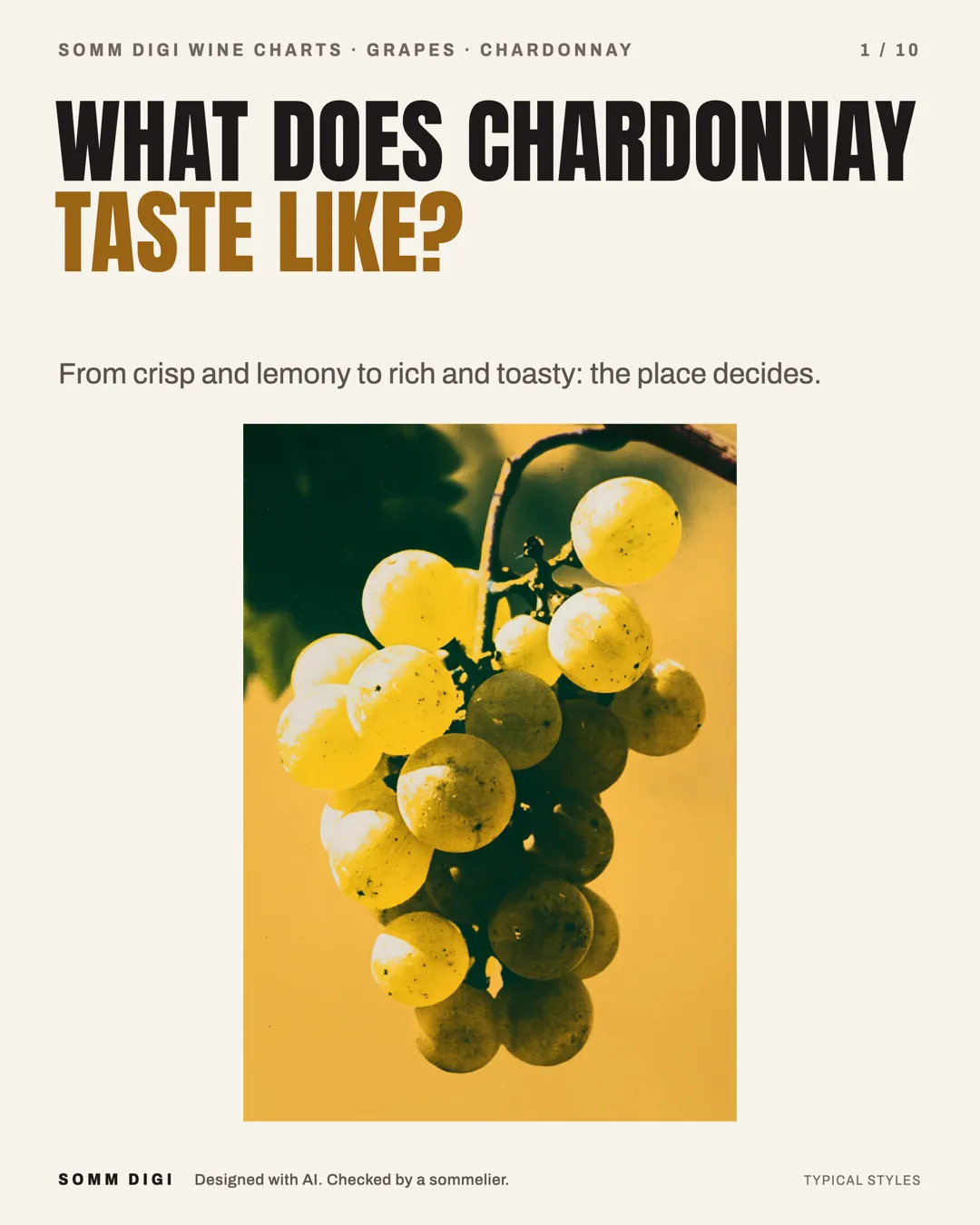
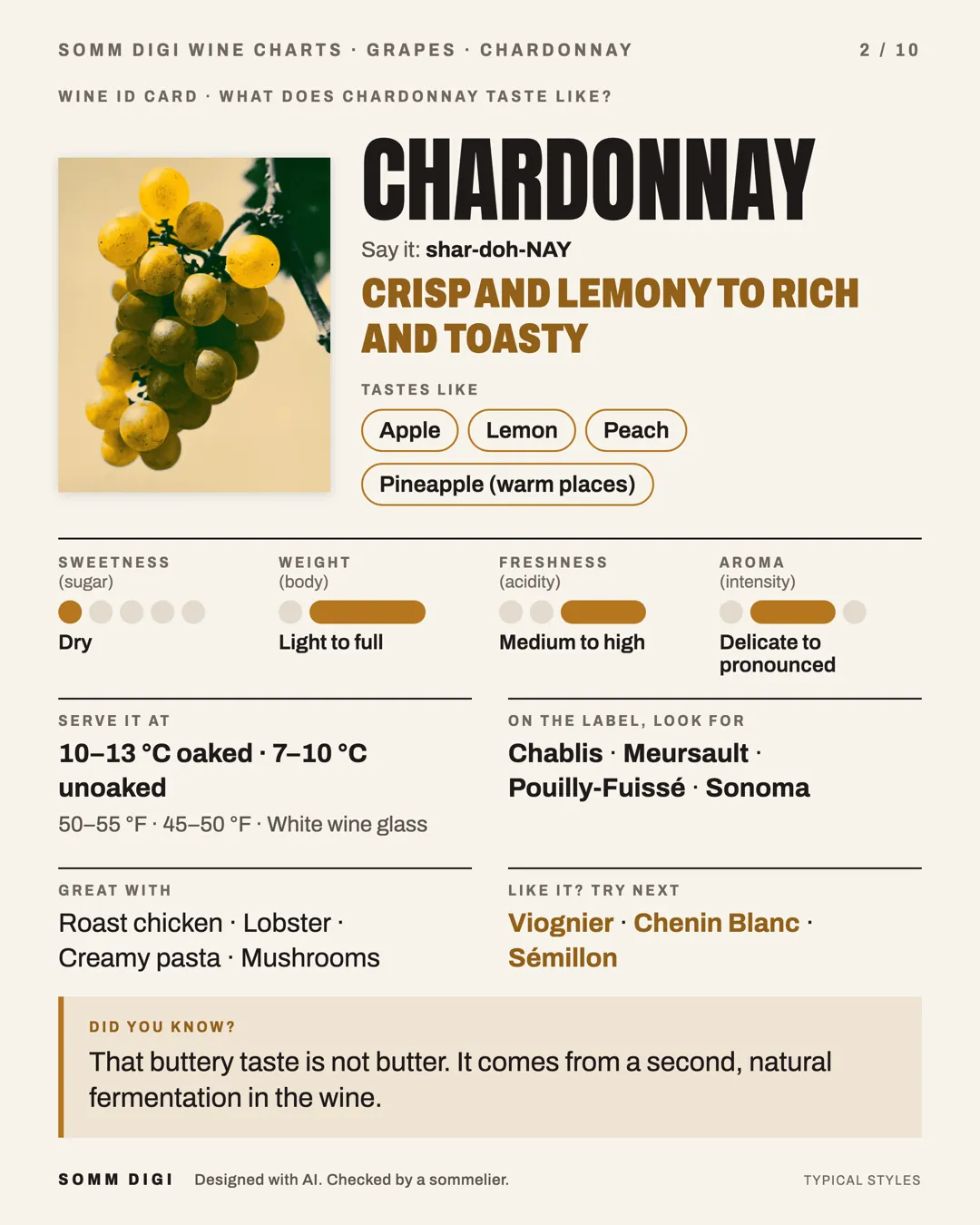
Chardonnay (say it shar-doh-NAY) is a white grape that makes dry wine in many styles. It can be light or full in body, with medium to high acidity, and its aromas run from delicate to pronounced.
Two things shape every bottle: where the grapes grow and what happens in the winery. Cool places give lemon and apple, warm places give peach and pineapple. Oak and a second, natural fermentation can add vanilla, toast and butter. Know those two and you can pick the Chardonnay you like. The profile card puts the essentials on one page.
Is Chardonnay sweet or dry?
Chardonnay is a dry wine. Some bottles taste rich, even buttery, but that richness comes from the climate and the winery, not from a sweet style.
So when you shop, the question is not dry or sweet. It is crisp or rich. For the crisp end, look for Chablis: cool, unoaked, apple and lemon. For the rich end, look for oak.
What does Chardonnay taste like?
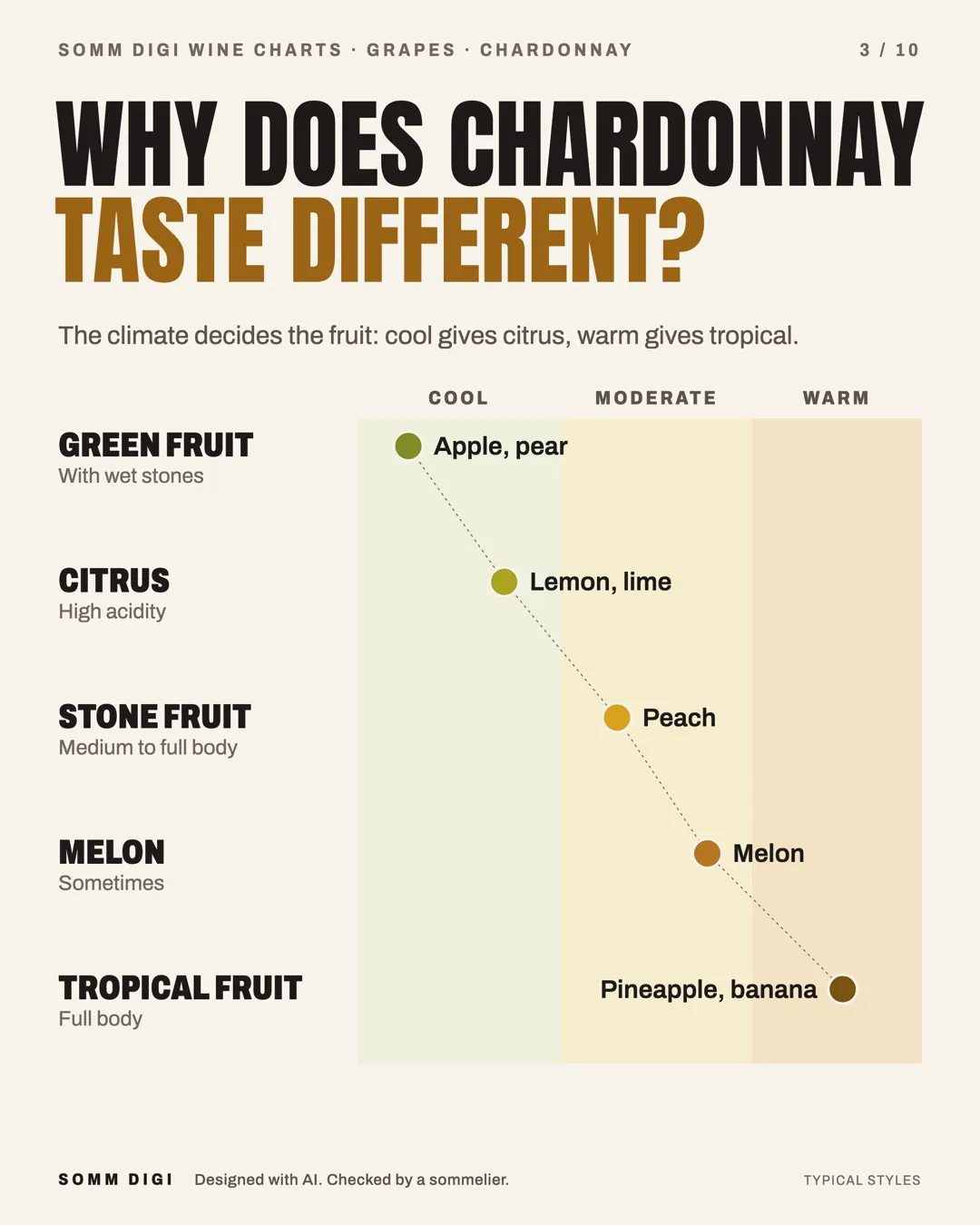
The climate decides the fruit. Cool places give citrus, warm places give tropical fruit, and everything in between sits on one line from crisp to rich.
In cool places, Chardonnay tastes of green fruit, apple and pear, often with a note of wet stones. Citrus comes too: lemon and lime, with high acidity.
Moderate places bring stone fruit, peach, with a medium to full body, and sometimes melon. Warm places go further, to tropical fruit like pineapple and banana, with a full body. The taste chart follows that line from cool to warm.
Why does Chardonnay taste like butter?
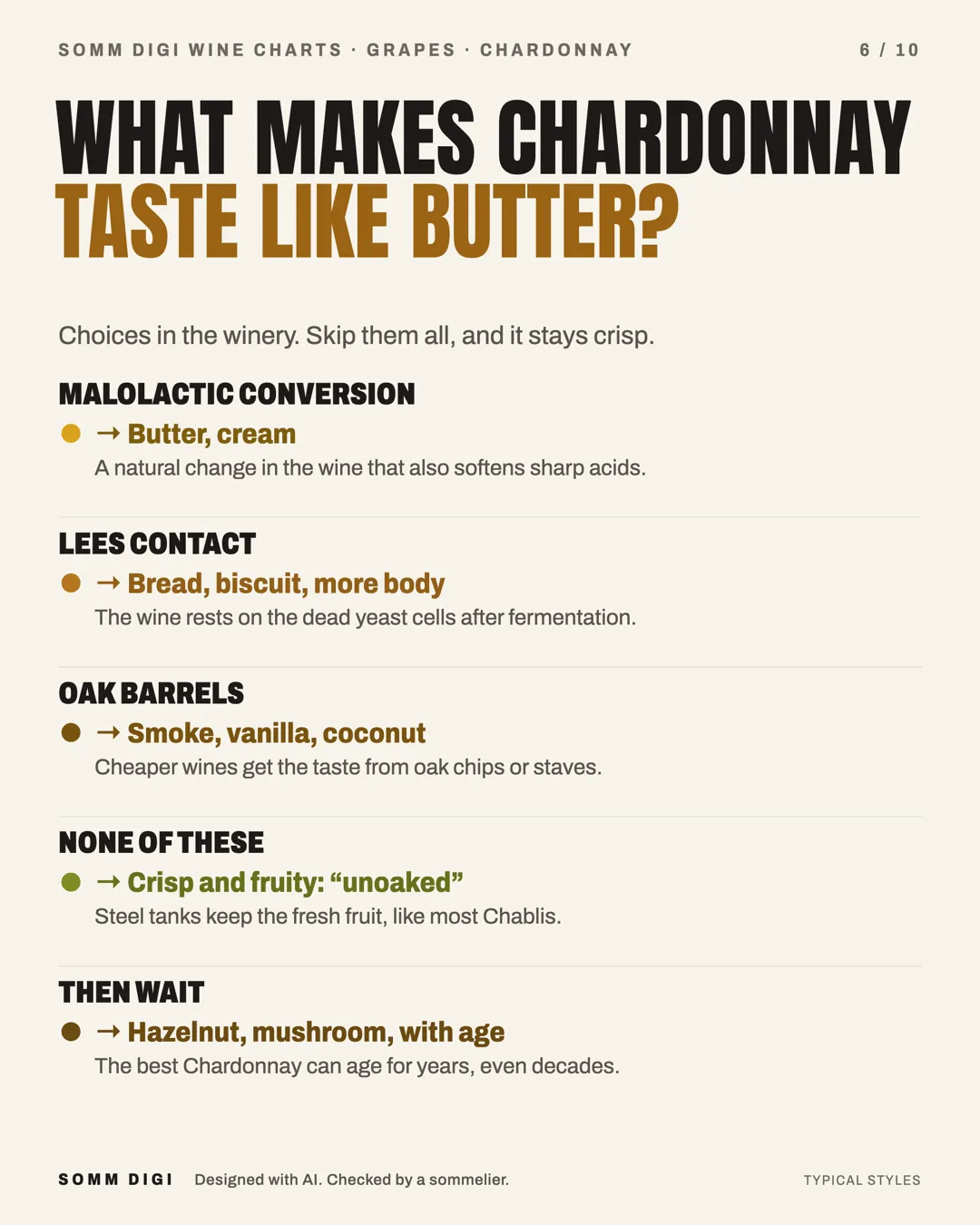
That buttery taste is not butter. It comes from a second, natural fermentation in the wine, called malolactic conversion. It brings notes of butter and cream, and it also softens sharp acids.
Two more winery choices add richness. Lees contact lets the wine rest on the dead yeast cells after fermentation: bread, biscuit and more body. Oak barrels bring smoke, vanilla and coconut; cheaper wines get that taste from oak chips or staves.
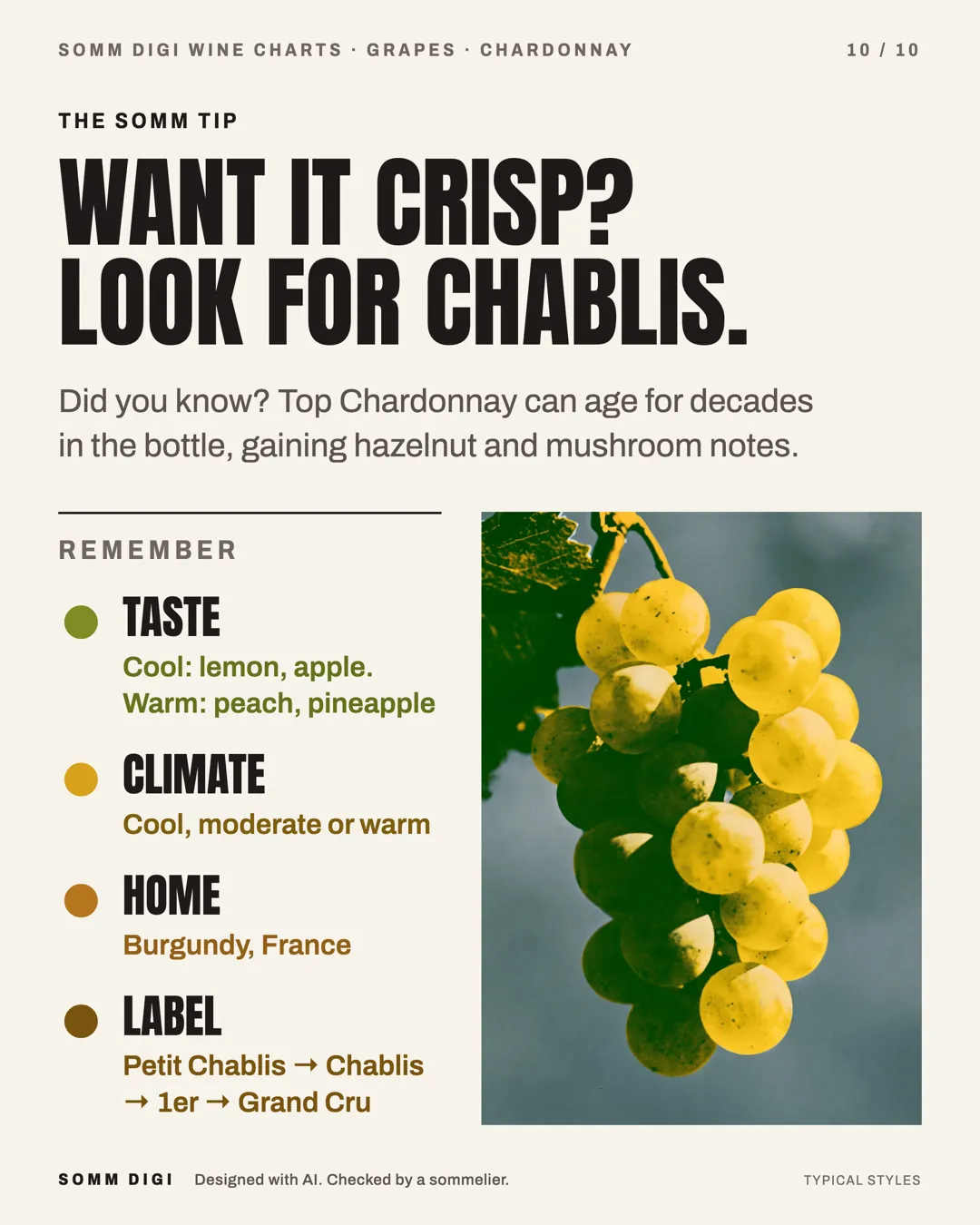
Skip all three and Chardonnay stays crisp and fruity. That is unoaked Chardonnay: steel tanks keep the fresh fruit, as in most Chablis. Then there is time. With age, Chardonnay gains hazelnut and mushroom, and top bottles can age for decades. The chart lists all five.
Oaked vs unoaked Chardonnay
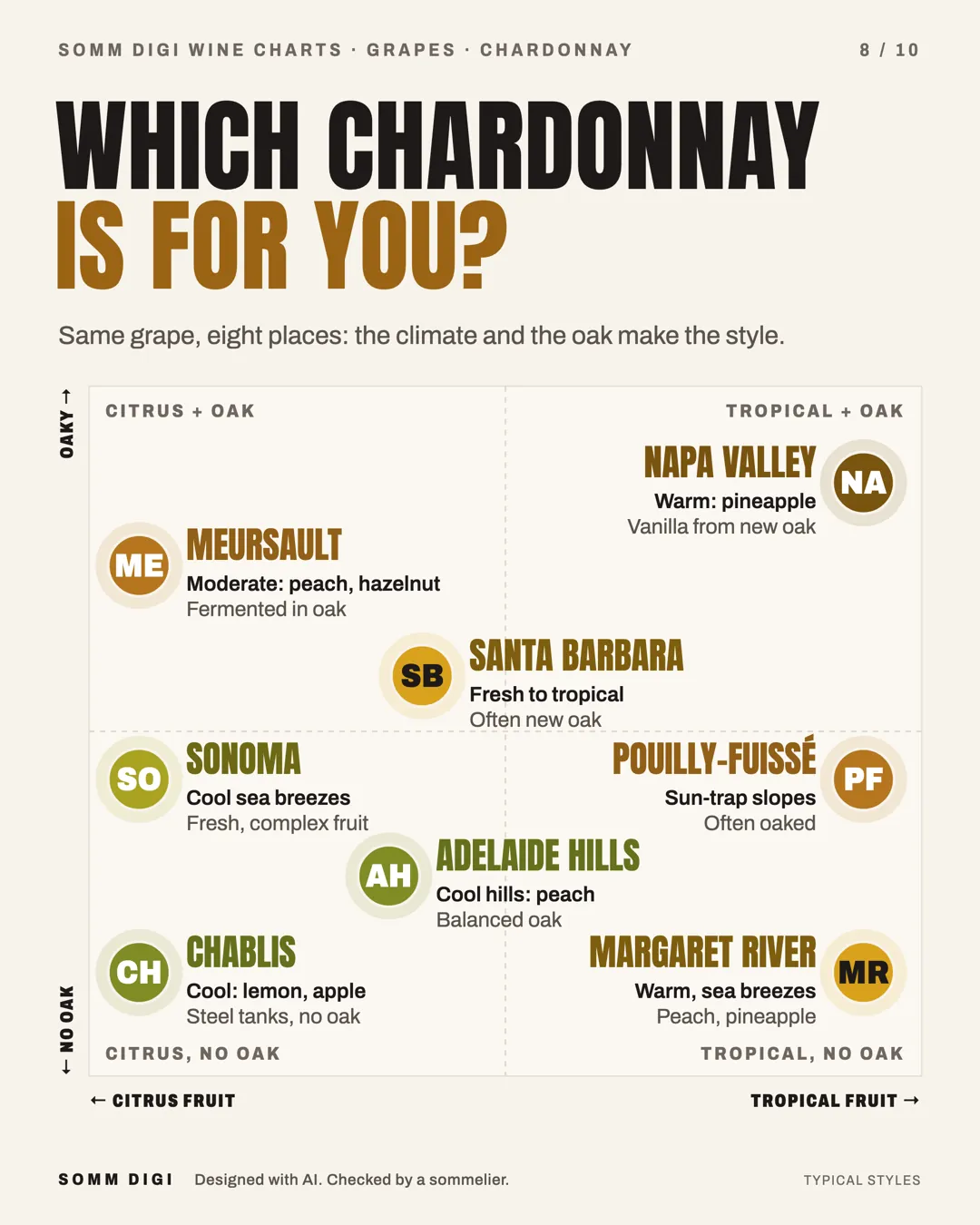
Same grape, eight places: the climate and the oak make the style. Line them up and you can choose by taste instead of by name.
At the fresh end sits Chablis: cool, lemon and apple, steel tanks and no oak. Sonoma has cool sea breezes and fresh, complex fruit. The Adelaide Hills, cool hills, give peach with balanced oak.
Further along, the fruit gets riper and the oak shows more. Meursault is moderate, fermented in oak: peach and hazelnut. Santa Barbara runs from fresh to tropical, often with new oak. Pouilly-Fuissé, from sun-trap slopes, is often oaked.
At the rich end, Margaret River is warm, with sea breezes: peach and pineapple. Napa Valley is warm too: pineapple, with vanilla from new oak. The style chart maps all eight.
Chardonnay vs Sauvignon Blanc
Both make dry white wine, but they take different paths. Sauvignon Blanc is zesty, light to medium in body, with high acidity and pronounced green aromas: cut grass, green bell pepper, gooseberry, passion fruit.
Chardonnay changes shape more. It runs from light to full, with medium to high acidity, and aromas from delicate to pronounced. Sauvignon Blanc usually stays in steel tanks, because oak would cover its green aromas. Chardonnay often takes the oak, along with butter and toast.
Time splits them too. Sauvignon Blanc is for drinking young, within a couple of years; top Chardonnay can age for decades. For grass and zest, choose Sauvignon Blanc. For a wine that can be crisp or creamy, choose Chardonnay.
Where does Chardonnay grow?
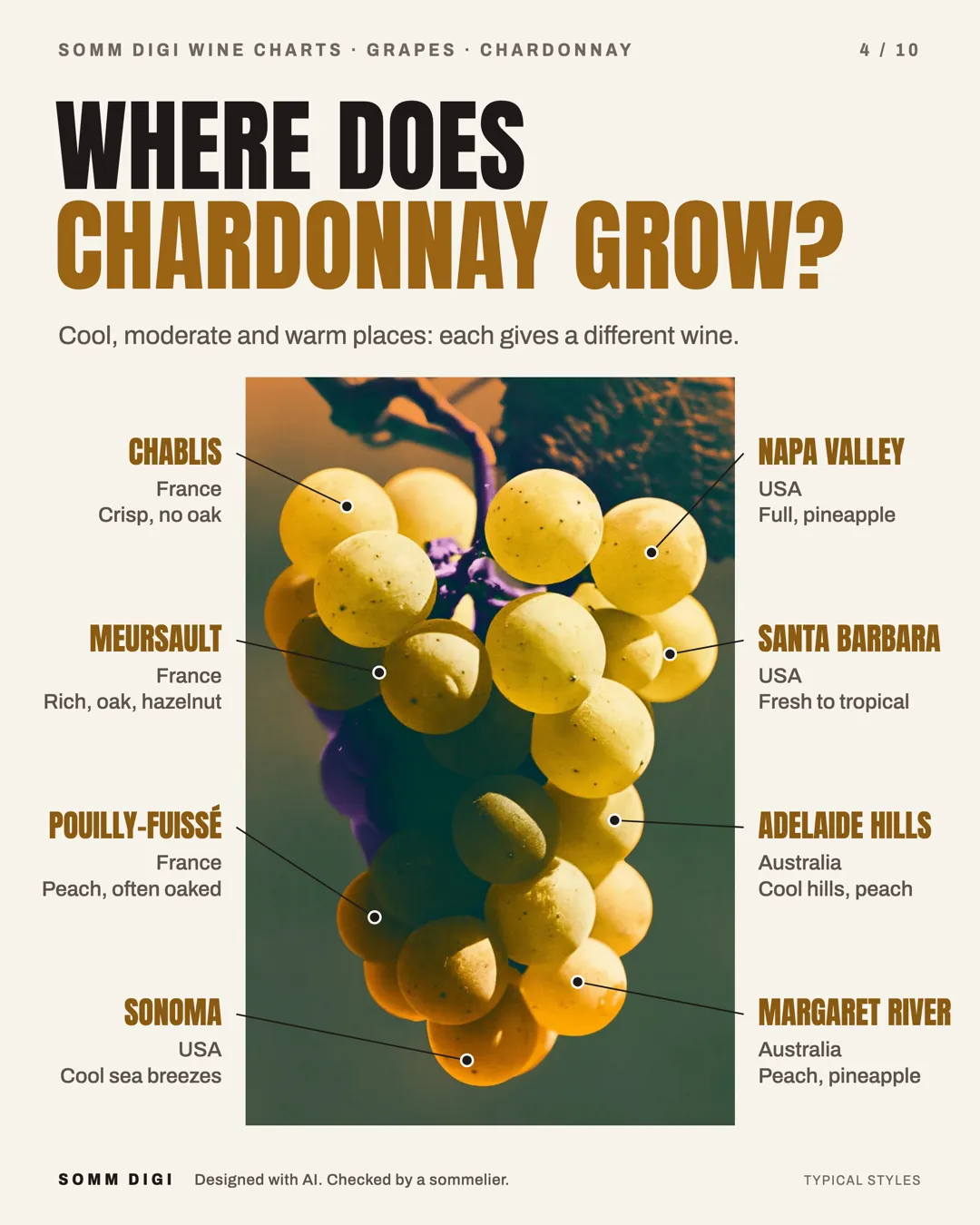
Chardonnay grows in cool, moderate and warm places, and each gives a different wine. France gives three styles: Chablis, crisp with no oak; Meursault, rich, with oak and hazelnut; and Pouilly-Fuissé, peach, often oaked.
In the USA, Sonoma has cool sea breezes, Napa Valley makes full wines that taste of pineapple, and Santa Barbara runs from fresh to tropical. Australia adds two more: the Adelaide Hills, cool hills and peach, and Margaret River, peach and pineapple. The regions chart shows all eight.
Pinot Grigio vs Chardonnay
Pinot Grigio is usually picked early for a light, crisp wine of apple and lemon, made in steel to keep it fruity. Its riper style, Pinot Gris, is fuller, with peach and ginger, and is sometimes off-dry.
Chardonnay covers more ground: crisp and stony in Chablis, rich with oak, butter and vanilla elsewhere, and always dry. Want simple and light? Pinot Grigio. Want oak and cream? Chardonnay.
Burgundy: Chardonnay's home
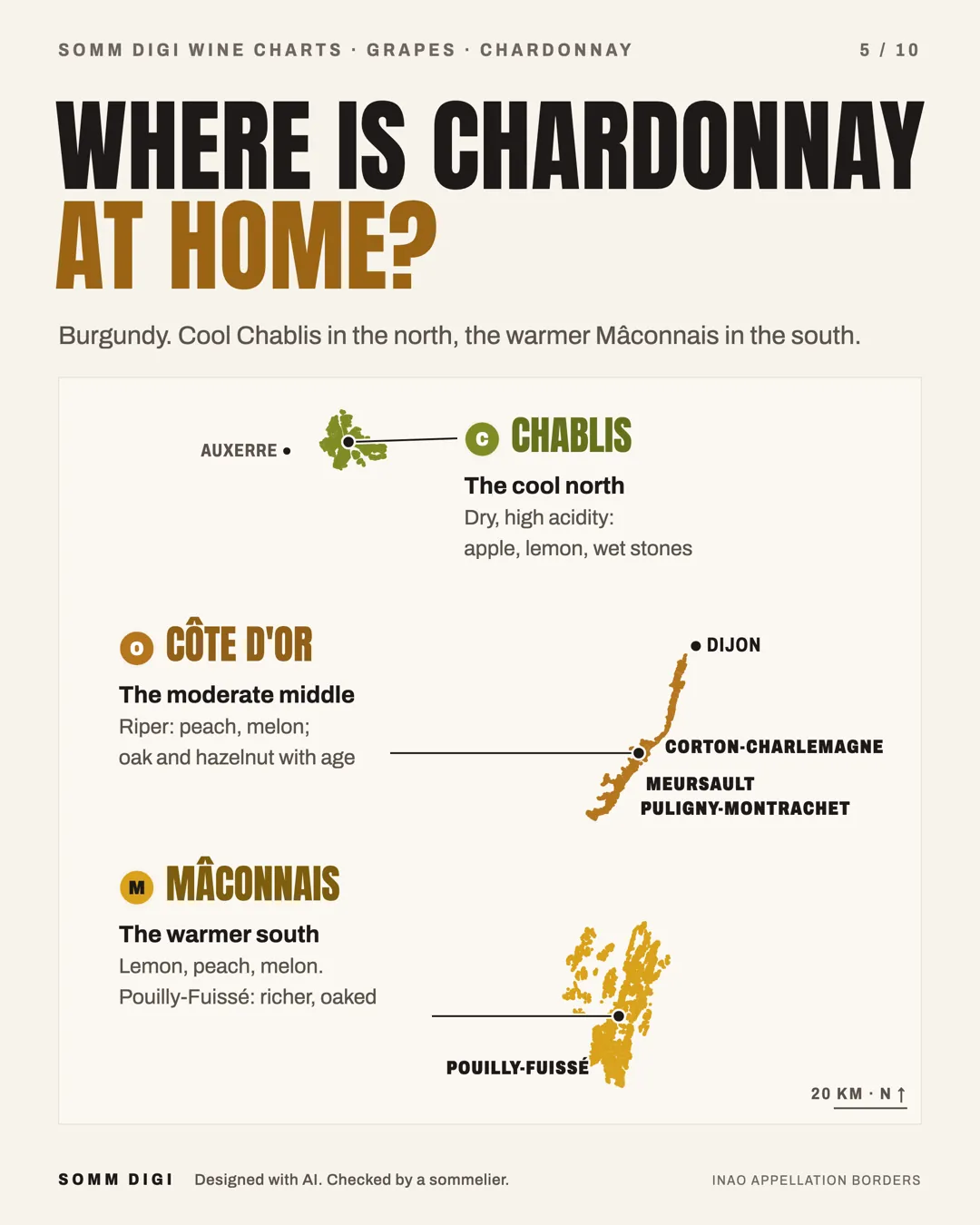
Chardonnay is at home in Burgundy, in France. Cool Chablis sits in the north, the warmer Mâconnais in the south, and the style changes as you travel.
In the cool north, Chablis and Chablis Grand Cru are dry, with high acidity: apple, lemon, wet stones. The moderate middle, with Meursault, Puligny-Montrachet and Corton-Charlemagne, gives riper wines of peach and melon, with oak and hazelnut as they age.
The warmer south, with Mâcon, Pouilly-Fuissé and Saint-Véran, tastes of lemon, peach and melon; Pouilly-Fuissé is the richer, oaked one. The map shows all three parts.
How to read a Chablis label
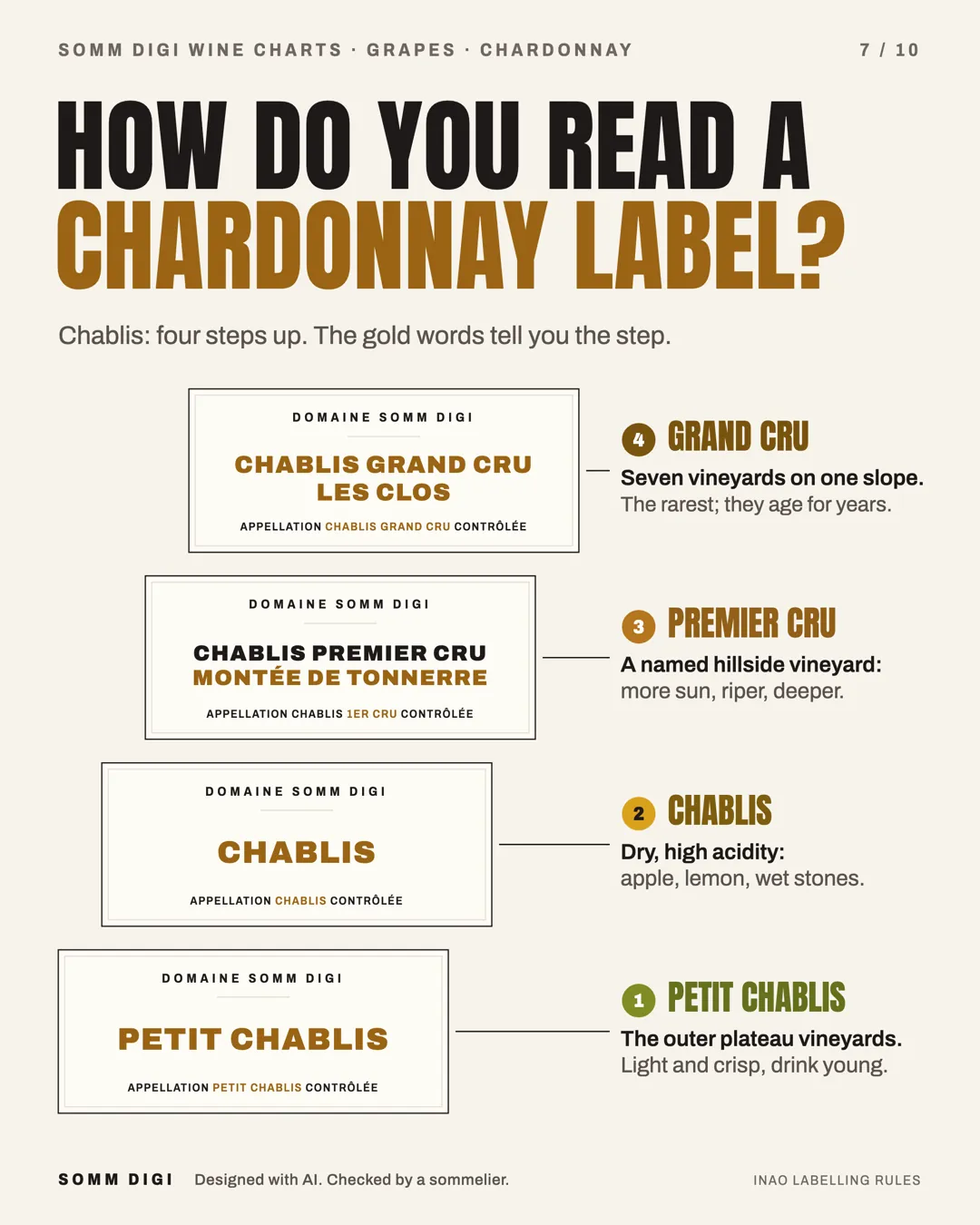
Chablis has four steps up, and the label tells you which one you are holding.
Petit Chablis comes from the outer plateau vineyards: light and crisp, to drink young. Chablis is dry, with high acidity: apple, lemon, wet stones.
Premier Cru is a named hillside vineyard with more sun, so the wine is riper and deeper. Grand Cru is seven vineyards on one slope: the rarest, made to age for years. The label chart shows the four steps.
If you remember one thing, make it the somm tip: want it crisp? Look for Chablis. And if you find a top bottle, keep it. Top Chardonnay can age for decades, gaining hazelnut and mushroom notes.
Should Chardonnay be chilled?
Yes, but not all to the same degree. Serve unoaked Chardonnay at 7–10 °C (45–50 °F) and oaked styles a little warmer, at 10–13 °C (50–55 °F).
Which glass?
A white wine glass suits every style. For shapes chosen for this grape, see glasses for Chardonnay on universalwineglasses.com, SOMM DIGI's glass site.
Chardonnay food pairing
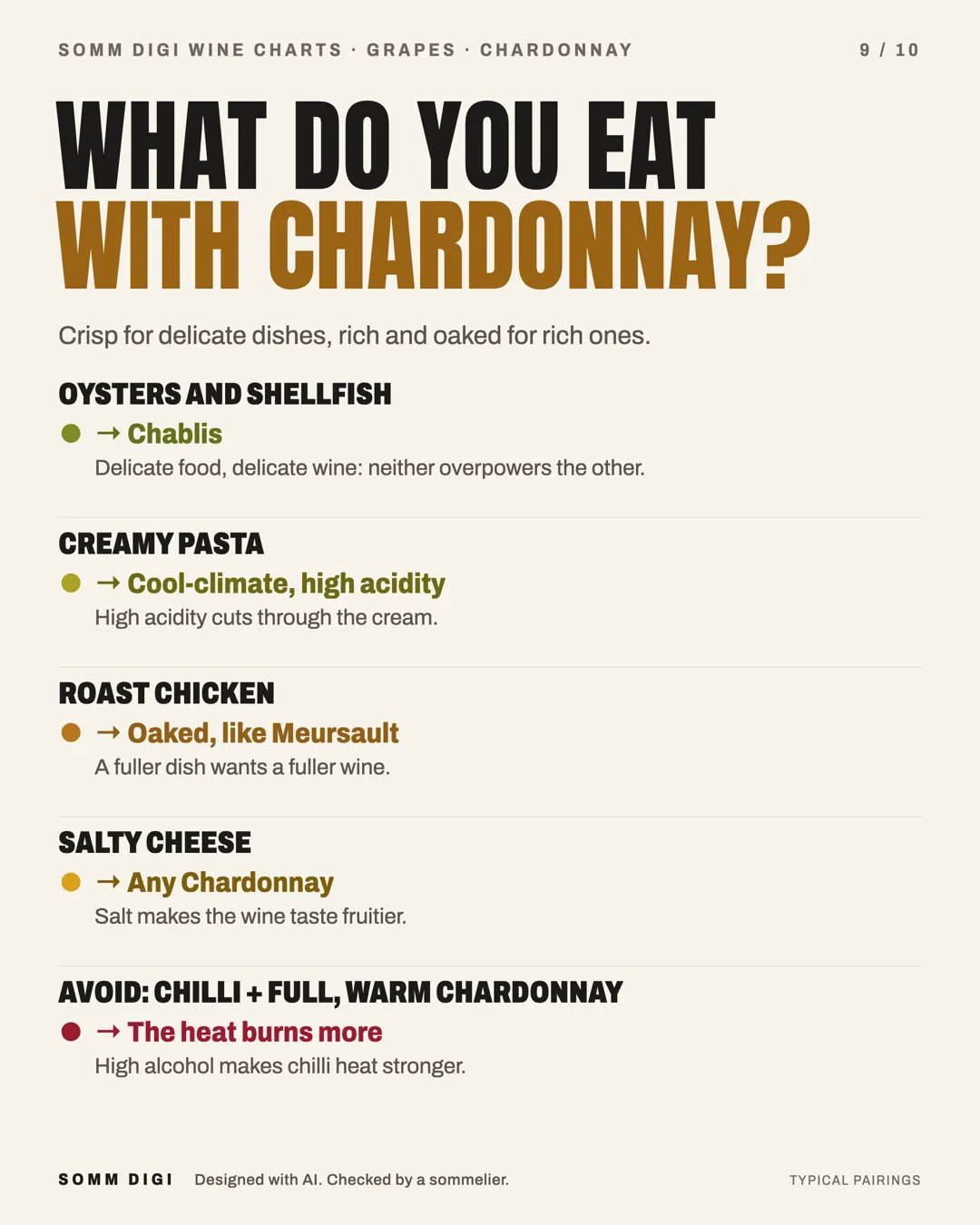
Crisp Chardonnay for delicate dishes, rich and oaked for rich ones. Start there and the rest follows.
With oysters and shellfish, pour a Chablis: delicate food and a delicate wine, so neither overpowers the other. Creamy pasta wants a cool-climate Chardonnay, because high acidity cuts through the cream. Roast chicken is a fuller dish, so it wants a fuller wine, an oaked one like Meursault.
Salty cheese works with any Chardonnay: salt makes the wine taste fruitier. Lobster and mushrooms are good matches too. Skip one: chilli with a full, warm-climate Chardonnay. High alcohol makes chilli heat stronger, so the heat burns more. The pairing chart has all five.
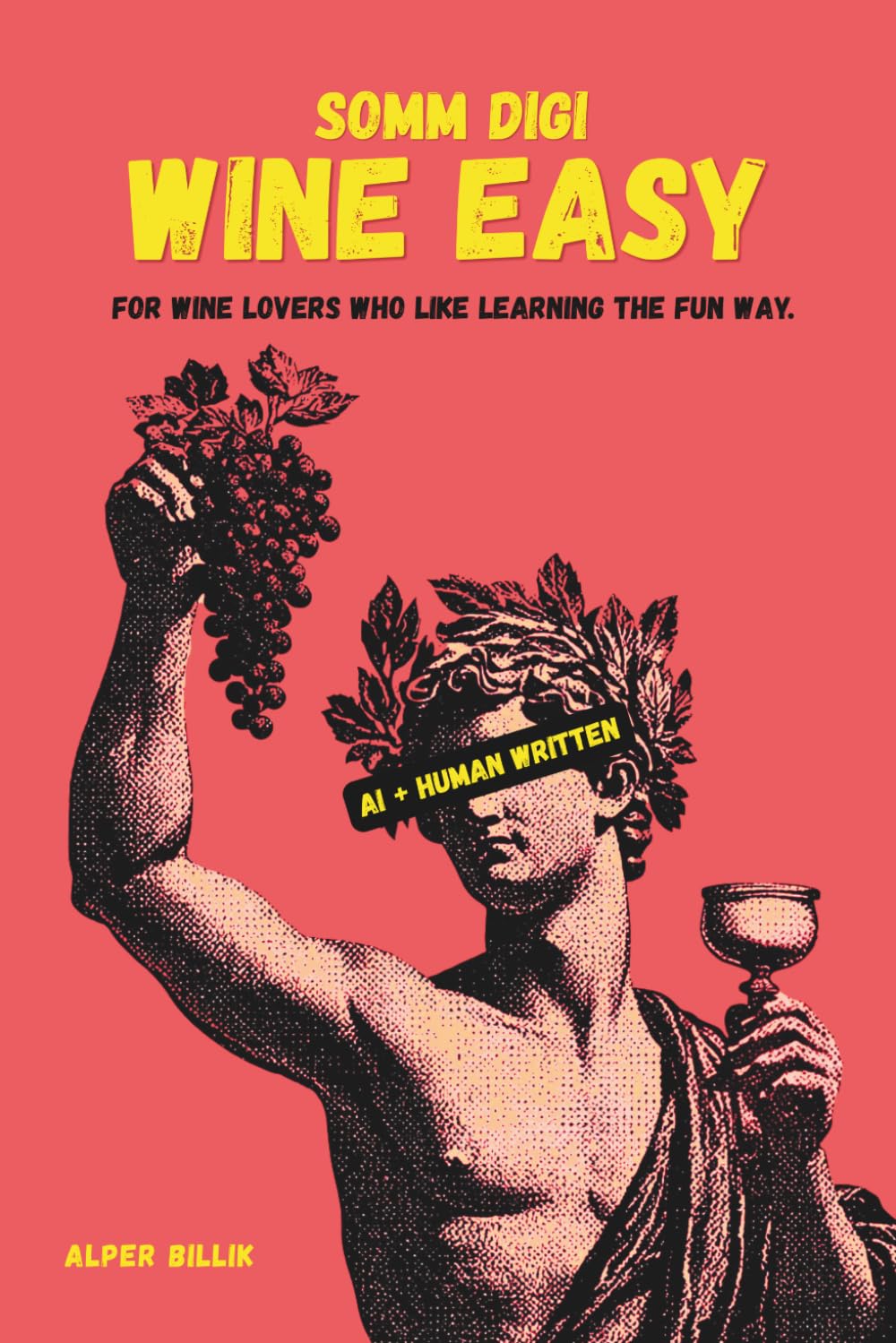
Learn wine the easy way
Wine Easy
The wine book that talks to you like a human: grapes, tasting, pairing and countries A–Z, in 388 full-colour pages.
Chardonnay questions, answered
How do you pronounce Chardonnay?
shar-doh-NAY.
Is Chardonnay a white wine?
Yes. Chardonnay is a white grape, and its wine is dry, from crisp and lemony to rich and toasty.
What is unoaked Chardonnay?
Chardonnay made without oak. Steel tanks keep the fresh fruit, so it tastes crisp and fruity, like most Chablis.
Why does some Chardonnay taste like butter?
A second, natural fermentation in the wine, called malolactic conversion. It adds butter and cream, and softens sharp acids.
Is Chablis made from Chardonnay?
Yes. Chablis is the cool north of Burgundy, Chardonnay's home: dry, with high acidity, apple, lemon and wet stones.
Does Chardonnay age well?
Top Chardonnay can age for decades in the bottle, gaining hazelnut and mushroom notes.
Try next
If you like Chardonnay
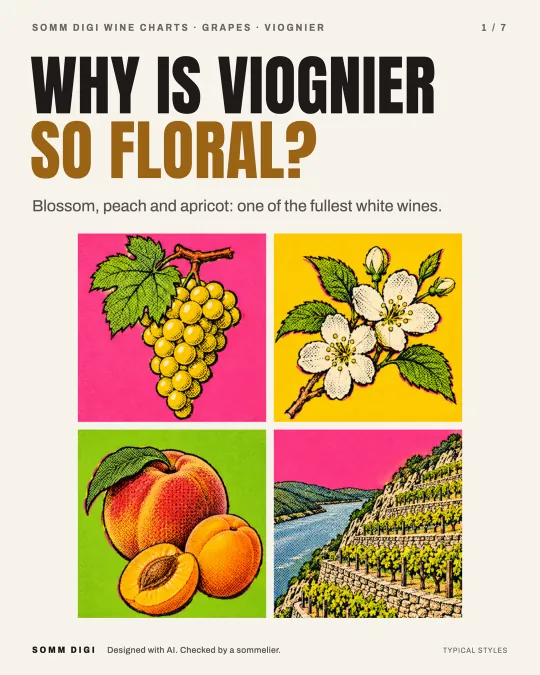
How this page was made. Charts designed with AI and checked by Alper Billik, Advanced Sommelier. Text written from the same chart facts and edited with AI.