
Study and careerAustralia & NZ
Penfolds Grange: the story of an Australian icon
How one winemaker's trip to Bordeaux, a secret cellar and new American oak made Australia's most famous red, what the label tells you, and how to serve a bottle.

Alper Billik · Advanced Sommelier
Updated October 2026 · 4 min read · Edited with AI
This article may contain affiliate links.
On this page
The short answer: Grange is a Shiraz-based red from Penfolds in South Australia, created by winemaker Max Schubert, first made as an experiment in 1951. It is a blend of grapes from several South Australian vineyards, finished in new American oak, and built to age for decades. Its story, of a wine the company once ordered stopped, is half of why people love it.
Penfolds, from 1844
Penfolds dates from 1844, when Dr Christopher Penfold and his wife Mary settled at Magill, at the foot of the hills east of Adelaide, and planted vines. Their cottage there was called The Grange, and a century later it gave the wine its name. Penfolds Magill Estate still stands on the site.
Max Schubert's idea
In 1950, Penfolds' chief winemaker Max Schubert travelled to Europe, and a side trip to Bordeaux changed his thinking. He saw wines matured in new oak barrels that could age for twenty years or more, and he wanted an Australian red that could do the same. Back home, he built it on Shiraz.
The first, experimental Grange was made in 1951; the 1952 was the first to be released. Tasted young, the wines were dense and tannic, and critics were not kind. In 1957 Penfolds' management told Schubert to stop. He kept making it anyway, quietly, in the cellar. As those early vintages aged and showed what they could become, the board changed its mind, and in 1960 Grange was officially back. It has been made every year since.
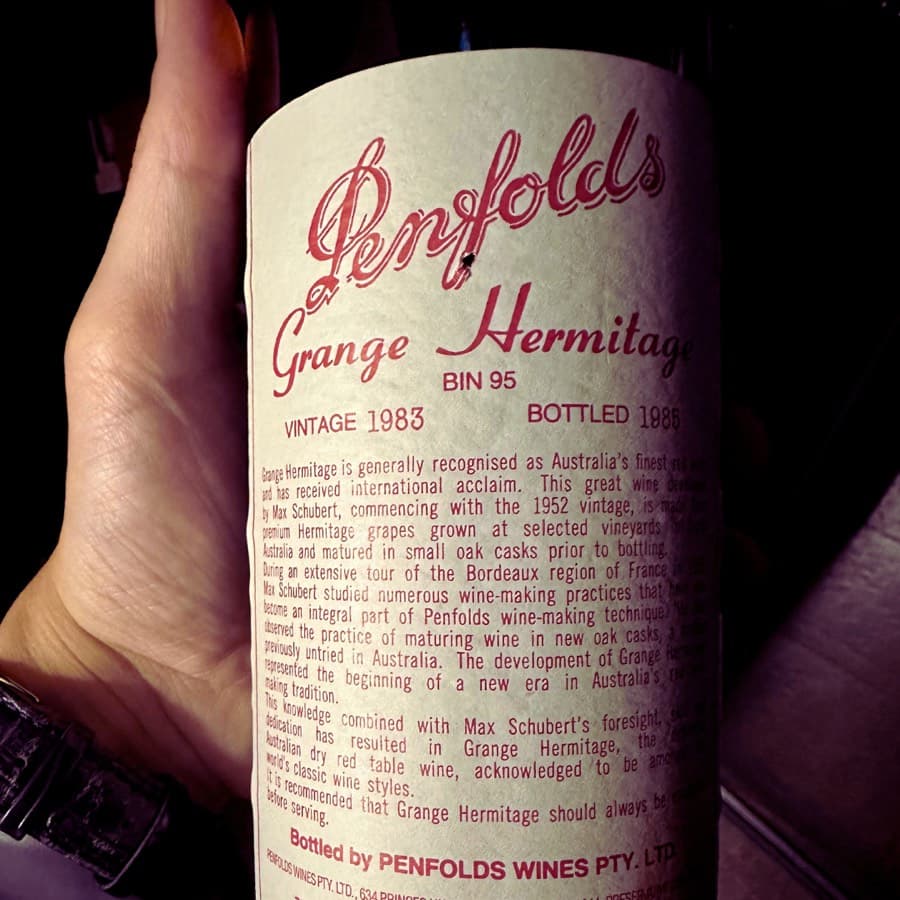
Grange Hermitage, Bin 95: reading the label
- Grange Hermitage: the original name. In Australia, "Hermitage" was long used for Shiraz, a nod to the Syrah of France's Hermitage hill. After European objections to the French place name, it was dropped with the 1990 vintage; since then the wine is simply Grange.
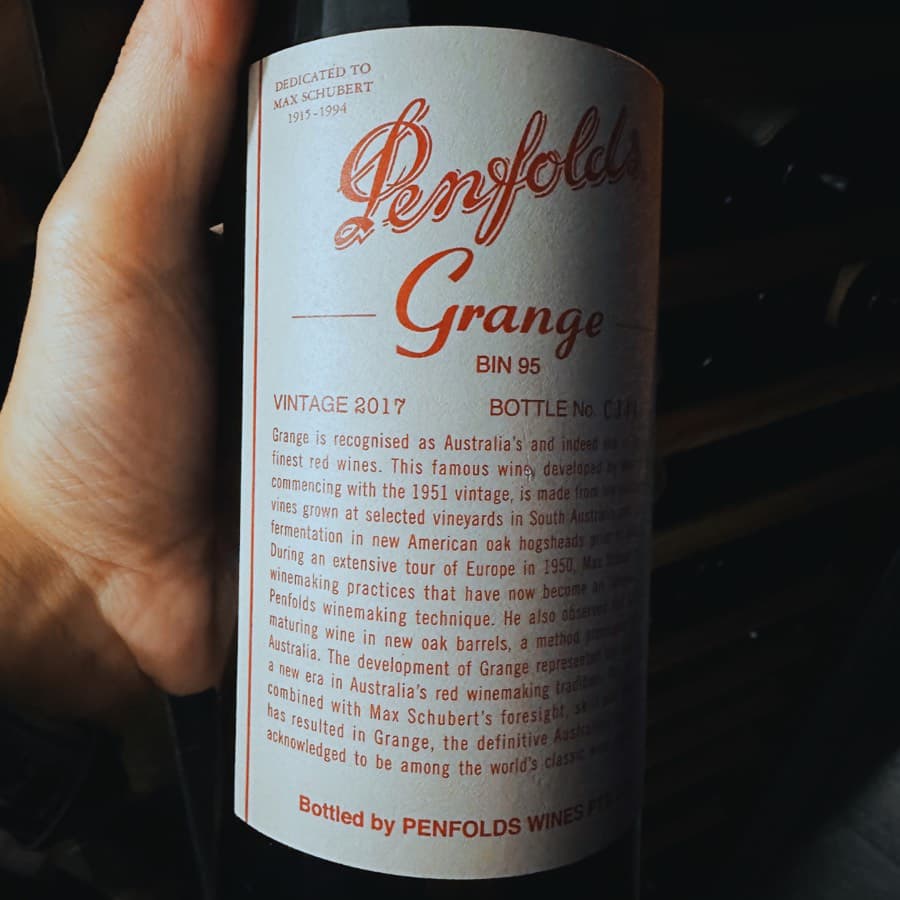
- Bin 95: Penfolds names many wines after the bin, the storage area in the cellar, where they were first kept (as with Bin 389 or Bin 707). Grange is Bin 95, on both labels above.
- Vintage and bottling date: the 1983 label says Bottled 1985: the wine spent its time in oak before going into bottle.
- The dedication: recent labels read "Dedicated to Max Schubert, 1915–1994".
One small detail in these two photos: the 1983 label says the wine began "with the 1952 vintage", the first released; the 2017 label says 1951, counting Schubert's first experimental wine. Both are part of the same story.
How Grange is made
- Grapes: fully ripe Shiraz, usually with a small share of Cabernet Sauvignon in many vintages, from several vineyards across South Australia. It is a multi-regional blend: the house style matters more than one site.
- Fermentation: finished in new American oak hogsheads (300-litre barrels). That gives Grange its signature richness, sweet spice and seamless oak.
- Ageing: 18 to 20 months in oak before bottling, then more time in bottle before release.
- Built to last: high concentration, firm tannin and good acidity mean the best vintages develop for decades.
In South Australia, Grange is officially listed as a Heritage Icon of the state. For more on the region's producers, see South Australia's five essential producers.
How to serve a bottle
- Young Grange (under about 15 years) is dense and tannic: decant it an hour or two ahead to let it open.
- Old Grange has a crust of sediment: stand the bottle upright for a day, then decant gently off the sediment, just before serving. The cork may be fragile; a two-pronged Ah-So helps.
- Temperature: around cellar temperature to cool room temperature, not warm.
- Glass: I would pour it into a large Bordeaux glass: a generous bowl that narrows at the top gives the aromas room and then focuses them. More in the Zalto Bordeaux glass.
- Food: roast or grilled lamb and beef, game, mushrooms, hard aged cheese.
Questions people ask
What grape is Penfolds Grange?
Mainly Shiraz, often with a small amount of Cabernet Sauvignon, from several South Australian vineyards.
Why was Grange called Grange Hermitage?
Grange is the name of the Penfold family's cottage at Magill; Hermitage was a traditional Australian name for Shiraz, after the French Hermitage hill. Hermitage was dropped from the 1990 vintage.
What does Bin 95 mean?
Penfolds names many of its wines after the cellar bin where they were first stored. Grange is Bin 95.
When was the first Grange made?
Max Schubert made the first experimental Grange in 1951. The 1952 was the first vintage released, and Grange has been made every year since.
Your exam kit
Where to study for your exam

 My book · AmazonSommelier Prep BookQuick questions and answers for a break at work.Order on Amazon
 My book · AmazonSommelier Level 1 Prep BookLevel 1's key topics in one small book you can carry anywhere.Order on Amazon
SOMM DIGI built the Court of Master Sommeliers Europe’s Learning Portal, and SOMM DIGI AI. Who is behind this
For sommeliers · next steps