
Study and careerExams & certifications
The WSET Level 3 tasting grid, and how to pass Level 3
The tasting grid, step by step, in plain words. The exam as it is in 2026. And what helped me pass with Merit.
Updated October 2026
Rewritten by Alper Billik, Advanced Sommelier
4 min read
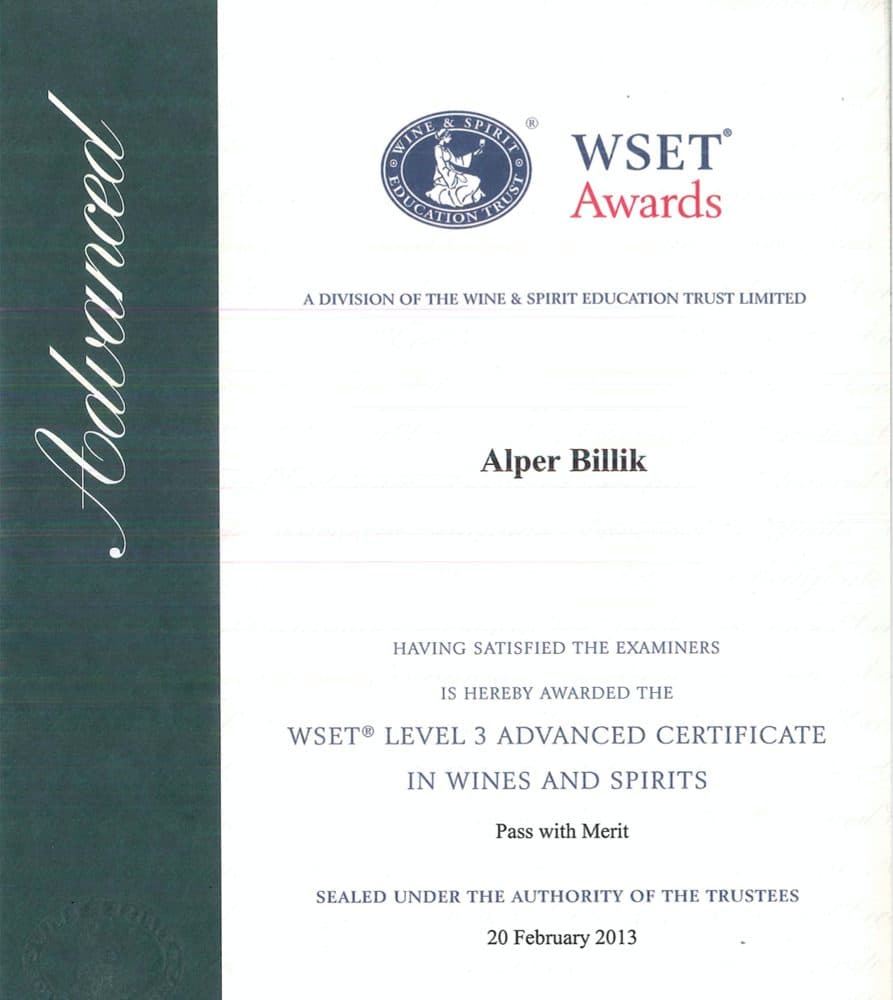
My WSET Level 3 certificate is dated February 2013. Back then the course was called the Level 3 Advanced Certificate in Wines and Spirits; today it is the Level 3 Award in Wines. I passed with Merit, and the part that made the difference was the tasting grid.
The Level 3 exam in 2026
- Theory: a closed-book paper with 50 multiple-choice questions and 4 short-answer questions, in 2 hours.
- Tasting: two still wines, tasted blind, described with the tasting grid, in 30 minutes.
- To pass: at least 55% on each section of the theory paper, and 55% across the two wines in the tasting.
- Grades: Pass from 55%, Merit from 65%, Distinction from 80%, with no paper below 65% for a Distinction.
Check the latest details on WSET's Level 3 page before you book.
What the tasting grid is
WSET calls it the Systematic Approach to Tasting, or SAT. It is a fixed order of questions you answer for every wine, with a fixed set of words for the answers. In the exam, marks go to using those words correctly. WSET publishes the Level 3 grid for free: download the official SAT from WSET and keep it next to every glass you taste.
Here is how I walk through it, in my own words.
1. Appearance
- Clarity: clear or hazy. Haze can be a fault.
- Intensity: how deep the colour is, from pale to deep.
- Colour: for whites, from lemon to gold to amber; for rosés, from pink to salmon to orange; for reds, from purple to ruby to garnet to tawny. Colour moves along that scale with age.
2. Nose
- Condition: clean, or faulty (cork taint, for example).
- Intensity: from light to pronounced.
- Aroma characteristics: sort what you smell into three families. Primary comes from the grape and the fermentation: fruit, flowers, herbs. Secondary comes from winemaking: yeast and lees (bread, biscuit), malolactic (butter, cream), oak (vanilla, toast, smoke). Tertiary comes from ageing: dried fruit, leather, earth, honey, nuts.
- Development: youthful, developing, fully developed, or tired and past its best.
3. Palate
- Structure: sweetness, acidity, tannin (for reds), alcohol and body, each on its own scale from low to high.
- Mousse: for sparkling wines, how the bubbles feel, from delicate to aggressive.
- Flavour: its intensity, and its characteristics, in the same three families as the nose.
- Finish: how long the flavours stay after you swallow or spit, from short to long.
4. Conclusions
- Quality: faulty, poor, acceptable, good, very good or outstanding.
- Why: justify the quality with balance, length, intensity and complexity. Students remember them as BLIC. This is where Merit and Distinction marks are won.
- Readiness for drinking: too young; can drink now but has potential for ageing; drink now, not suitable for ageing; or too old.
How to score points in the tasting
- Use the grid's words, not your own. “Pronounced” scores; “really strong” doesn't.
- Give several aromas per family. One fruit is thin; three fruits plus an oak note and a sign of age shows you looked.
- Never skip BLIC. A quality call without its reasons loses easy marks.
- Split the time: about 15 minutes per wine, and leave a minute to check you filled every line.
- Practise on classics side by side: Chablis next to an oaked Chardonnay, Sancerre next to Marlborough Sauvignon Blanc, Bordeaux next to Burgundy.
How to pass the theory
- Explain the why. The short-answer questions reward cause and effect: this climate, so this grape ripens like this, so the wine tastes like this.
- Learn regions in pairs. Compare a cool and a warm example of the same grape; the contrast is often the question.
- Write answers by hand, against the clock. Four short answers in the time left after 50 multiple-choice questions is a real skill.
- Quiz yourself every day. Ten minutes of questions beats an hour of rereading.
For daily questions, SOMM DIGI AI has 3,000+ exam-prep questions and makes quizzes on any region you choose, free to start. My Sommelier Prep Book is 149 pages of mixed questions across regions, grapes, styles and winemaking.
Questions people ask
What is the WSET Level 3 tasting grid?
The Systematic Approach to Tasting (SAT): a fixed order of observations, appearance, nose, palate and conclusions, with a fixed vocabulary. WSET publishes it for free.
What is the pass mark for WSET Level 3?
55% on each section of the theory paper and 55% across the two wines of the tasting. Merit starts at 65%, Distinction at 80%.
How many wines are in the WSET Level 3 tasting exam?
Two still wines, tasted blind, in 30 minutes.
What does BLIC mean?
Balance, length, intensity, complexity: the four reasons you give for your quality assessment.
For sommeliers · next steps