
Study and careerExams & certifications
How to become a Certified Sommelier: the steps, the exam and how to prepare
Two exams with the Court of Master Sommeliers, the Introductory then the Certified. What each Court asks for, and how I would prepare for the tasting and the service.
Updated October 2026
Rewritten by Alper Billik, Advanced Sommelier
5 min read
The short answer: you pass two exams with the Court of Master Sommeliers: first the Introductory, then the Certified. The Certified is one day: a theory paper, a blind tasting and a practical service exam. You need 60% in each, all at the same sitting. There is no way to skip the Introductory.
I started with the Introductory at the Culinary Institute of America in Napa in 2012, passed the Certified, and went on to pass the Advanced in 2019. Here is the path as the two Courts run it today, and how I would prepare.
Where I stand: I work with the Court of Master Sommeliers Europe, whose online Learning Portal SOMM DIGI builds.
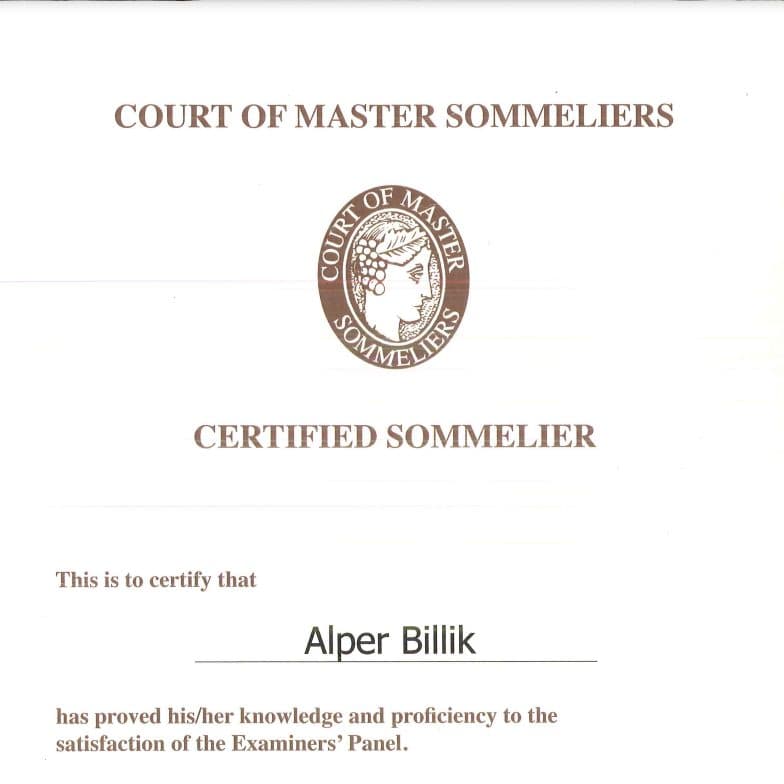
Step 1: the Introductory
- Europe: two days of lectures and tastings with Master Sommeliers, then exams on the morning of day three: a multiple-choice theory paper and a short service test. 60% in each. Enrolment is from age 18.
- Americas: two days in person, or online over up to six months. The exam is 70 multiple-choice questions in 45 minutes, with 60% to pass. You must be 21.
Test yourself first with my free Level 1 Sommelier Practice Test: 40 questions in the style of the real exam.
Step 2: the time in between
- Europe: you must take the Certified within three years of passing the Introductory. The Court also considers the top candidates from an Introductory held just before a Certified, so some people sit both on one trip.
- Americas: there is no deadline any more, and the two can't be taken back to back. The Court suggests about a year between them, and recommends at least three years in the industry before the Certified.
Step 3: the Certified exam
| Part | Court of Master Sommeliers Europe | Court of Master Sommeliers Americas |
|---|---|---|
| Theory | 40 multiple-choice and short-answer questions | 45 questions in 38 minutes: multiple choice, short answer, simple maths and matching |
| Tasting | Two wines, blind, written on the Court's tasting grid | Four wines (two white, two red), blind, written, in 45 minutes |
| Service | A practical service test | A service exam in a mock restaurant, with tasks such as opening wines, recommending drinks and discussing food pairings |
| To pass | 60% in each part, all passed together | 60% in each part, in one sitting |
- Theory
- Court of Master Sommeliers Europe40 multiple-choice and short-answer questions
- Court of Master Sommeliers Americas45 questions in 38 minutes: multiple choice, short answer, simple maths and matching
- Tasting
- Court of Master Sommeliers EuropeTwo wines, blind, written on the Court's tasting grid
- Court of Master Sommeliers AmericasFour wines (two white, two red), blind, written, in 45 minutes
- Service
- Court of Master Sommeliers EuropeA practical service test
- Court of Master Sommeliers AmericasA service exam in a mock restaurant, with tasks such as opening wines, recommending drinks and discussing food pairings
- To pass
- Court of Master Sommeliers Europe60% in each part, all passed together
- Court of Master Sommeliers Americas60% in each part, in one sitting
Check the latest rules with your Court: Europe or the Americas.
Preparing the theory
The theory is the most to learn, and the Court of Master Sommeliers Europe asks for at least ten weeks of study. My guide to the Certified theory exam lists the topics region by region, with a ten-week plan and practice questions.
Preparing the tasting
- Learn the grid until it is automatic. Europe lets you download its tasting grid and instructions in advance. Use the same grid for every wine you taste, in the same order, every time.
- Taste the classics side by side: Sauvignon Blanc from Sancerre and from Marlborough, Chardonnay from Chablis and from California, Pinot Noir from Burgundy and from Oregon. The contrast teaches more than either wine alone.
- Taste blind with others. A study group catches what you can't see in yourself.
- Always reach a conclusion. Finish every note with what you think the wine is, and why.
- Time yourself. In the Americas, four wines in 45 minutes is about eleven minutes a wine.
Preparing the service
- Sparkling wine first. Open it quietly and safely, and practise until you can pour one bottle evenly into eight glasses.
- Decant a red with sediment, smoothly, explaining what you do as you do it.
- Know a drinks list by heart: apéritifs, classic cocktails, spirits and digestifs, with a recommendation ready for each.
- Be ready to pair. Recommend a wine for a dish, give your reason, and offer an alternative. See food and wine pairing for CMS exams.
- Dress and kit: come in your working clothes, with your corkscrew and the tools of the trade.
- Talk while you work. The examiner is your guest. Service is hospitality, not just technique.
On the day
- Lay out your clothes and your kit the night before.
- Eat before you go. A hungry palate is a distracted palate.
- If something goes wrong in service, stay calm, fix it and carry on, as you would with a real guest.
- Between exams, don't compare answers. Get ready for the next part instead.
After the Certified
The Court of Master Sommeliers Europe calls the Certified its primary qualification for working sommeliers, and it is the entry ticket to the Advanced. When you are ready, read how to prepare for the Advanced. Planning the budget? Here is what each level costs.
Questions people ask
How long does it take to become a Certified Sommelier?
There is no fixed time. In Europe you must sit the Certified within three years of the Introductory, after at least ten weeks of study. The Americas suggest about a year between the two exams.
Can I skip the Introductory?
No. Every level of the Court must be passed in order.
Do I need restaurant experience?
Europe expects an appropriate amount of service experience with wine and beverages, judged case by case. The Americas recommend at least three years in the industry before the Certified.
What is the pass mark for the Certified Sommelier exam?
60% in each of the three parts, theory, tasting and service, at the same sitting.
Is the Certified Sommelier the same as Level 2?
Yes. People often call it Level 2, because it is the second of the Court's four levels.
For sommeliers · next steps